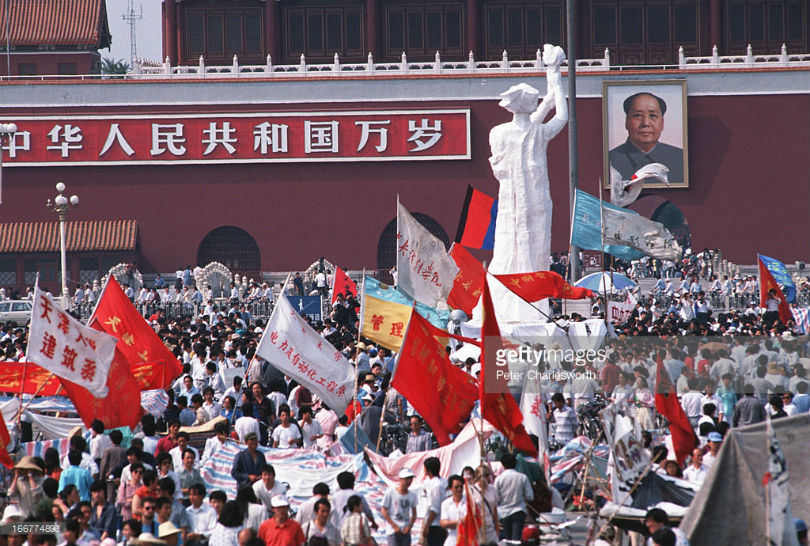
A six-week-long demonstration on behalf of democracy in Beijing’s Tiananmen Square, in which more than a million people peacefully assembled and made their voices heard, was quashed with tanks and armed troops and gunfire on this date in 1989. Trucks, tanks, and soldiers and police on foot surged into the protest while firing their weapons at will. Even onlookers in nearby buildings were hit.
Very little verified information ever made it out in the aftermath. The Chinese government does not acknowledge the massacre and in official publications the event is euphemistically called the “June 4 Incident.”
The identity of one man who was wearing a white long-sleeved shirt and swinging a bag of what appeared to be his week’s groceries in one hand while he held up the line of tanks for a precious few minutes the day after the massacre remains unknown and ever-unknowable. The lack of information is indicated by the estimated number of injured and dead: it is believed that the number of dead lies somewhere between 241 (the government’s announced claim, although it further claimed that no one died in the square itself) and several thousand were killed by the Chinese government and upwards of 10,000 were injured.
CNN’s coverage that day (below the jump):
Read More
41.386282
-74.347017
Thank you for sharing this via one of these wonderful services:


 The Gad About Town