
Today in History: Bloomsday

“It soared, a bird, it held its flight, a swift pure cry, soar silver orb it leaped serene, speeding, sustained, to come, don’t spin it out too long long breath he breath long life, soaring high, high resplendent, aflame, crowned, high in the effulgence symbolistic, high, of the ethereal bosom, high, of the high vast irradiation everywhere all soaring all around about the all, the endlessnessnessness …”—James Joyce, Ulysses, “Wandering Rocks”

On June 16, 1904, James Joyce and Nora Barnacle had their first date. They later married. To commemorate this, Joyce set this date as the date during which the events in his novel Ulysses take place. The novel covers an ordinary day in the life of Leopold Bloom, an ordinary Dubliner. The closing chapter is written from inside the thoughts of Molly Bloom (Leopold’s wife) as she falls asleep, and the last words of the novel are seen in the image at top.

Joyce and his future wife met on June 10 on Nassau Street in Dublin. He spotted her and struck up a conversation. She thought he was a Swedish sailor, with his blue eyes and yachting cap. He asked her out on a date and they agreed to meet on June 14, but she stood him up. He wrote a dejected note and they decided to meet on June 16. On June 16, they strolled together at Ringsend in Dublin. That was all, but they were a couple from that day on.
Read More
Today in History: June 15

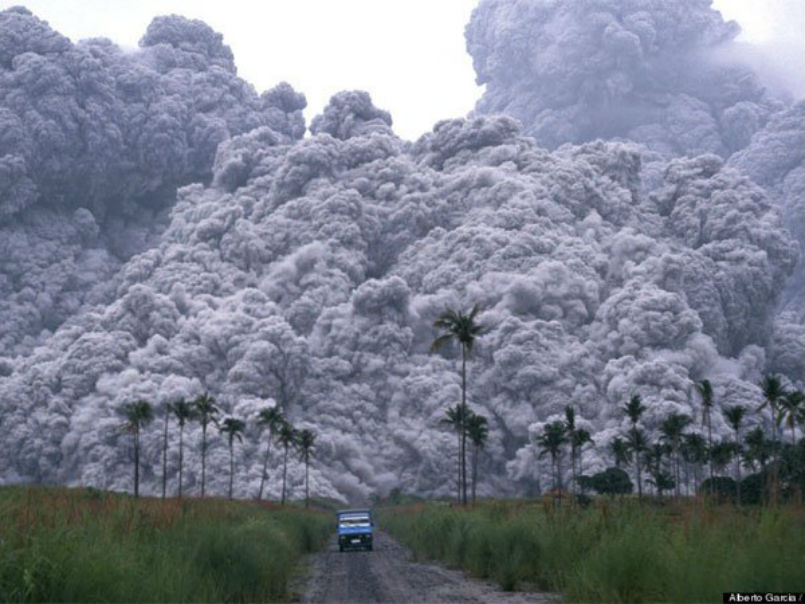
A 2000-foot deep lake now sits atop Mount Pinatubo on the island of Luzon in the Philippines. It is picturesque, a popular hiking destination, but 25 years ago today, it did not exist. On this date in 1991, the summit of the volcano was still in place, but after a year of earthquakes and huge explosions that sometimes sent ash clouds as tall as 15 miles into the atmosphere, the climactic explosion came.

Technically, it was an Ultra-Plinian type eruption. Seismographs nearby, at Clark Air Force Base, were rendered inoperable: they were knocked offline completely by what they were supposed to measure. The explosion was the second-largest volcanic eruption in the Twentieth Century and it was 10 times larger than the eruption of Mount St. Helens a decade earlier. The top 1000-plus feet of the mountain was removed by the blast, and the ash and other materials (such as sulphur dioxide) that were launched 20 miles into the atmosphere for several continuous hours affected global climate for the next two years: a global cooling hurt agriculture around the world.

The photo at top, by Alberto Garcia, was taken from more than 20 miles away from the eruption. The cloud almost overtook the speeding trucks. Garcia now resides in Canada.

Even with a year of warnings, several hundred people lost their lives as a result of the eruption. Many were lost because, by coincidence, a typhoon struck Luzon the same day as the eruption and this brought more ash down more quickly than it would have fallen on its own over some regions, and rooftops collapsed under the weight of the mud falling from the sky.
Read More

Today in History: June 14

Chestnuts roasting on an open fire,
Jack Frost nipping at your nose,
Yuletide carols being sung by a choir,
And folks dressed up like Eskimos.
—Bob Wells and Mel Tormé, “The Christmas Song”

According to BMI (Broadcast Music, Inc.), “The Christmas Song” is the most-performed of the many holiday classics one hears every holiday season. My offering a simple phrase (or two) from the song may be enough for readers to supply the rest of the song for themselves, words and music.

Nat King Cole recorded the song for the very first time 70 years ago today. Chances are that it is his version of the song that one is hearing in the MP3 player of one’s mind.

That first recording, the one that is 70 today, is not the Nat King Cole recording of the song that one hears thrown at one’s ears from every storefront during the holiday season. That version, sweetly syrupy-sweet, was recorded in 1961. The original recording of this holiday classic, which was written in the summer of 1945 by two songwriters who were trying “to stay cool by thinking cool,” according to Tormé, is of the The King Cole Trio: Nat King Cole, voice and piano; Oscar Moore, guitar; Johnny Miller, bass; and it is worth hearing, even on a June day (video below the jump):
Read More