I remember coming into the fete and seeing all the sideshows. And also hearing all this great music wafting in from this little Tannoy system. It was John and the band. I remember I was amazed and thought, ‘Oh great’, because I was obviously into the music. I remember John singing a song called ‘Come Go With Me.’ He’d heard it on the radio. He didn’t really know the verses, but he knew the chorus. The rest he just made up himself. I just thought, ‘Well, he looks good, he’s singing well and he seems like a great lead singer to me.’ Of course, he had his glasses off, so he really looked suave. I remember John was good. He was really the only outstanding member, all the rest kind of slipped away.—Paul McCartney, February 1995, Record Collector
The Woolton Parish Church’s “Garden Fete,” a neighborhood fair, of July 6, 1957, featured a long list of attractions and entertainment acts to fill the day: the Liverpool Police Dogs on display, a parade, the crowning of the Rose Queen, the “Band of the Cheshire Yeomanry,” and “The Quarry Men Skiffle Group,” who were also slated to perform at the “Grand Dance” that night at 8:00 p.m.
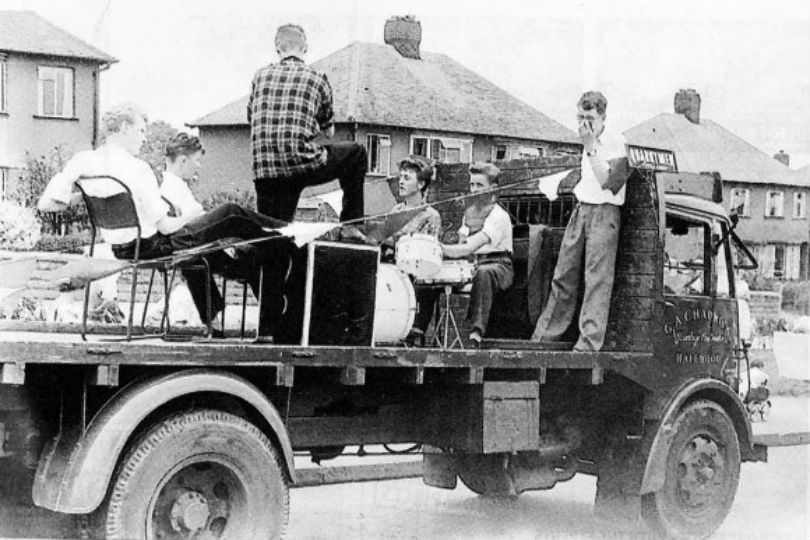
Paul McCartney, a 14-year-old who had started to perform music, remembered seeing the band during the day as they were carried through the neighborhood on the back of a flatbed truck. The lead singer of the Quarry Men was John Lennon, a 16-year-old, and McCartney noticed that Lennon, while “suave” and “outstanding,” also was performing on an improperly tuned guitar. (Lennon tuned it like a banjo, which is what he had learned to play on.) McCartney showed the musicians how to tune their guitars, and then performed some songs he knew: Eddie Cochran’s “Twenty Flight Rock,” Gene Vincent’s “Be-Bop-A-Lula,” and some songs by Little Richard. Lennon impressed McCartney and McCartney impressed Lennon.
(Photo at top; Lennon, in plaid, is seated at center, next to the white-shirted drummer, with his back against the cab of the truck.)
Read More
41.386282
-74.347017
Thank you for sharing this via one of these wonderful services: