Today in History: July 7

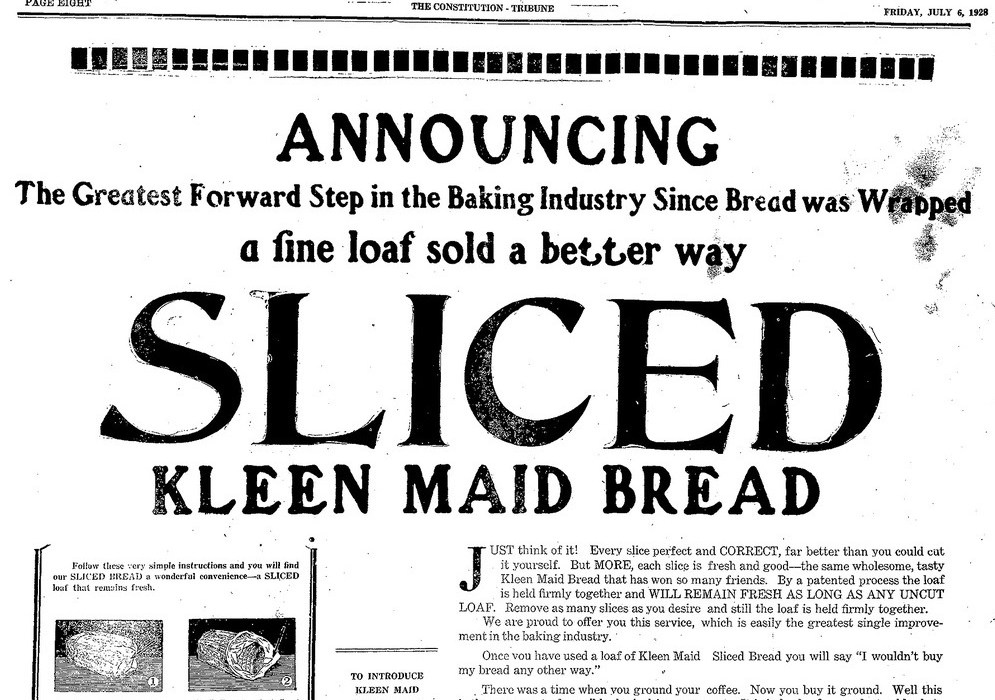
Announcing: The Greatest Forward Step in the Baking Industry Since Bread was Wrapped—Sliced Kleen Maid Bread—an ad placed in Chillicothe, Missouri, newspapers announcing the newest greatest thing, to be sold starting July 7, 1928.

The Chillicothe Baking Company started selling loaves of sliced bread on this date in 1928. An inventor from Davenport, Iowa, Otto Rohwedder, had dedicated years of his life to perfecting a machine that would slice a loaf of bread. His invention solved problems that only someone who had spent years trying to invent a machine to slice loaves of bread would know needed to be addressed: slice uniformity; a means of holding the loaf together, now that slicing it has ruined the loaf’s structural integrity; protection from drying out, now that the loaf’s insides have been exposed. His machine sliced and wrapped the loaves.
Read More

Today in History: July 6

I remember coming into the fete and seeing all the sideshows. And also hearing all this great music wafting in from this little Tannoy system. It was John and the band. I remember I was amazed and thought, ‘Oh great’, because I was obviously into the music. I remember John singing a song called ‘Come Go With Me.’ He’d heard it on the radio. He didn’t really know the verses, but he knew the chorus. The rest he just made up himself. I just thought, ‘Well, he looks good, he’s singing well and he seems like a great lead singer to me.’ Of course, he had his glasses off, so he really looked suave. I remember John was good. He was really the only outstanding member, all the rest kind of slipped away.—Paul McCartney, February 1995, Record Collector

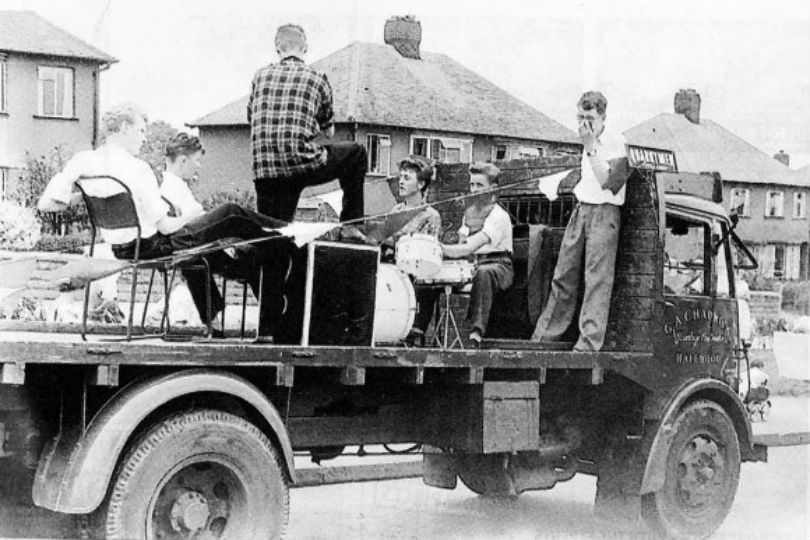
The Woolton Parish Church’s “Garden Fete,” a neighborhood fair, of July 6, 1957, featured a long list of attractions and entertainment acts to fill the day: the Liverpool Police Dogs on display, a parade, the crowning of the Rose Queen, the “Band of the Cheshire Yeomanry,” and “The Quarry Men Skiffle Group,” who were also slated to perform at the “Grand Dance” that night at 8:00 p.m.

Paul McCartney, a 14-year-old who had started to perform music, remembered seeing the band during the day as they were carried through the neighborhood on the back of a flatbed truck. The lead singer of the Quarry Men was John Lennon, a 16-year-old, and McCartney noticed that Lennon, while “suave” and “outstanding,” also was performing on an improperly tuned guitar. (Lennon tuned it like a banjo, which is what he had learned to play on.) McCartney showed the musicians how to tune their guitars, and then performed some songs he knew: Eddie Cochran’s “Twenty Flight Rock,” Gene Vincent’s “Be-Bop-A-Lula,” and some songs by Little Richard. Lennon impressed McCartney and McCartney impressed Lennon.

(Photo at top; Lennon, in plaid, is seated at center, next to the white-shirted drummer, with his back against the cab of the truck.)
Read More

Today in History: July 5

Why am I called upon to speak here today? What have I, or those I represent, to do with your national independence? Are the great principles of political freedom and of natural justice, embodied in that Declaration of Independence, extended to us? And am I, therefore, called upon to bring our humble offering to the national altar, and to confess the benefits and express devout gratitude for the blessings resulting from your independence to us?
 
I am not included within the pale of this glorious anniversary! Your high independence only reveals the immeasurable distance between us.
[…]
This Fourth of July is yours, not mine. You may rejoice, I must mourn. To drag a man in fetters into the grand illuminated temple of liberty, and call upon him to join you in joyous anthems, were inhuman mockery and sacrilegious irony. Do you mean, citizens, to mock me, by asking me to speak today?
 
What, to the American slave, is your Fourth of July? I answer: a day that reveals to him, more than all other days of the year, the gross injustice and cruelty to which he is a constant victim. …
—Frederick Douglass, July 5, 1852, speech: “What to the Slave Is the Fourth of July?”

Frederick Douglass, born a slave, was by 1850 one of America’s most famous abolitionists. (In Europe, he was one of the most famous Americans, period.) On this date in 1852, the Rochester Ladies’ Anti-Slavery Society asked him to speak on the topic “The Meaning of July Fourth for the Negro.” Some two-thousand five hundred words followed, a speech that whose title is often rendered as “What to the Slave Is the Fourth of July?”

Here is James Earl Jones reading a section of the speech, at a 2004 dramatic reading of Howard Zinn’s The People’s History of the United States. Zinn introduces (video after the jump):
Read More