Overworked and Underplayed

“It was Ellis Island that ruined my shoulder.” A friend told me that recently. I pressed him to explain.

For many years he held a job etching signs for the sides of buildings, huge signs that are hand-made on enormous equipment, and the combination of a great deal of repetitive motion with the necessary delicate manipulation of heavy slabs of metal took its toll on his body. He blames the enormity of that one contract, the Ellis Island job, on his injury. Not the many other jobs that were similar, or the fact that he has continued etching large-scale objects, or that he has played electric guitar in a band for four decades on the side.

Someday, “The Ellis Island Job” will be a short story title from my fingers. Or the title of a song for his band.
Read More

Today in History: September 5

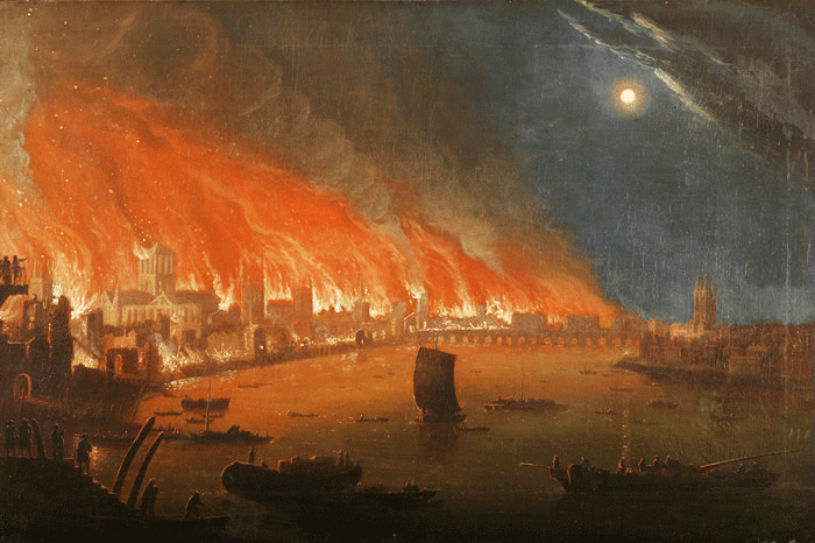
The Great Fire of London was finally extinguished 350 years ago today. It burned for three days in the crowded central City of London, which was full of wood buildings hemmed in by the old Roman city stone wall. In three days, the fire destroyed St. Paul’s Cathedral and over 13,000 residences and almost 90 churches. About 80,000 people had lived in central London and it is thought that some 70,000 lost their homes.

Samuel Pepys, a navy official, explored the city while the fire was burning and after, and he returned home each day to record what he encountered in a diary. On September 5, he wrote that the pavement itself on the streets he walked was hot enough to burn his feet through his shoes.

The painting above by an unknown artist and dates from around 1700. The artist may have been painting from memory … or not.

The fire broke apart into manageable smaller fires when the winds that had been driving it onward from house to house for days and nights finally died down and the firebreaks that had been established (in which homes were destroyed to cut the fire off from any more fuel) finally had an influence on the conflagration. Firefighting technology was not primitive in 1666 (London had “fire engines” that could carry water from the River Thames, but they could not be maneuvered in the narrow alleys of central London), but firefighting companies were not common and fighting fires in crowded cities with narrow lanes and wooden buildings with basements in which families stored coal was not something anyone had trained for.
Read More

Today in History: September 4

The two pitchers were old by baseball standards. They were yesterday’s heroes. Christy Mathewson was 36 and Mordecai “Three Finger” Brown was a month shy of 40. Mathewson had been a star with the New York Giants and Brown with the Cubs and they had faced each other two dozen times over the years. Mathewson won 13 and Brown 11 of those games, and in one 1905 game, Mathewson threw a no-hitter and Brown allowed only one hit on his side, but it scored the run that beat him.

One hundred years ago today, the two legendary pitchers faced each other one final time. It was each man’s last game in Major League Baseball. Brown had announced his retirement (he continued pitching in the minor leagues into his 40s, though) and Mathewson had taken a new job: after 15-plus seasons pitching for the New York Giants, the Giants manager John McGraw allowed him to sign with the Cincinnati Reds as that team’s manager. Mathewson postponed his retirement from pitching for one last game and as manager assigned himself the start of the second game of a double-header against his old rival, Brown.

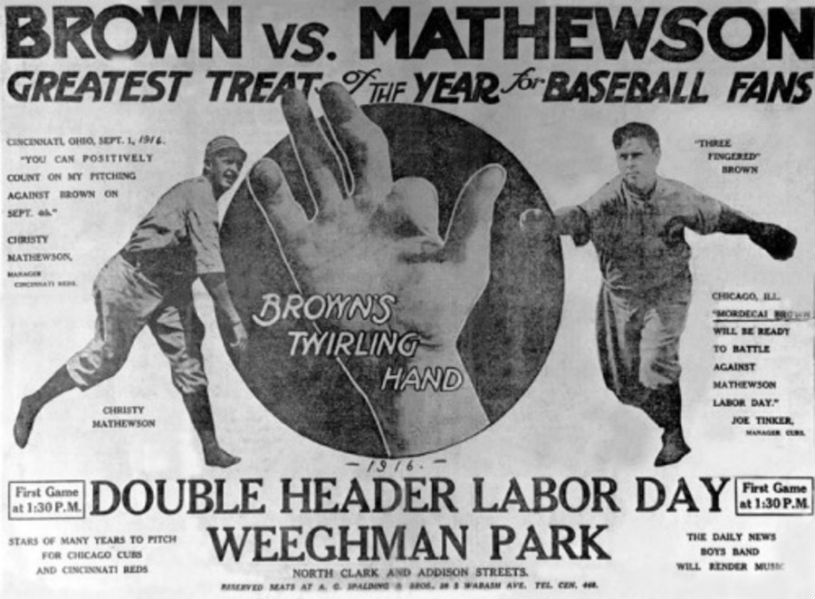
The game was played in Chicago, at Weeghman Park, which is now known as Wrigley Field. The newspaper ads were large (above) even though they were for a late-season game between two teams with losing records, but this was because history was going to be glimpsed one last time. (The ad also explains Mordecai “Three Finger” Brown’s famous nickname. He had lost his right index finger in a farming accident when he was a child. That half-finger gave him a wicked curve ball.)
Read More