Today in History; Nov. 30

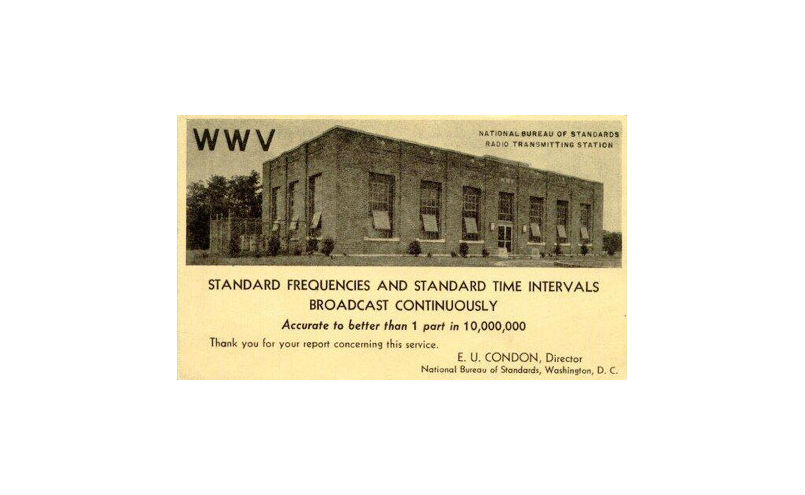
Every minute on the minute, twenty-four hours a day, every day, a chime is heard and an unidentified male voice announces the time. This is the bulk of a day’s programming for radio station WWV, which operates on five radio bands: 2.5, 5, 10, 15 and 20 MHz. A ticking sound is also heard throughout the day; this sound is an audio version of a clock’s second hand. This audio clock is calibrated to the U.S. government’s atomic clocks so that anyone tuning in to WWV can set their own clocks by the radio broadcast.

WWV is the oldest continuously operated radio station in the United States; it was launched in May 1920. Its operations are a part of the National Institute of Standards and Technology, the branch of our government that measures things. Until 50 years ago today, the radio station and transmitter were headquartered in Maryland, but at precisely midnight December 1, 1966, WWV switched its broadcast to a new transmitter in Fort Collins, Colorado, a location that every device in America that sets its own time knows intimately. This new location brought the station transmitter so much closer to our nation’s atomic oscillators that its time measurements and announcements were brought ten times closer to true time.
Read More

Century’s End

Every person who is not Emma Morano (pictured above) of Verbania, Italy, was born after January 1, 1900. Ms. Morano was born on November 29, 1899, a mere 117 years ago today, and she is the oldest person alive on the planet now and is also the last human being who was here the century before last. The 19th Century still walks among us.

In the United States, the last living connection with 19th Century was severed last May with the death of Susannah Mushatt Jones of Brooklyn, New York, who was born on July 6, 1899. She held the title of oldest person in the world from June 2015 until this May. Every person alive in America right now was born after the dawn of the 20th Century or in this current one.
Read More

A Memory of Cary Grant

A memoir about the night I saw Cary Grant in person:

* * * *
Starting in the mid-1980s, Cary Grant toured in a one-man question-and-answer show, A Conversation with Cary Grant, in which he spent ninety minutes or so answering questions from audience members. Several other movie stars and celebrities have since taken on similar productions in which they and their fans bask in an accepted and reflected adoration— Gregory Peck, for one—but Grant was the first. The show was an extended, and deserved, curtain call from beginning to end.

One cool feature to Grant’s tour was that it brought him to theaters in which he had performed during his vaudeville years in the 1920s. Thus it was that in April 1985 I found myself sitting in the balcony of the small (1500 seat) Ulster Performing Arts Center (UPAC) in Kingston, New York, a stage on which he had performed decades earlier. I was 16 and a movie nerd and Cary Grant was my idol.
Read More