Time and Dr. Johnson

Samuel Johnson wrote, “He that hopes to look back hereafter with satisfaction upon past years must learn to know the present value of single minutes, and endeavor to let no particle of time fall useless to the ground.”—Rambler 108, March 30, 1751

Dr. Johnson was 41 in March of 1751 and several years into his work on his most lasting project, his Dictionary. Unlike most of the dictionaries developed for any language, and all dictionaries in English, Johnson’s “A Dictionary of the English Language” was written by one man. An entire dictionary, with more than 40,000 word entries and over 100,000 literary quotations to back up and explain Johnson’s definitions and create an etymology (the study of the origin of words). It took Johnson nine years to complete it; 75 years later, Noah Webster published his own dictionary, which had 70,000 entries, took 25 years to complete, and cites Johnson throughout. The first completed edition of the Oxford English Dictionary took 75 years and dozens of scholars to compile its first edition, published in 1928.

Johnson’s Dictionary is not the best one written for or in the English language—the dictionary that sits forgotten on your shelf is probably named Webster and not Johnson, and the website that you use instead of a book is also not named “Johnson.com” or something like that. Johnson’s definitions are often complete sentences and are sometimes essays on the topic inspired by the word under consideration. His treatment of the word “time,” for instance, offers fourteen different meanings for the word: “1. The measure of duration. 2. Space of time. 3. Interval. 4. Season; proper time. 5. A considerable space of duration; continuance; process of time. 6. Age; particular part of time. 7. Past time. 8. Early time. 9. Time considered as affording opportunity. 10. Particular quality of the present. 11. Particular time. 12. Hour of childbirth. 13. Repetition of any thing, or mention with reference to repetition. 14. Musical measure.” (“Time,” Johnson’s Dictionary)

Johnson offers a quote from English literature, usually the King James Bible, Shakespeare, Milton, Swift, or Dryden, as a pertinent example for each particular definition. Sometimes he offers as many as seven quotes. For his fourteen definitions of “Time,” he uses forty-six quotes.
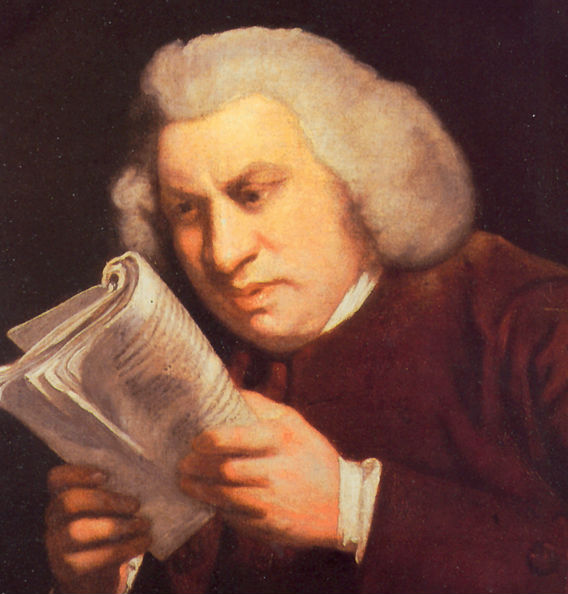
Samuel_Johnson

Samuel Johnson by Joshua Reynolds

This project would be difficult enough to produce in our era of desktop publishing (is there an app for dictionary creation?); Johnson put together his Dictionary in his house, with workmen appearing every so often to assemble a printing press and run off some pages. He paid them out of his own pocket. His personal library, large but not comprehensive, was supplemented by books borrowed from friends. The books were so covered with his markings that they were not worth being returned, the friends remembered.

It took him nine years to complete the Dictionary, yet he had promised it in three. For the rest of his career, Johnson was ridiculed as a slow worker; he proposed to work up an edition of Shakespeare’s plays (the first ever single source, authoritative edition that would be created) in 1756 and started attracting subscribers, but by 1762 another writer took a public jibe at him: “He for subscribers baits his hook/and takes your cash, but where’s the book?” His Shakespeare was published in 1765.

While working on his Dictionary, he published a self-written, twice-weekly periodical, The Rambler, to earn a living. (In other words, he wrote a blog while working on his big project.) Then, while working on his edition of Shakespeare, he published a weekly blog, um, magazine, called The Idler.

Samuel Johnson visited the topic of time over a dozen times in those two journals, and perhaps for understandable reasons: For someone so productive and yet considered a slow worker (The Idler was so named as a joke about his avoiding the long slow work on his Shakespeare), it is likely that few writers had considered time in so many facets. Any waking hour not spent earning a living was indeed “a particle of time (dropped) useless to the ground.”

Johnson had many health issues, ranging from regular bouts with a bleak depression, which he was the first to name the “black dog”; nearsightedness that glasses did not aid (or vanity made him avoid them); a disfiguring skin condition; and Tourette syndrome, a condition that did not have a name until the late 1800s and was not considered a medical condition in Johnson’s lifetime. The tics made him seem an odd character, and he felt he had to win people over with his wit. (Asked once why he made noises, he said it was a bad habit.) His many tics and violent gesticulations are described in every contemporary account about him written by his friends, so the posthumous diagnosis seems a trustworthy one.

A year and a half before his death, he described time and its slowness in old age thus:

The black dog I hope always to resist, and in time to drive, though I am deprived of almost all those that used to help me. … When I rise my breakfast is solitary, the black dog waits to share it, from breakfast to dinner he continues barking, […] After dinner, what remains but to count the clock, and hope for that sleep which I can scarce expect. Night comes at last, and some hours of restlessness and confusion bring me again to a day of solitude. What shall exclude the black dog from an habitation like this?

____________________________________________
The WordPress Daily Prompt for February 25 asks, “If you could slow down an action that usually zooms by, or speed up an event that normally drags on, which would you choose, and why?”

The WordPress Daily Prompt for November 1 asks, “If you could slow down an action that usually zooms by, or speed up an event that normally drags on, which would you choose, and why?”

* * * *
Please subscribe to The Gad About Town on Facebook: http://www.facebook.com/thegadabouttown

Inequality for No One

“The Mexicans here, they’re better than the ones in California. They’re polite here. I like our Mexicans: they work hard and don’t make me think about them.”

This was small talk, office talk. It always surprises me how quickly people get comfortable enough with me that they gush out their own prejudices, as if they think/assume I have similar sympathies. I had no idea what to say in reply to something that was no longer small talk, so I mumbled that I was suddenly hungry and was going to the lunch room, immediately. “Our Mexicans” was the only phrase in my head. It kept clanging around in there.

The conversation took place in our shared office cubicle in a factory in Iowa; four of us occupied the space and one joined me in the walk to the cafeteria.

“‘Our Mexicans?'” I repeated. “That’s a concept?” He said he was surprised, too. I suggested that maybe when we returned to the cubicle, I would ask her opinion about Iowa vs. California Jews or other groups of people. I did not.

(In the years since, I have heard “our black people” spoken. By an African-American man. Regional prejudice trumped the more traditional kind, and it got the expected laugh from the white people in the room.)

The speaker who had stunned me was a woman who had moved with her family from California to Iowa—on purpose—to escape from California’s California-ness (read: liberal politics and “awful regulations” on cars and guns) and prevent her young daughters from growing up in the Golden State. No jobs had turned up in Nebraska, which was her and her husband’s first choice, so Iowa it was. Both states are 97%-98% white in population.

* * * *
Every woman I know, including the one from California, has reported that she has experienced sexual harassment. Every woman walks through a different day than any man does: she is gauged and judged for her appearance. Young and old, woman are called tarts or teases, or a phrase like “she must have been a looker when she was younger” is used. I dated a woman who had been raped, except she was puzzled when I called it that; in her description she said the guy had “come on strong” and that she should have said “no” more forcefully. “Did you say ‘No’?” I asked. She had, and he had penetrated her. That is rape.

Several women friends have described unpleasant encounters in which anonymous men have exposed themselves; one woman found a man rubbing his open-zippered self against her on a crowded subway, another was given a private show while she was seated on a crowded bus.

* * * *
It is not a nature vs. nurture matter that many people seem to think in this progression of loyalties: Self > family > tribe/extended family > neighborhood > region > population type (color or creed) > interest group > nation. I am conscious that I have not included income, but maybe “interest group” covers that. Humans are tribal, but this is not something we are born with; it is taught. We teach each other to find and use power over others, or to act like we have it.

My family inculcated in my sister and me a sense that we all were pretty lucky, blessed even, to be middle-class and white in America of the 1960s and ’70s. And that luck, simple luck, is not something to brag about or wield like a privilege.

Oh, but I am a member of a minority, you see, many of them. I am the product of a “mixed” marriage, Jewish and Baptist. I am disabled, living with a rare neuromuscular disease. Perhaps some breaks can be given to me. Give me some breaks, universe! This thinking is attractive, insidiously so. I deserve something, something more than I have. Say it with me.

I am a part of the uncomplaining majority, which makes me a minority. Reward me now.

It is indeed insidious, and in my lifetime it has become sickeningly popular. Call it the appeal of the self-declared minority, or the privilege of being underprivileged. The majority, the lucky blessed majority, has appropriated the language, and what it thinks is the mindset, of being underprivileged or even a victim. The powerful majority population decided that enough has been asked of it over time and has started to regard each activist minority population demanding mere equality as another squeaky wheel that gets oil. If finding a way to be the squeaky wheel means getting more privileges and benefits, well, how could they be against being the squeaky wheel? It can be one more way to more power.

Justice and fairness are not equal, but they are just and fair. We should do all we can—I should do all I can—to increase those two things.

* * * *
Today is Blog Action Day. It is estimated that there are more than 250 million blogs published around the world and spread among many hosting companies, many of which are publicly traded. That is a lot of voices, and if they could be united for one day about something other than the universal appeal of cats, they could direct attention in some productive areas. Public attention is not as productive as action and changing minds, but it is better than no action at all.

Blog Action Day is an annual event that was started in 2007. A topic of activist concern is selected and announced in advance. This year’s topic is “inequality.”

2014bloggerbadge

____________________________________________
The WordPress Daily Prompt for October 16 asks, “Did you know today is Blog Action Day? Join bloggers from around the world and write a post about what inequality means to you. Have you ever encountered it in your daily life?

* * * *
Please subscribe to The Gad About Town on Facebook: http://www.facebook.com/thegadabouttown

Daily Prompt: Vote for Not-Him

The WordPress Daily Prompt for August 7 asks, “Tell us about a time you made a false assumption about a person or a place—how did they prove you wrong?”
__________________________________

If you are interested in the horse race nature of American politics, the drop-everything-every-four-years-so-we-can-fill-all-the-jobs-in-Washington portion of our public life, you could do no worse than live in either New Hampshire or Iowa for the year before Election Day. This is because, for reasons I could bore you with but will not, Iowa is the first state in the country to hold a vote for President, in January of election year, and New Hampshire is the second state, usually a week later. (Through the spring and summer of election year, the major political parties conduct state-by-state votes, and the winner of the most votes is sometimes, often, usually that party’s candidate for the national election in November.)

These two states fight very hard every four years to hold their place as first, fight so hard that both states always claim to be first every time, even a week apart, because Iowa uses one type of voting system and New Hampshire a completely different one. So they are both always first. It comes down to money: because they are first, both states receive a quadrennial economic boost unlike any other, with political candidates and their support teams and journalists and their support teams needing food, shelter, television time for months before January. Some nationally famous politicians have rented houses in Iowa to live in and signed year-long leases for the year of door-to-door campaigning they will do. Other states would love to be first in the nation, to attract those millions of dollars, but these two small-population states put up a winning fight with both the Democratic and the Republican parties every four years and get to be first in the nation to cast ballots.

From 2000 to 2004, I lived in Cedar Rapids, Iowa, a city of about 125,000 in a state of three million. A state that is larger than New York State but with one-sixth of the population. So that means that in 2003, I was in the second-largest city in the first of the two “First in the Nation” vote-casting states for Election 2004: Bush v. Kerry. With George W. Bush running for re-election unopposed, it meant that almost every Democrat elected to any office anywhere in the country was campaigning in Iowa.

Cedar Rapids, Iowa. In the foreground is a Quaker Oats factory. My apartment building is the red brick building smack in the middle of the photo, across the highway from Quaker Oats.

Cedar Rapids, Iowa. In the foreground is a Quaker Oats factory. My apartment building is the red brick building smack in the middle of the photo, across the highway from Quaker Oats.

I am a progressive voter, to the left of most Democrats but tending to vote for them. But I also fall head over ballot for every candidate who claims to be the representative from the Land of New Ideas. Rarely do we hear what those New Ideas might be or how much he or she may think they will cost, but I love the idea of New Ideas. Selling New Ideas is an Old Idea, but it gets me every time. And so my life’s list of candidates I have rooted to run for the next office higher than the one they already possessed includes several people named Kennedy, Gary Hart, the late Paul Tsongas, Bill Bradley, and, in 2003, a North Carolina senator named John Edwards. There are others, but I am blushing while typing this.

I should retire my political instincts. Then-Senator Edwards was one of the few politicians I have ever heard speak about rural as well as urban poverty as a blight, a blight because it is a problem that can be tackled. I was inspired. From 2004-’08, it could be said that he pushed the bigger-name candidates to the left (some might think that a good thing), but from 2004-’08 it could also be said that he was doing some other (scandalous) things.

And I met him! And my immediate in-person sense of the man was: “I do not like him.” In January 2004, days before us Democratic Iowans were to cast our first in the nation votes, our so very first votes that New Hampshire was going to be the second first, so stuff it, New England!, just days before that, I saw him speak. Great speech. People are poor. Terrific. Speech over. In the crowded room, we all discovered that that single door entrance over there was now the single door exit for everyone, including the candidate and his handlers, who must hate situations like this in Iowa and New Hampshire. I was next to him for the five minutes it took to leave. He shook my hand—he shook everyone’s hand within reach. I have met a few politicians and I have met quite a few people who ought to run for office, but I have never been rendered invisible quite as quickly as I was by that man. It may qualify as the single most bizarre social encounter I have ever had: I have been dismissed mid-conversation plenty of times, even made to feel that I offended someone, but never looked at like I did not exist.

Perhaps it was the overwhelming crowd and the fact that I did not immediately produce a way out and he was looking for one, or perhaps it was the woman behind me. Or perhaps it was because, a bright man, a good reader of juries in his lawyer life, he felt my instinct to not like him. Or perhaps it was the woman behind me who wanted and received his autograph. I have no idea.

What did I do with this instinct to not like John Edwards? I convinced myself to ignore it and campaigned for him at my caucus site on election night and swung our district over to him. My instinct to ignore my instincts can not be trusted.