Today in History: March 12

The Fukushima Daiichi nuclear disaster took place five years ago today. A tsunami that formed after the Tōhoku earthquake flooded the six-reactor complex, which caused electrical failures and ultimately, three nuclear meltdowns.

* * * *
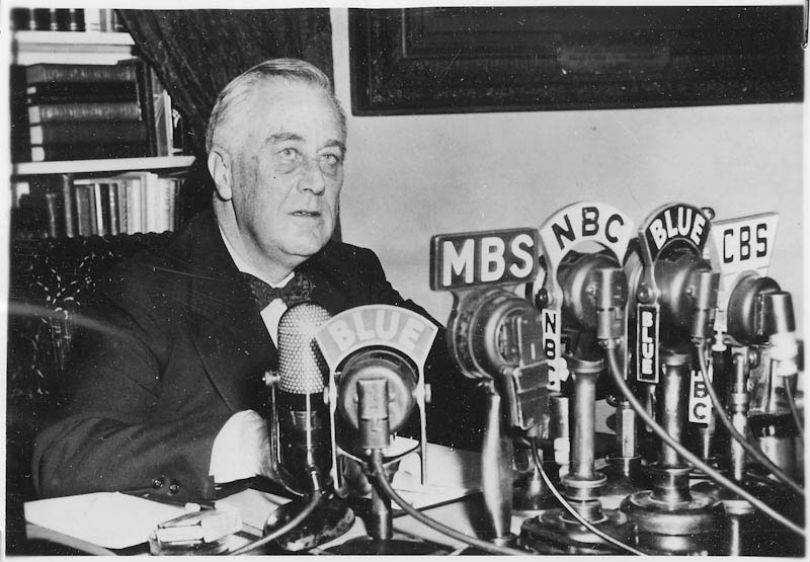
President Franklin Roosevelt delivered his first “Fireside chat” with the American people over the national radio networks on this date in 1933, one week after he took office. Most of his radio talks were on Sundays, as this first one was; he gave a total of 30 such explanatory speeches between 1933 and 1944. “On the Banking Crisis” was the first. The term “fireside chat” was not employed immediately, but by the second chat, delivered on May 7, the speeches were known by that name. It is estimated that up to 60 million Americans listened. Audio (below the fold):
Read More

Today in History: March 11

“Time is an illusion. Lunchtime doubly so.”—Douglas Adams, “The Hitchhiker’s Guide to the Galaxy.”

Douglas Adams was born on this date in 1952.

* * * *
The costliest natural disaster in world history took place five years ago today. The 2011 Tōhoku earthquake and tsunami started with a magnitude 9.0 megathrust earthquake—the most powerful to ever hit Japan and the fourth most powerful in recorded history and one that shifted the entire planet on its axis by half a foot—followed by a tsunami that struck the Sendai area particularly hard (100 foot waves reached several miles inland) and flooded the Fukushima Daiichi Nuclear Power Plant complex, which led to several nuclear meltdowns at that facility. The World Bank has estimated that the combined cost of these several events topped $235 billion. More than 15,000 individuals lost their lives in the quake-tsunami event.
Read More

Today in History: March 10

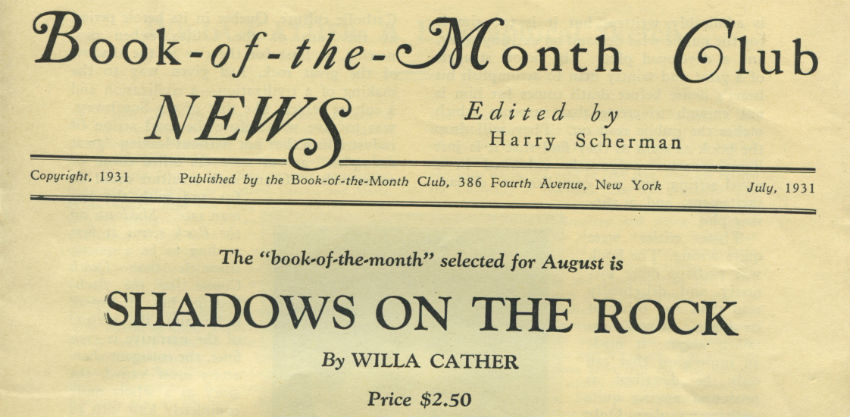
“Lolly Willowes, or The Loving Huntsman,” by Sylvia Townsend Warner was published in 1926, and on this date that year, 90 years ago today, it was the first announced selection of the Book of the Month Club, which exists to this day. The first selection committee featured Christopher Morley, Dorothy Canfield, and Heywood Broun; the current committee includes Craig Ferguson. In the late 1980s, the Club reached its peak membership of 1.5 million subscribers, but that has dwindled in subsequent years.

* * * *
Alexander Graham Bell successfully contacted his assistant, Thomas Watson, 140 years ago today. (It is not true that Watson immediately began work on inventing voicemail.) It was three days after Bell was awarded the patent for his “Improvement in telegraphy,” and it was the first proof that their invention, the telephone, worked. Watson heard his boss’ voice transmitted on the experimental apparatus in a legendary moment: “Mr. Watson—Come here—I want to see you.”

Less than ten years later, on April 15, 1885, Bell recorded his own voice on a wax and cardboard disc. This was never a great medium for recording, but it was one of many that was experimented with as a medium. Flimsy from the moment it was recorded and then dried out with age, the disc had never been played, its contents never transposed to a more permanent medium, until 2013 when audio technicians used optical scanners to recover the recording. Here (below the fold) is Alexander Graham Bell in 1885 introducing himself to us here in the 2010s:
Read More