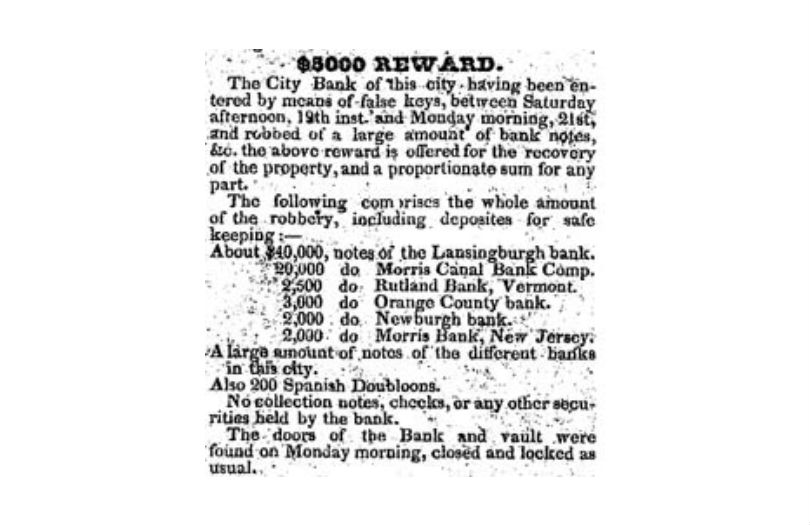
Edward Smith had a great idea: obtain a set of keys to the front doors of City Bank on Wall Street, let himself in one weekend morning, and grab as much as he could between then and when the bank opened for business again the following Monday. This was in 1831, and on this date that year, 185 years ago today, he broke into the bank and stole $245,000 dollars in banknotes and coins, an amount that is the equivalent of $6.8 million in 2015 dollars. This is the first reported bank robbery in U.S. history. Not the first robbery, the first to make the papers. (See image at top.)
A sudden improvement in his manner of living was the giveaway: the week of the robbery he rented a new room that was too expensive for a young shoe salesman, which had been his profession, and he spent about $60,000 quite quickly. His new landlord was curious about a tenant who would not leave his room without either securing or carrying with him three particular suitcases. One day when he left two of them behind, the landlord and local police picked the locks on one of them and discovered the stolen money. Smith was arrested and all of the money except the $60,000 he had spent was recovered. He was convicted after a one-day trial, did five years’ hard labor in Sing Sing, and there Edward Smith drops off the stage of history.
* * * *
Ninety minutes after a U.S.-imposed deadline on Iraq’s President Saddam Hussein expired—leave Iraq or face war—war began on this date in 2003. “Operation Iraqi Freedom” was underway, with forces primarily made of a coalition between the United States and Great Britain.
Read More
41.399382
-74.271754
Thank you for sharing this via one of these wonderful services:

 The Gad About Town