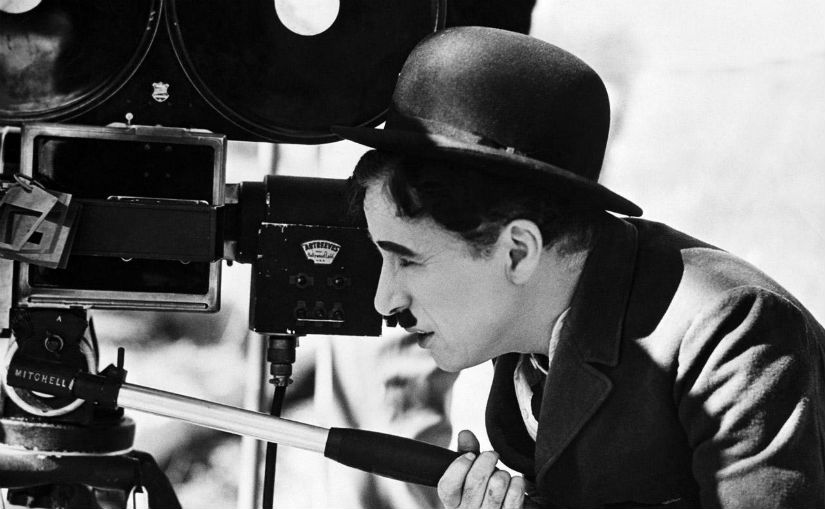
Today in History: April 16

Sir Charles Chaplin was born on this date in 1889. The world of his parents was one of desperate poverty—his father was an alcoholic music hall singer and his mother had been an unsuccessful stage performer, and neither seemed inclined to be parents—and by age seven the boy was living in workhouses, paupers’ schools, and, finally on the streets.

By age 26, he was the most famous movie star—really, the most famous human, on the planet.

In 1914, Chaplin developed his most important creation, the Tramp. He started with the costume, and with it came the character, or the beginnings of one. On January 10, of that year, the Tramp, wearing what soon would be his globally recognized outfit of baggy pants, too-small derby hat, bendy cane, and little mustache, made his public debut in front of a crowd at a youth car derby in Venice, California. A film of his antics, “Kid Auto Races in Venice,” was released a couple weeks later, in February.

The Tramp came to Chaplin fully formed, it appears. Not only is the costume complete in the six-minute-long movie but his full array of gestures—the twirl of the cane, the dismissive tip of the hat, the flat-footed walk, a kick of the leg to turn his body entirely around—is seen. (There is one prop and one gesture that are unfamiliar to viewers of today, though, and they did not stay with the character: he is seen smoking cigarettes throughout the short.)

Here is all six minutes and nine seconds of “Kid Auto Races at Venice” (below the fold):
Read More

Today in History: April 15

Joey Ramone died 15 years ago today.

The Ramones made an artistic statement out of the concept of limitations—both self-imposed limitations (two-minute songs) and those forced on them by the fact that none of the members knew much more about music than they wanted to be stars by making music—and that statement still reverberates, almost 40 years on. I just listened to a eulogy for Joey Ramone by Jello Biafra of the Dead Kennedys, and Jello is as moving about Joey Ramone as Jello Biafra will ever allow himself to be.

In his huge book about punk rock and its antecedents, “Lipstick Traces,” Greil Marcus mentions the Ramones but once, in a tossed-off joke that is both punk in its sharp shot and a bit of a punking-out: “‘Beat on the brat/With a baseball bat’—what could be more punk than that? Not stopping there—and that is where the Ramones stopped for years.” Yet Joey Ramone, so awkward on stage that he owned it, unschooled in singing yet embodying a sound, really had aspirations, which he met, as a crooner (“What a Wonderful World” below the fold):
Read More

Today in History: April 14

I could not help remarking and admiring (although from his rich ideality I had been prepared to expect it) a peculiar analytic ability in Dupin. He seemed, too, to take an eager delight in its exercise—if not exactly in its display—and did not hesitate to confess the pleasure thus derived. …—from “The Murders in the Rue Morgue” by Edgar Allan Poe

Graham’s Magazine, a periodical based in Philadelphia, published a story by its new assistant editor, Edgar Allan Poe, 175 years ago today. It was called, “The Murders in the Rue Morgue,” and it was the first popular modern detective story. C. Auguste Dupin is an amateur detective in Paris who uses his powers of analysis—”ratiocination” is Poe’s term—to solve a brutal double murder. Readers follow Dupin and his sidekick (who narrates the tale) as they learn new clues and Dupin perceives their possible relationship to the crime. Every detective in literary history—Holmes, Poirot, Jessica Fletcher—is an offspring of Poe’s Dupin.
Read More