Daily Prompt: Born at the Right Time

The WordPress Daily Prompt for August 9 asks, “When life gives you lemons … make something else. Tell us about a time you used an object or resolved a tricky situation in an unorthodox way.”
__________________________________

“Life has taken you down a different road, and your GPS is broken.”

One of my myths I believed about myself, deep into grown-up-hood, was that I had incredibly good timing. When it was time to make a life decision, even if that decision was to not make a decision at all, I made it (or did not make it), decisively and without looking back. As said above, this is actually a myth.

The reality was that when in one of life’s corners, I took what was available, crumbs or cake, and kept it moving. “Consequences” was a four-syllable word for “things I will probably ignore.” For the most part, my life was spent chasing employment, trying to find something akin to permanence, only to flub it after three or four years.

I am starting to understand a sentence: “Shall not regret the past nor wish to shut the door on it.” Perhaps I made a lot of errors, but no mistakes. I am not certain about that, but I continue making my amends. If I am here (check) and all is fundamentally well (check), then the road that I followed that brought me here brought me to a good place. There is nothing wrong with this road. I am a signpost on it for others.

I do not have many specific “MacGyver”-type incidents of situational brilliance in my life, not yet anyway. More often than not, my mouth has talked me into increased trouble instead of save me, like that time when I talked a New York State Trooper into giving me a ticket. (He did not, because paperwork. And to annoy me. I am grateful—now.) And I am not a physically resourceful person. My relationship with the natural word of objects and things is that of a reluctant participant, one who breaks unbreakable things and walks into street signs.

When my body started to change in my late 30s, when the symptoms of adult spinal muscular atrophy first showed, it came with a jolt. Only recently have I learned that this is a common experience among people with neuromuscular diseases. When walking becomes difficult—in my case because the nerves that had been sending (ever dimmer) signals to my legs (which had started to atrophy from receiving ever dimmer signals)—the end of normal walking comes as if everything had been just fine one day and the next day as if one’s shoes had been nailed to the ground or one’s co-workers had painted the floor with superglue. It is sudden and scary when the progression of deterioration is undetected and undetectable until the day it is not.

The strange thing is my behavior regarding this: I attempted to MacGyver my response. Rather, I attempted to manufacture a cliche of a MacGyver response. Very little was done consciously on my part other than to buy a cane and start to use the local cab service for any journey longer than my front door to my room, some of whose drivers actually carried me from their car to my front door—stone sober (I emphasize this because my history could imply otherwise)—because my legs had had enough for that day. I developed a mode of walking, a stiff waddle that I hoped would not attract attention. It did.

I attempted to “strong and silent” my way through it as if I was confident that there was a something better on another side of a tunnel that saw me traveling through it in secret terror.

What would MacGyver really do? Probably what I ultimately did: visit a damn doctor. See a neurologist. I have learned to ask for help and even to (and this is a tricky thing) accept it. I still walk with a waddle but I am no longer counting down the minutes to a lesser and lesser able self, which is what I was doing before I knew what the heck was changing in my body. Accepting reality and using all the tools at my disposal, changing into the person who tries to do those things, that is making lemonade, I guess. That’s how I get to play MacGyver in my life. My GPS is finished re-calculating a route.

Daily Prompt: The Curse of Concern

The WordPress Daily Prompt for August 5 asks us to play voyeur in our own lives: “We often capture strangers in photos we take in public. Open your photo library, and stop at the first picture that features a person you don’t know. Now tell the story of that person.”
___________________________________

I do not know the attractive couple entering the photo above from the left side of the frame, but that is okay, as I did not take the photo, and this is not about them. If I had a steadier hand with the photo editing Clone Stamp tool, they would be an oddly tall bush of purple flowers or a stack of blue Peroni umbrellas or two copies of that bicycle that they are walking towards. My hand is not that steady, so their brief moment together (are they still together?) was spared awkward editing. May the rest of their lives together or apart continue to be free of terrible editing decisions or deletion by a heavy-handed photo perfectionist.

But the photo above sets the scene:

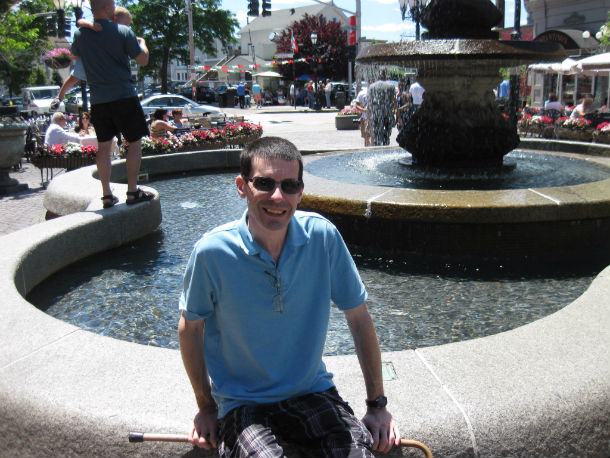
It is May. My beloved and I are eating brunch at the table under the Peroni umbrella that is all the way to the right in the photo above. We are at DePasquale Square on Federal Hill in Providence, Rhode Island, in an outdoors restaurant called Caffe Dolce Vita. After brunch, we walk to about where the above picture was taken, turn around, and she takes this photo of me:

providence riB

Two things: One, with spinal muscular atrophy type 3 or 4, which is what I have, sitting on a hard but rounded surface like the fountain I am sitting on instead feels for me like I am sitting on the edge of a plane sending troops into a war zone and the sarge is about to kick me out even though I do not yet have my parachute strapped on, so I am sitting on my cane for stability; two, that man behind me is strolling along the same fountain as if it is wider than a mere tightrope … with a child in his arms.

I knew I was going to hear a splash before it never happened. You can even almost make out the look of concerned anticipation on the face of the elderly woman sitting closer to the street. (Well, I can, now.) So a fall into the fountain by father and child was inevitable because it was already seen in the eyes of a worried old person, like a curse, the curse of concern. There is no worse curse than that, the curse of anonymous concern, because it is often followed by the worst four-word sequence in the English language: “You should not have … .”

“You should not have” shown your child the sun-dappled fountain up close as if the world was his and he can touch the sun itself in your safe arms.

Perhaps the curse of concern really is a curse only in the idea that you will hear from loved ones and strangers alike—loved ones as if they are strangers: “I didn’t think you could do it,” and strangers as if they are as close as loved ones: “I didn’t think you ought to have tried”—about their ability to foresee your future failure or your imperfect success.

I respect “I told you so” from people more, because, if it is spoken truthfully, perhaps the speaker had indeed offered advice that I had ignored or implemented poorly. “You should not have” is blaming me for your impotence at controlling the most recent past. I bring this up in order to confess that too often, I am that “concerned bystander” about to ex post facto say “Tsk” at someone about something they should not have done, but did do.

So I did not say anything, not anything at all, to the father and child behind me before I used my cane to grab his ankle and trip them into the fountain.

(I might have made up part of this story: I do know the couple in the photo at top.)

Daily Prompt: Keep Your Friends Close

The WordPress Daily Prompt for July 25 asks: “Do you—or did you ever—have a Best Friend? Do you believe in the idea of one person whose friendship matters the most? Tell us a story about your BFF (or lack thereof).”

I have been quite blessed when it comes to friends and I seem to always have had a couple friends whom I could count on for anything and share any fun. The “couple” of friends has always changed in personnel, however, and not grown, which is not a complaint, just a description. For much of my life, I was profoundly self-obsessed, and the thing about being self-obsessed is that, for a while, people who are very generous and warm-hearted will be generous and warm, but some will realize that they do not need to keep throwing love and attention down an ever-deeper well. Some will start to reflect what they are being given. In many cases, fairly or not, it could be said that we train the world in how to treat us. And in many other cases, fairly or not, we do not train the world in how to treat us. Not at all.

I have had friends abandon me when I was still present and available for them, and I have abandoned others. Neither type may have been friendships. When I was younger, I did not think “friendship” was a word that I needed to define; one had friends and that was that. Like furniture. It is only logical that I did not think one needed to cultivate or work on friendships, any more than one needed to make sure a chair remained a chair. Thus, I did not have a definition of “friendship.”

Lynne, Cubby, and Mark 1

Lynne, Cubby, and The Gad About Town

I am with two great friends in the photo at right, taken recently. Through the years, life has beaten me into a state of reasonableness, and I am capable of being present for myself and thus, for and with others. (Cubby, the friend in the middle, has a blog. It is worth visiting.) In the photo, one can see the affection, but you can not see that I am holding myself up with two folding chairs I had grabbed because I left my cane somewhere in the room there. My condition, called spinal muscular atrophy, is slowly robbing me of balance and stability and the use of my legs.

Each of these two friends has helped me physically walk, even when they were annoyed at me over something. That is a pretty sweet definition of friendship. And I hope I have been there for each of them when crises came, and even when life just got irksome and irritating, which is sometimes a more meaningful part of friendship. I hope I am becoming a more meaningful friend than the one I had been for many self-obsessed years for many best friends.

My one best friend is my great love, Jen, but in her case, “friend” is exactly what she is and yet it does not say enough.