The WordPress Daily Prompt for July 25 asks: “Do you—or did you ever—have a Best Friend? Do you believe in the idea of one person whose friendship matters the most? Tell us a story about your BFF (or lack thereof).”
I have been quite blessed when it comes to friends and I seem to always have had a couple friends whom I could count on for anything and share any fun. The “couple” of friends has always changed in personnel, however, and not grown, which is not a complaint, just a description. For much of my life, I was profoundly self-obsessed, and the thing about being self-obsessed is that, for a while, people who are very generous and warm-hearted will be generous and warm, but some will realize that they do not need to keep throwing love and attention down an ever-deeper well. Some will start to reflect what they are being given. In many cases, fairly or not, it could be said that we train the world in how to treat us. And in many other cases, fairly or not, we do not train the world in how to treat us. Not at all.
I have had friends abandon me when I was still present and available for them, and I have abandoned others. Neither type may have been friendships. When I was younger, I did not think “friendship” was a word that I needed to define; one had friends and that was that. Like furniture. It is only logical that I did not think one needed to cultivate or work on friendships, any more than one needed to make sure a chair remained a chair. Thus, I did not have a definition of “friendship.”
Lynne, Cubby, and The Gad About Town
I am with two great friends in the photo at right, taken recently. Through the years, life has beaten me into a state of reasonableness, and I am capable of being present for myself and thus, for and with others. (Cubby, the friend in the middle, has a blog. It is worth visiting.) In the photo, one can see the affection, but you can not see that I am holding myself up with two folding chairs I had grabbed because I left my cane somewhere in the room there. My condition, called spinal muscular atrophy, is slowly robbing me of balance and stability and the use of my legs.
Each of these two friends has helped me physically walk, even when they were annoyed at me over something. That is a pretty sweet definition of friendship. And I hope I have been there for each of them when crises came, and even when life just got irksome and irritating, which is sometimes a more meaningful part of friendship. I hope I am becoming a more meaningful friend than the one I had been for many self-obsessed years for many best friends.
My one best friend is my great love, Jen, but in her case, “friend” is exactly what she is and yet it does not say enough.
Thank you for sharing this via one of these wonderful services:
“What a terrible thing to learn you have in the middle of your life.” That was my neurologist, my new neurologist, speaking.
In 2012 my first neurologist, Dr. M, diagnosed me with late-onset Friedreich’s ataxia, or at least he reported that he felt I have a form of spinocerebellar ataxia (SCA), a disease that has dozens of forms and is genetic in origin. Dr. M’s work led to insurance approval to conduct an expensive genetic test to identify which ataxia I have. (The approval would not have been granted frivolously, so I underwent three MRIs, one EMG test, many blood labs to eliminate Lyme disease and the many other viruses that could be a cause of my symptoms, and started seeing a cardiologist. The fact of my cardiomyopathy led to approval for the DNA test.) But Dr. M moved to a different practice and I met my new doctor, Dr. K, this month.
Dr. K reviewed the first doctor’s extensive notes and looked at me. “You don’t have Friedreich’s ataxia.” (Dr. M was not much for granting eye contact, so this moment of direct conversation surprised me.) Dr. K asked me about my symptoms and when they seemed to begin to appear, some of which I have written about elsewhere. Since 2005 I have been aware, at first dimly, of a mobility disorder developing in me; today, in 2014, I walk with a cane, stiffly, like I am wearing very tight jeans, have little sensation in my lower legs and even have moments of “body confusion” in which I think I am moving my right leg but my left leg moves. I sway when I stand and fall/walk into walls and my sense of where I am in the world contributes moments of comedy to my day.
‘Abby Normal?’ Not my brain, but good-looking one like mine.
My MRIs show a spinal cord that is shedding its myelin sheath protecting the nerves inside, a couple vertebrae that have spontaneously fused—”When did you have this happen?” Dr. K asked me. “I don’t know,” I replied. “I’ve never had anything done on my back.” “Car accident?” “No.” “Okay, you have a spontaneous fusion”—and places where the nerves themselves are atrophying, withering. But my brain, my cerebellum specifically, it is a healthy brain. I have a fine-looking thinker. Thus, Dr. K posited, I do not have a spinocereballar ataxia, as my cerebellum is healthy.
I spoke in Dr. M’s defense. “I think he was surmising from the tests …” Do not use the words “think” or “surmise” with neurologists. “Ataxia,” Dr. K offered, “has been treated like an umbrella term for patients with movement disorders like yours. But it really is a specific disease and you do not have a spinocerebellar ataxia.” He turned to his computer and started typing what I thought would be yet more patient notes and requests for another battery of tests (Dr. M had generated several pages on my case), but then I noticed what looked like a Wikipedia page on his monitor.
“Based on your labs and the extensive deterioration in your spine and weakness in your legs, you have spinal muscular atrophy, I believe Type IV.” (I swear I heard him say “Type IV” with Roman numerals and in italics.) “Has anyone suggested this to you? No? It may be Type III, but I would say that you have a type called Kugelberg Welander, but very late-onset.” He looked back at me. “You have a genetic disease. What a terrible thing to learn you have in the middle of your life. Your symptoms are severe and I have not seen many adult cases, but you will live, I think, a long life. Your legs will continue to get weaker, but you will adjust.”
(How beautiful is it to have a doctor look in your eye and simply say, “What a terrible thing?” To my first neurologist, a terrific clinician and lab expert, I sometimes felt like I was an interesting case but basically a piece of meat that had the unfortunate habit of speaking.)
“You’re a writer? You’ll probably be teaching me about this by our next visit.”
Spinal muscular atrophy is a genetic disease, a muscular dystrophy that in most cases affects children, but not in my case. The vast majority of spinal muscular atrophy stories are incredibly sad: Type I strikes infants who do not ever control their own movements and eventually suffer respiratory failure and die before age 2. The second type strikes children before age 2 and renders them unable to walk, but most SMA Type II patients live into adulthood. Many children and young adults seen on the annual Muscular Dystrophy Association telethons through the years have had SMA Type II. Type III and Type IV—and there seems to be some debate as to whether there is a Type IV at all—are considered “late onset” and offer patients the lifelong challenge of impaired and deteriorating mobility and, eventually, respiratory difficulty. Since my symptoms struck in my mid-30s and grew aggressive after 40, I seem to be the very picture of an argument for naming a separate Type IV, if what I have is a spinal muscular atrophy.
Dr. K asked about family and friends. I mentioned something about having developed some friendships as a result of reaching out to the online ataxia community (Jason and Kristin: this is me talking about you). “But you don’t have ataxia!” he exclaimed. When he asked if I am still interested in a genetic test to definitively identify what it is I do have, I reminded him that I had been approved for a test for Friedreich’s ataxia. All that test would have shown us, he replied, is that I do not have FA, not what I have.
So one neurologist posited that I have a spinocerebellar ataxia (SCA) of unknown cause and unknown type and another that I have spinal muscular atrophy (SMA), which is rare when it strikes adults but has a relatively gentle prognosis, if a challenging one, with a future of ever decreasing mobility. I know that I do not know. My daily challenges are unchanged by either diagnosis. I could never wish either SCA or SMA on people I detest, but my disease leads me every day to deeper friendships and I hope more patience. Those are both good things. I think I laugh at myself more. I have to.
Since my preliminary diagnosis in 2012, I have been learning about the different ataxias and following the research progress that seems to be unfolding almost every day, especially as it affects Friedreich’s ataxia.
Both FA and the other SCAs and SMA are very serious rare diseases that all too frequently constrain, impair, or even end young lives. But late-onset genetic disease patients, like me, provide a useful, slow-motion version of their disease as it unfolds. As the doctor says in this video here embedded: “The SMA type 3 and type 4 patients are probably going to provide critical information as to the mechanisms of SMA. It is also possible, that a better understanding of the type 3 and type 4 patient, understanding why their disease is so much more benign than the type 1 and type 2 patient, might provide additional windows of insight into therapeutic strategies.”
One friend has antiphospholipid antibody syndrome, which causes blood clots to form in any blood vessel in the body and leads to transient ischemic attacks (TIAs), or what she cheerfully refers to as “mini-strokes.” (Most people who have recurring TIAs call them mini-strokes; my friend has the happy quality of coming away from hers with anecdotes about the experience that make them almost sound like something I want to have, too.)
One of my closest friends has fibromyalgia, a disease of chronic pain with a “here today, gone tomorrow, here again and worse” pattern-less pattern of symptom presentation that sometimes renders her almost breathless with the pain. Everyone experiences physical pain, but a full-body stabbing pain with no traceable cause, and thus not many ways to treat it?
Other friends have multiple sclerosis, one whose symptoms are affecting his balance and control of his legs, and one whose hands are malfunctioning. One other friend has a form of epilepsy that is triggered by sleep deprivation yet also causes insomnia, which is one of the most vicious of vicious cycles I can imagine.
I have spinal muscular atrophy, type 4, a progressive, degenerative neuromuscular disorder. I have difficulty walking, because I am losing muscular control of my legs and my balance is affected because my legs from the knees down do not function.
Each of these conditions is a rare disease or a special form of a disease that makes it rare. Sadly, my personal, anecdotal experience with rare diseases is that they are not so rare, but each disease I mentioned above affects fewer than 200,000 Americans apiece, making each one a “rare disease.” However, there are almost 7000 officially recognized rare diseases in total, so rare diseases affect some 30 million Americans, or almost one in 10 people. Eighty percent of rare diseases are genetic in origin and fifty percent affect young children.
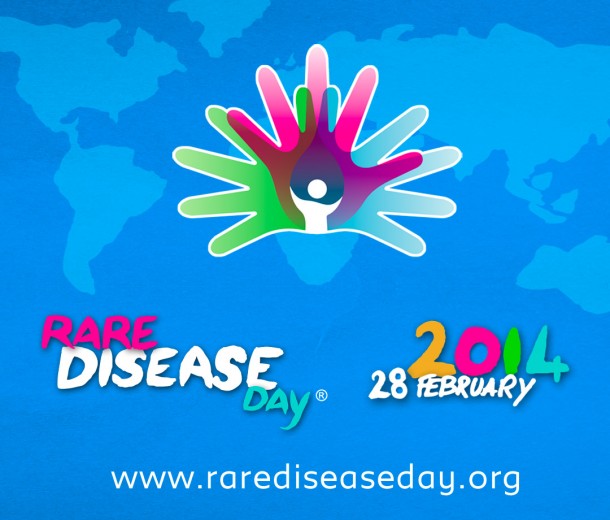
February 28, today, is International Rare Disease Day. Rare Disease Day was first established in 2008 by EURODIS, the European Rare Disease Organization. In 2009, the National Organization for Rare Disorders (NORD) in the United States joined the effort to educate the public, advocate for better care, and shape policies to improve access to health care. This year’s theme is “Join Together for Better Care.”
Even though some 30 million Americans have a rare disease, and many millions more have rare diseases around the planet, each disease affects relatively few people, so rare diseases are also known as “orphan diseases.” The medical and pharmaceutical industries do not have a stellar history with treating rare diseases; drugs for rare diseases are called “orphan drugs,” because they do not address a family of disorders. In the video below, Sean Hepburn Ferrer, son of Audrey Hepburn and Mel Ferrer, addresses this issue. His mother died in 1993 from a rare form of cancer, Pseudomyxoma adenocarcinoma, that had not been researched in decades. A diagnosis was difficult to come by and treatments were limited to decades-old knowledge.
Those who care for and live with people with rare diseases are also affected by the disease and the sometimes grueling path to diagnosis. My family, my friends, and my girlfriend have walked with me every step of my path and keep me upbeat, encouraged, and sane. This day, honoring care for those with rare diseases, honors them, too. I love them.
41.747593-74.086810
Thank you for sharing this via one of these wonderful services:




 The Gad About Town