SCA or SMA? Ataxia or Atrophy?

“What a terrible thing to learn you have in the middle of your life.” That was my neurologist, my new neurologist, speaking.

In 2012 my first neurologist, Dr. M, diagnosed me with late-onset Friedreich’s ataxia, or at least he reported that he felt I have a form of spinocerebellar ataxia (SCA), a disease that has dozens of forms and is genetic in origin. Dr. M’s work led to insurance approval to conduct an expensive genetic test to identify which ataxia I have. (The approval would not have been granted frivolously, so I underwent three MRIs, one EMG test, many blood labs to eliminate Lyme disease and the many other viruses that could be a cause of my symptoms, and started seeing a cardiologist. The fact of my cardiomyopathy led to approval for the DNA test.) But Dr. M moved to a different practice and I met my new doctor, Dr. K, this month.

Dr. K reviewed the first doctor’s extensive notes and looked at me. “You don’t have Friedreich’s ataxia.” (Dr. M was not much for granting eye contact, so this moment of direct conversation surprised me.) Dr. K asked me about my symptoms and when they seemed to begin to appear, some of which I have written about elsewhere. Since 2005 I have been aware, at first dimly, of a mobility disorder developing in me; today, in 2014, I walk with a cane, stiffly, like I am wearing very tight jeans, have little sensation in my lower legs and even have moments of “body confusion” in which I think I am moving my right leg but my left leg moves. I sway when I stand and fall/walk into walls and my sense of where I am in the world contributes moments of comedy to my day.

normal brain

‘Abby Normal?’ Not my brain, but good-looking one like mine.

My MRIs show a spinal cord that is shedding its myelin sheath protecting the nerves inside, a couple vertebrae that have spontaneously fused—”When did you have this happen?” Dr. K asked me. “I don’t know,” I replied. “I’ve never had anything done on my back.” “Car accident?” “No.” “Okay, you have a spontaneous fusion”—and places where the nerves themselves are atrophying, withering. But my brain, my cerebellum specifically, it is a healthy brain. I have a fine-looking thinker. Thus, Dr. K posited, I do not have a spinocereballar ataxia, as my cerebellum is healthy.

I spoke in Dr. M’s defense. “I think he was surmising from the tests …” Do not use the words “think” or “surmise” with neurologists. “Ataxia,” Dr. K offered, “has been treated like an umbrella term for patients with movement disorders like yours. But it really is a specific disease and you do not have a spinocerebellar ataxia.” He turned to his computer and started typing what I thought would be yet more patient notes and requests for another battery of tests (Dr. M had generated several pages on my case), but then I noticed what looked like a Wikipedia page on his monitor.

“Based on your labs and the extensive deterioration in your spine and weakness in your legs, you have spinal muscular atrophy, I believe Type IV.” (I swear I heard him say “Type IV” with Roman numerals and in italics.) “Has anyone suggested this to you? No? It may be Type III, but I would say that you have a type called Kugelberg Welander, but very late-onset.” He looked back at me. “You have a genetic disease. What a terrible thing to learn you have in the middle of your life. Your symptoms are severe and I have not seen many adult cases, but you will live, I think, a long life. Your legs will continue to get weaker, but you will adjust.”

(How beautiful is it to have a doctor look in your eye and simply say, “What a terrible thing?” To my first neurologist, a terrific clinician and lab expert, I sometimes felt like I was an interesting case but basically a piece of meat that had the unfortunate habit of speaking.)

“You’re a writer? You’ll probably be teaching me about this by our next visit.”

Spinal muscular atrophy is a genetic disease, a muscular dystrophy that in most cases affects children, but not in my case. The vast majority of spinal muscular atrophy stories are incredibly sad: Type I strikes infants who do not ever control their own movements and eventually suffer respiratory failure and die before age 2. The second type strikes children before age 2 and renders them unable to walk, but most SMA Type II patients live into adulthood. Many children and young adults seen on the annual Muscular Dystrophy Association telethons through the years have had SMA Type II. Type III and Type IV—and there seems to be some debate as to whether there is a Type IV at all—are considered “late onset” and offer patients the lifelong challenge of impaired and deteriorating mobility and, eventually, respiratory difficulty. Since my symptoms struck in my mid-30s and grew aggressive after 40, I seem to be the very picture of an argument for naming a separate Type IV, if what I have is a spinal muscular atrophy.

Dr. K asked about family and friends. I mentioned something about having developed some friendships as a result of reaching out to the online ataxia community (Jason and Kristin: this is me talking about you). “But you don’t have ataxia!” he exclaimed. When he asked if I am still interested in a genetic test to definitively identify what it is I do have, I reminded him that I had been approved for a test for Friedreich’s ataxia. All that test would have shown us, he replied, is that I do not have FA, not what I have.

So one neurologist posited that I have a spinocerebellar ataxia (SCA) of unknown cause and unknown type and another that I have spinal muscular atrophy (SMA), which is rare when it strikes adults but has a relatively gentle prognosis, if a challenging one, with a future of ever decreasing mobility. I know that I do not know. My daily challenges are unchanged by either diagnosis. I could never wish either SCA or SMA on people I detest, but my disease leads me every day to deeper friendships and I hope more patience. Those are both good things. I think I laugh at myself more. I have to.

Since my preliminary diagnosis in 2012, I have been learning about the different ataxias and following the research progress that seems to be unfolding almost every day, especially as it affects Friedreich’s ataxia.

Both FA and the other SCAs and SMA are very serious rare diseases that all too frequently constrain, impair, or even end young lives. But late-onset genetic disease patients, like me, provide a useful, slow-motion version of their disease as it unfolds. As the doctor says in this video here embedded: “The SMA type 3 and type 4 patients are probably going to provide critical information as to the mechanisms of SMA. It is also possible, that a better understanding of the type 3 and type 4 patient, understanding why their disease is so much more benign than the type 1 and type 2 patient, might provide additional windows of insight into therapeutic strategies.”

I have signed up to be listed on the International SMA Patient Registry.

Snow-taxia: Ataxia, Part 3

The first snowstorm of the year provided me with an opportunity to compare my ataxia symptoms from last year to now. I joked with a friend that weather like today’s gives everyone a moment to experience what it is like for me and other ataxians every dry, sunny day.

New Paltz, where I live, is laid out on a gentle downward slope to the Wallkill River, the north-flowing, rather narrow (only about 175 feet wide at New Paltz), tributary of the Hudson River. As this year unfolded, I became aware that walking downhill, even with a cane, is becoming a greater challenge. I take it slowly. Walking uphill, I can still develop a rhythm (this is the only chance I have to tell anyone that I have rhythm!) and make my way. 

Watching the snowflakes accumulate.
Photo by Mark Aldrich

I am very happy that I can walk safely. I refuse to give in to unhappy thinking about things lost or experiences that I can’t really do again–heck, I’d enjoy making snow angels like when I was a kid, but I do not know what the bottom half would look like (an angel on a stick? a realistic depiction of someone thrashing about in the snow?) and I and whomever would be standing by to pick me up (completely necessary) would pretty much erase it upon picking me up. I am lucky that I have people in my life who will pick me up if I fall in the snow. I can walk and I am not going to play emotional games with myself, listen to the inner monologue about how soon? How soon until I can not, or will not, or fall badly? (Soon enough, and my worst face plant of a stumble and fall so far in 2013 was on a sunny, dry day, anyway.)

So I ventured out this morning to visit my support group and not spend the day watching the snowflakes accumulate. At first, I was not going to risk a fall–after the first snowfall of the season, sections of New Paltz’s sidewalks sometimes remain snow-covered until around May 15–and I know that the cane is not my friend on ice. Things that I used to like about walking in winter, I no longer enjoy: the moment of unsureness, of feeling a slide start, or the sound of my boot punching a crunchy hole through what I thought was solid ground–these now represent some of the difficulties with the everyday that my new world offers me.

I safely arrived at my destination. No falls, no slips–so now I am probably falsely confident. (But I happily accepted a ride home.)

A Duck About Town: SMA and Me

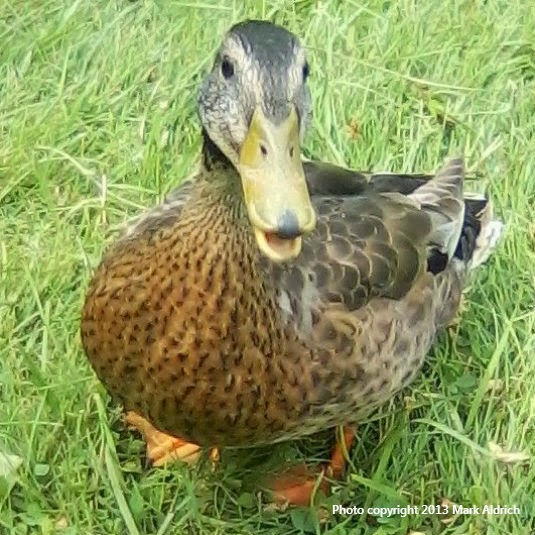
It is hard to see, but on the top left side of the “The Gad About Town” tab (at least on a Windows browser), to the right of the WordPress logo, there is a little square box that looks like a blob of brown and green. I first placed it there as an inside joke with myself, but the story is worth sharing. The full-size photo is at the bottom of this article.

It is a photo of a duck. 

In 2012, I was diagnosed with a still-undetermined form of spinocerebellar ataxia. (I just noticed that the word “spinocerebellar” now freely flows from my fingers as I type it; I insist on Wikipedia’ing it to check the spelling—to preserve the illusion to myself that this is still new to me—but it is now forever in my vocabulary.) This disease, which I have written about before (“Ataxia“) and will again, is progressive, degenerative, affects my sense of balance, and is robbing me of my physical control of my legs. 

(October 22, 2014 update: in May 2014, a new neurologist was assigned to me and he corrected the first diagnosis to something else, spinal muscular atrophy type IV. Friedreich’s ataxia, the first diagnosis, carries with it a shortened lifespan, a diagnosis that in turn carries with it more than a few nights lying awake and staring into every abyss one thinks is on the other side of any door. Please visit my article about the re-diagnosis, “SCA or SMA?” Everything else in this article, written in December 2013, still reflects my perceptions.)

My symptoms first appeared in 2006, I now realize, when my walking began to slow. I was always a rapid walker, and I felt like I was moving my legs in the same way I had always moved them, but the time it took for me to complete familiar walks was getting ever longer. Even in 2005, while mowing a friend’s lawn, I noticed that it took me longer than it “ought to” have. My legs were tiring easily. Finally, I started to run late for appointments (most hazardously, my job across town) and was perennially underestimating the time it would take me to walk somewhere.

All this was new. I shared what I was experiencing with no one, except to promise when my lateness was noticed that I would “do better” next time.

* * * *

A blue heron, patrolling the shore like a cop on the beat.–Photo by Mark Aldrich

This spring and summer, some friends and I made frequent visits to a pond at a local college campus. A former make-out nook for at least a one of us, this year it became a quiet place to get away from some turmoils in our lives. Several species of waterfowl live on the pond, which is nonetheless quite small. One day a blue heron came by, which is a common but always special sight here in New Paltz. It hung around long enough for me to photograph it walking along the shore.

There are usually a few breeds of duck on the pond, and my friends and I became “expert” in observing the inter-species social behaviors of the different breeds. (In a word, some breeds are just bullies, even to humans who are feeding them breadcrumbs.) We developed story lines about each duck family’s day.

One family of five, a mother duck and her four ducklings, became “my” family. This was because one of her offspring was lame. He or she—I decided he was a he, but I believe it is a she (those who know about such things can tell immediately when looking at the photo below)—appeared to have a broken right leg. Cute and small as they all were, the four of them fuzzy and adorable like they were posing for a children’s book cover, the siblings would push him away from our breadcrumbs, but he always fought hard for his share.

Broken or born that way, he held his leg tucked alongside, which forced him to remain seated on the ground when the others were toddling towards the crumbs. Then, in a flurry of action, he would start to wobbly waddle, but he was perpetually a few steps behind. He was slow in other ways, too: by the time his siblings were free of their baby fuzz and displaying more grown-up plumage, he still had some fuzz.

I saw that, even with his right leg held in a crook, even sitting awkwardly on the ground, once he started walking, after a few unsteady strides he would catch up to his siblings. But he honked just as loudly as they did, each of them telling the others to mind their manners at the top of their voices. In the water, he appeared to swim as quickly as the others.

* * * *

In 2008, the bizarre sensation of being always on the edge of a fall became a part of my life. I could not walk across a parking lot without first looking across it to plan which cars I would use as targets for potential falls. I started walking with a cane.

Faced with the prospect of crossing an empty parking lot (I worked for an electronics retailer that frequently locates its stores in open-air plazas, so that is why I have twice mentioned parking lots), I would look for an abandoned shopping cart (there was a grocery store nearby) and use that as a walker.

As before, I shared what I was experiencing with no one, except sometimes I made jokes about walking with a cane—I named it “Michael,” as in the actor—and I did not have a doctor, because I was 40 and a guy and why bother?

I did not have a doctor, because 40. I was 40 and my legs felt like they were in boots nailed to the ground. I would take a step only to find that neither leg moved.

By 2011, completely foreseeable circumstances had given me the beautiful gift of poverty and thus Medicaid. Now able to afford a few visits to a neurologist, I underwent the series of tests that led to my diagnosis.

* * * *

After that first visit to the duck pond, I did not expect to see “my” duck again. My not-so learned musings about inter-species duck behavior and observations about seeing him clubbed regularly by his siblings led me to my expert prediction. Marlin Perkins in my mind, I lectured one of my ever-patient friends about my sad theory that he probably had been rejected and abandoned “for the greater good of the family.”

On our next visit, two weeks later, he was still there. Of course. He was still missing every first chance at breadcrumbs—even those tossed specifically at him—but fought his siblings to get his crumbs once he started moving. They still pushed him away from their second and third chances at crumbs on the ground, but he was louder than the others and was getting faster, even limping, but doing something like using his lame limb like a cane. He was using his lame leg.

* * * *

I use a method of walking that I devised without knowing what I was doing back at the electronics store: I push off with my right leg, like a right-handed pitcher, and swing my legs under me, using the cane to tap a rhythm. Once I get myself up to speed, I can outpace many of my friends. It is difficult for me to stop suddenly, like when I am jay-walking, so I do not do that. There are days where I do not know what my legs are going to do and we seem to educate each other.

Two friends who walk with me step by step.

Every day, I live with the sensation of being on the edge of a fall all the time, even when I am sitting on a chair that has arms on both sides, and I stand upright by bracing myself with the cane, standing against a wall, or by surprising a friend (often, my beautiful girlfriend) by grabbing their shoulders. In the photo seen here, taken in October 2013, I am with two of my closest friends, but I am holding myself up with a folding chair on each side.

Because I have a diagnosis, I know why I am experiencing these things, and new developments can no longer be as surprising as the discovery in 2008 that it seemed that I could no longer walk. Because I have friends in whom I confide (like you who may be reading this), any new development will not be experienced like running head-first into a wall, which is how it felt for me in 2008.

* * * *

My buddy.–Photo by Mark Aldrich

The photo here is of “my” duck, closer to fully grown in July, waddling up to me. He would take two steps at a time and then pause or plop down, then would take a couple more. First his right foot, then his left, then a stop and reset for another pair of steps. He did not come as close to us breadcrumb tossers as some of the others did that day, but he fought as valiantly as any duck that I would call mine should.

This is the photo that accompanies this blog, next to “The Gad About Town” name. He is my duck about town.

It is now December 2013 and I hope he is still with us, but in the warm south, ornery at his siblings every staggered step of the way.