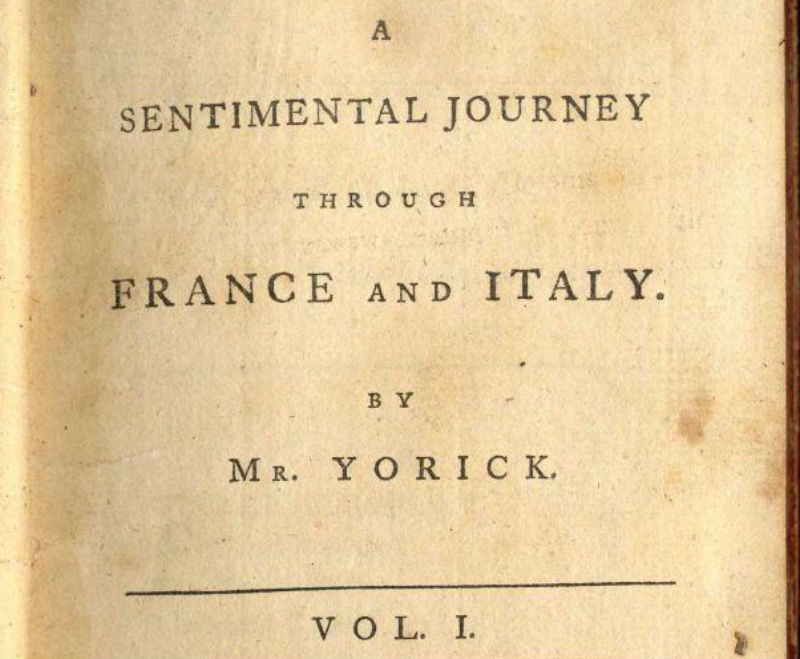
A Sentimental Journey Through …

Laurence Sterne was dying of consumption, the polite yet dramatic term that people used to employ for pulmonary diseases, especially tuberculosis. He had contracted it by 1740, when he was still in his 20s, and he fought for his every breath for his remaining three decades of life.

In 1765, he left England in search of better breathing, and he traveled abroad to France and Italy. He was a surprise best-selling author by this point, a clergyman who had decided on a whim to start telling the life story of a character but by not telling it in a straightforward manner, to comically digress his way through “The Life and Opinions of Tristram Shandy, Gentleman.” One of the earliest novels in English or any language, “Shandy” was an instant success when its first two volumes started appearing in 1759.

The genre we call “travel writing” was not as common in the 1760s as it is now, and most works in that genre at that time were quite unsentimental: verbal pictures of natural phenomena and wonders of the man-made world and warnings-slash-complaints about the foreignness of foreigners on their strange home turf. In his 1765 journey, Sterne encountered fellow novelist Tobias Smollett, and the stern, dry Smollett left such an impression on the always amused Sterne that in his book, “A Sentimental Journey Through France and Italy,” he based a character named “Smelfungus” on Smollett. Nice revenge.
Read More
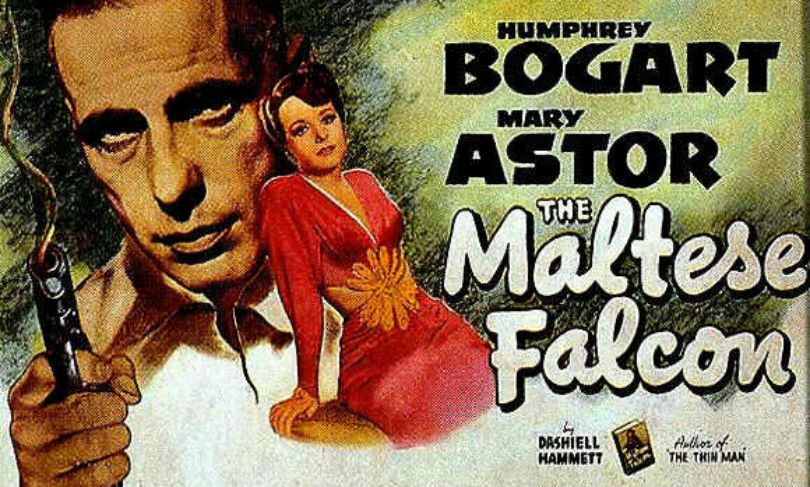

What Dreams Are Made Of

Alfred Hitchcock is credited with coining the term “MacGuffin,” but not the thing itself, which has been around since people started telling stories to each other. In spy movies and thrillers, a MacGuffin is the object that sets the plot of the movie in motion; it’s usually a something people desire that the hero and his nemeses pursue, and that pursuit provides the film’s plot. The specific nature and form of the MacGuffin is usually unimportant to the overall plot. In plot terms, but not theological ones, the apple in Genesis is a MacGuffin.

Neither of the two most famous examples of a MacGuffin in film history appear in a Hitchcock film however, even though he used the device quite frequently in his many movies (he directed more than 50 films from the 1920s through the ’70s).
Read More

The Long and the Short of It

I see an old photo of myself and I think I can return there. A previous year, another existence, is merely another place I have visited, lived in, breathed the air of. The 1990s are only as far away as a bus ticket whose price is a bit out of my reach; I think I can visit 1979 as easily as visit Phoenix if I would just save up for a couple months. I am going to see Vermont again, I am going to visit Iowa again; I have not seen the Pacific Ocean yet, but I know I will. Next year, maybe.
 
I know what the 1980s sounded like, what food tasted like then/there, just as I know what Cedar Rapids, Iowa, or Poughkeepsie, New York, sounds like. The ability to visit one (Poughkeepsie) but not the other (1983) offends me.—The Gad About Town, “So It Goes …

Now is all we have and Kurt Vonnegut knew this, knew it better than most. Reliving the firebombing of Dresden in February 1945 was necessary for him and he engaged that memory, both in print and in his psyche many times; coming to understand that February 1945 and November 1918 and March 2016 all co-exist in an Eternal Now is spiritual, somewhat. But my finding myself frustrated at the expense of a bus ticket to 1983 is Hell in its exquisite pointlessness, its empty longing.
Read More