Crisis Mismanagement

Should I, after tea and cakes and ices,
Have the strength to force the moment to its crisis?
—T. S. Eliot, “The Love Song of J. Alfred Prufrock”

* * * *
“Take my advice—I’m not using it.” I can tell you to keep calm. At my worst, I might insist that you keep calm. But as someone who can introduce stress into the least stressful, sweetly innocuous, and even some of the more pleasant experiences in life, when I am confronted with the parts of life that others find truly stressful, I hunker down and find the effort deep inside myself to make them yet more stressful.

In one of my lesser achievements in the field of stress management, I gave myself a black eye while tying my shoes. These were boots with leather laces (I am not a cowboy) and such laces can take a little effort to yank into position. While securing my “half-knot” on my right shoe, the length of lace in my left hand broke and I clocked myself in the right eye. At the time, I was 34 years old, not 11.
Read More
Auden at Home

In About the House, published in 1965, W. H. Auden gives readers a tour of his home in Kirchstetten, Austria. Each of the twelve poems in the section titled “Thanksgiving for a Habitat,” bears a dedication to an individual, one of Auden’s friends.

(“Down There,” about the cellar, is dedicated to Irving Weiss, and “Up There,” about the attic, is dedicated to Anne Weiss. Irving Weiss taught in the English Department of SUNY New Paltz and retired in 1985, before I was a student in that department, but he was still around when I was there. Anne was his wife. For me, “Auden dedicated a poem to him” may as well have been the caption under his face each time I saw Professor Weiss. He is still alive, 94 years old, and a profile of him in a recent Long Island newspaper does not mention any of the above.)

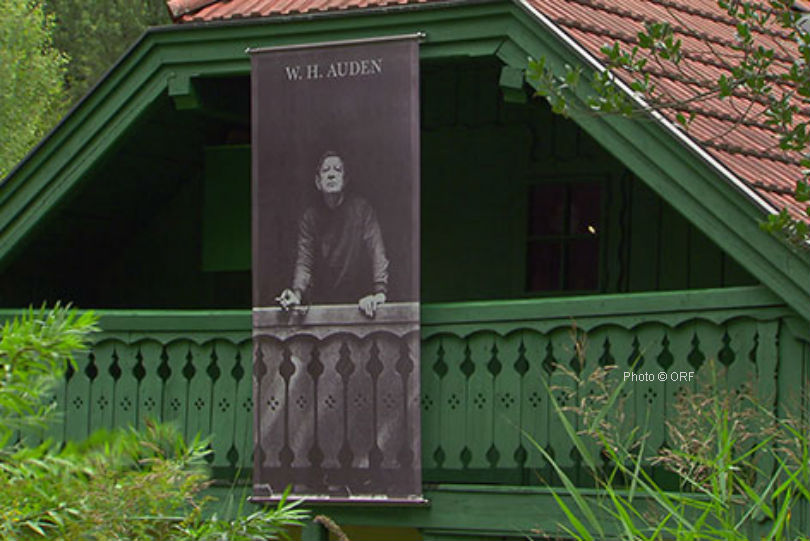
Back to Auden’s home (pictured in a recent photo at top with a poster bringing the master back to the porch outside his upstairs study):
Read More

Memories of the Future

In his Confessions, St. Augustine writes, “What then is time? If no one asks me, I know; if I wish to explain it to one that asks, I know not.” He decides that time is an idea, unique to humans, and also unique in that we can simultaneously grasp the past in memory, the present by attention, and the future by expectation. In our minds, but only there, we are not locked to one perception of one reality.

Earlier, I deleted everything that I had written up to that point by dragging my unbuttoned shirtsleeve across my laptop’s touchpad while reaching for my coffee. (No, I can not replicate the results in an experiment; yes, like an idiot, I have attempted to replicate these results in an experiment.) In a feat of memory, I retyped all that I had written to that point: simultaneously, I remembered what I had written, was super-present and typed it attentively in the moment, and I lived in expectation of a future in which I regularly saved my work, a lesson I first learned, oh, 20 years ago.

I was in three specific time-experiences at once, and each one sucked.
Read More