
#IStandWithAhmed

They handcuffed the kid.

I for one remember being 14 years old: I spent it overwhelmed. In junior high (7th and 8th grades in my school district at the time), my general proficiency at the whole learning thing bit me where it hurt the most: my ego. My success in 7th grade placed me in advanced classes the next school year that even carried the letter “X” in their name to signify their specialness. “English 8X,” and such.

It overwhelmed me. “Math 8X” was algebra delivered one year early and some geometry offered up two years early, and I nearly flunked. I liked my side projects too much: I wrote all the time, more than was expected or required in my English class by my English teacher, because that is what a 14-year-old who likes a certain subject in school does. I would bring my extra work into class to show my teacher because I could not not think about Math and Science enough that year. My teacher was bright enough to let me read my work in front of class to help me along, because I suspect she knew that my fragile ego needed to know that there indeed were things I could do well.

So I understand Ahmed Mohamed, a 14-year-old at MacArthur High School, near Dallas, Texas. He is the opposite of me: he loves science and engineering and devotes whatever extra time he has to tinkering and building things. On Monday, he brought in to school something he had thrown together in 20 minutes: a clock. He was arrested, led out of school in handcuffs by five police officers, and given a three-day suspension, which he is still serving. He was spared spending any time in jail, but he was fingerprinted and locked up in the Irving juvenile detention center. Here is the moment of his arrest (please notice the NASA t-shirt):
Read More

So Darn Humble

The word “humblebrag” has been around long enough that even I have heard of it. (Is that a humblebrag?) A collection of examples has been collected in a book that I have not yet read, entitled, “Humblebrag.” The word is common enough that it is even in the Oxford Dictionary, at least in the online edition.

For some reason, I only recently learned the term and, egomaniac that I am, I thought that I had come up with the concept years ago. I certainly had not.
Read More

Pippa’s Song

The year’s at the spring
       And day’s at the morn;
       Morning’s at seven;
       The hillside’s dew-pearled;
       The lark’s on the wing;
       The snail’s on the thorn:
       God’s in His heaven—
       All’s right with the world!
—Robert Browning, “Pippa’s Song” from his verse play “Pippa Passes”

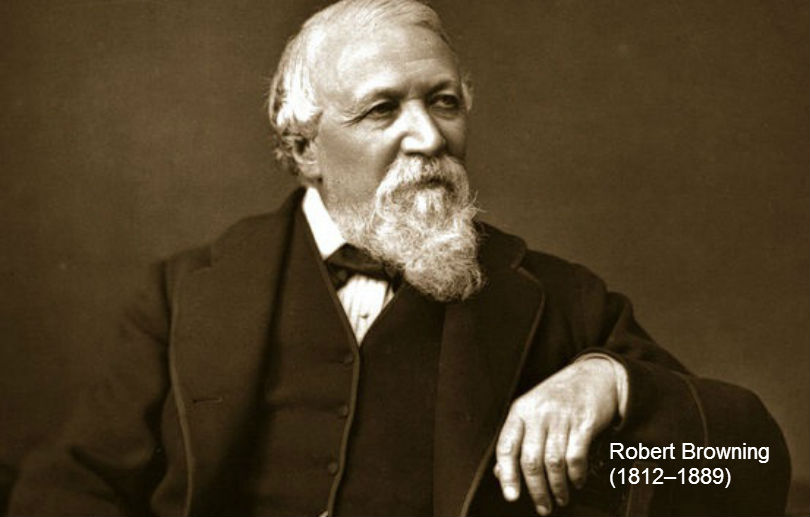
Robert Browning‘s long poem, “Pippa Passes,” published in 1841, is a verse drama, which means it was not written with the intention of any person staging a performance of it, and life ever since has fulfilled that lack of intention. The poem-as-play has not been performed by any notable theater company in more than a century. “Pippa Passes” is remembered for two things. Well, three things.

For one, it is remembered for not being remembered, for not living on in culture’s memory at all, even though at the time critics were quick to count it among Browning’s masterworks. Also, it is remembered because Browning accidentally used a vulgarity in it because he thought the slang word he used referred to a part of a nun’s habit. This was pointed out to him in his lifetime, and even though he made emendations in 1849 and 1863, he chose not to correct the one glaring one, and insisted that if he did not know it was a vulgarity, how was it a vulgarity?

Last, one line from it, a single line, lives on to this day as an expression we might hear more than once every day: “God’s in His heaven/All’s right with the world.” Young Pippa sings it.

(Shall I discuss the vulgarity below the fold?)
Read More