‘Two of One Kind’


This is the story that moved me the most today. Clara Gantt of Los Angeles, 94 years old, accepted the remains of her husband on Friday at Los Angeles International Airport, a short time after learning that he had in fact died in 1951 as a prisoner of war in North Korea. That country has slowly, so slowly, begun to release information about and even the mortal remains of battlefield dead and dead POWs to its sworn enemy, the United States.

Mrs. Gantt’s final contact from her husband was a Christmastime letter sent from the front at the end of 1950. Shortly after, historians now know, he was taken prisoner on the battlefield and died in Korean custody. They had only been married for two years, or 65, depending on whether one asks Mrs. Gantt.

Her dedication to the memory of her late husband was such that she refused to consider him her late husband until this year, when she learned that the government had received remains from North Korea and positively identified them as Sgt. Joseph Gantt. She told reporters that even when she was able to purchase a house for herself in the 1960s, she also hired a gardener to tend it, since she knew he did not like yard work and she wanted him feel free to do whatever he liked when he returned home from the war.

From the Los Angeles Times story: “During the last 63 years, no one else caught Clara Gantt’s fancy as she waited for news of her husband. She told the base officials assigned to check wives’ homes for other men to come by anytime, (as) they’d never catch her with anyone.

“‘I am very, very proud of him. He was a wonderful husband, an understanding man,’ she told reporters at the airport. ‘I always did love my husband, we was two of one kind, we loved each other. And that made our marriage complete.'”

Widow, 94, Receives Remains of Fallen Husband

I learned about that kind of enduring love from my grandparents. Eighteen years ago this month, William Aldrich died, aged 91. Bill and Edith (Pearson) Aldrich were married for 64 years. I asked my grandmother if she could recall how they met. “How did we meet? I don’t think I remember,” she said and looked at her sister-in-law, my great-aunt June, and repeated my question.”What did we do?” she asked. June brightened, “We danced.”

“I guess we danced,” my grandmother nodded and looked at me. The two of them held hands and repeated, “We danced.”

Edith Aldrich had a gift that the widow in Los Angeles did not receive: She saw her husband every day for 64 years. But both love stories are priceless.

As they grew old and then older, my grandparent’s life became that “complete” marriage. In their small Vermont hill town, the mail was delivered twice a day to the country store. My grandfather would march down the hill, cross highway 100 and the bridge over the West River, collect the mail and return. Her eyes would follow him every step.

By age 85, he was living with Alzheimer’s and her watchful care included hiding the car keys and having my uncle (and once, me) conceal the lawnmower behind the barn, lest he act on his foggy desire to fix something, anything, and hurt himself. (When I last saw him, age 89, he was still able to bend at the waist and pluck his hated dandelions out of the ground from a standing position, so he remained physically strong till the end.)

My grandmother outlived her beloved Bill by almost 14 years, dying in June 2009 at age 98. One day, years into her widowhood, she and I went for a walk on her road, the same road as the family cemetery, and she mentioned him.

“I miss your grandfather every day,” she told me, as if this was something she had been thinking about. “I’m not interested in joining him just yet, but I know he’s waiting for me.” 
 

Retailizations

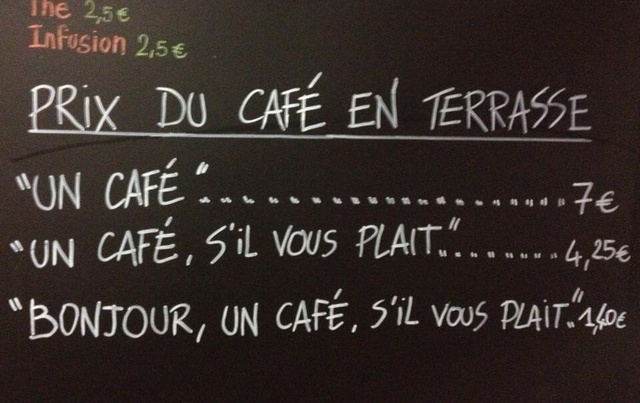
A coffeehouse in France (okay, that right there may be one of the greatest four-word phrases I have ever typed; one almost does not need to continue. Please return from your daydream when you feel up to it) … . A coffeehouse in Nice, France (oh, come on, does this anecdote just keep getting sweeter? The setting may as well be, “A coffeehouse located in Sweet Kisses in Everyone Is Always Smiling Land”) … and, yes, I certainly know that the city’s name is pronounced “neese,’ and not the easy way to a punny joke, but a pun is a pun. 

coffee

Photo from Gawker.com

A coffeehouse in Nice, France, has posted a new price board, seen above and explained in “This Coffeehouse Will Charge You Less if You’re Nice.” If you stride up to the counter and demand a coffee, you will be charged 7€, which is approximately ten bucks and a typographical nightmare. If you say, “Please,” after, you will receive a discount. If you request the coffee and service in the more formal, polite, fashion, you will be charged even less. How great is this?

I worked at several retail jobs spread out over a quarter of a century. (I have also taught college composition, written for newspapers, and written and illustrated technical manuals. Either I have lived an interesting life or a shambling one; these are not mutually exclusive things.) I worked at a bookstore, an electronics retailer, a department store. At each, I desired the power to post a similar sign: a “ten-percent politeness discount on all hardcovers; twenty percent off before 11:00 a.m.,” at the bookstore, say. 

Retail clerks (sales associates, as we are more commonly titled now) occupy a couple different spaces in the average customer’s psyche, it seems. At the bookstore, there were customers who seemed to believe that one of the requirements for employment was that we had read every book in stock, and maybe every copy of each title. Some acted like they saw it as a personal challenge to find out which books I had not read. (At least once, after I had determined that a customer was playing this game, I started to insist that I had not yet read a book–any book–and that I just liked working retail jobs. “I’d like it more if we sold socks,” I told him.)

At the electronics retailer, it was assumed each of us working there was secretly a computer programmer and desktop publisher and ham radio operator who had not yet been discovered and, in our pure-hearted love of working a low-paying retail job as opposed to working as a high-paid consultant, we would/could/should provide professional-level advice for however much we were getting paid. Or for the fee of free.

Both customers are the same, of course, and they have a reasonable desire. Who doesn’t want to discover one’s own personal shopper at every store one walks into? We all want to be insiders. There were many customers at the bookstore with whom I shared great literary conversations and learned to anticipate their next reading needs, and there were many many customers at the electronics retailer.

But if I am your perfect personal shopper, I am probably letting someone else down. (While I was selling furniture at the department store, I had a customer ask me if I thought one couch was more comfortable than another. You know something? Furniture is a surprisingly personal choice. The couch I find comfortable might strike you as high-backed and about as inviting as a bus-station bench.) 

Other customers see the clerks in stores as interchangeable and invisible. Those are the customers the French coffeeshop is addressing. These are the customers who are supremely irked by the fact that a store opens at a certain time and not earlier–when they are there–or in fact has to close at a given hour–again, when they are there. They want to be treated as exceptional and important even as they treat the employees as the equivalent of a store fixture like a shelf or a display. This customer is the only customer who will actually say out loud to a clerk, “The customer is always right.” 

To handle this customer, I learned the “manager trick”: I would anticipate an impending complaint, announce preemptively that I would voluntarily involve the store manager in the conversation, sally forth to the backroom, and conduct the following conversation:

“Hi. Have you heard my chat with so-and-so?”

“Yes. It sounds like you know what to do.”

“I told her (or him) that I would demonstrate sympathy with their side to management, so I am speaking with you now.”

“This is a positive show of solidarity. But you’ll tell them I won’t budge, whatever the conversation is about.”

“Yes. Who are the Yankees playing tonight?”

I would return to the front of the store and repeat what I had been telling the customer all along, but with the added rhetorical support of the manager’s “words.” It usually worked.

It always worked, except once. I stupidly confessed to a friend that I sometimes employed the “manager trick,” and explained what it is, thinking it would amuse him. A few days later, a mutual friend began to negotiate something with me at the store. When I explained that I was going to speak with my manager, he accompanied me step by step to the back of the store. My friend had betrayed my secret.


Against Casinos

I love casinos–the air of excitement heightened by the oft-rumored, never confirmed, super-rich, extra-oxygenated air in them–and I love my memories of random camaraderie generated at the card tables and my many stories of money won and money spent by me and my friends:

  • There was that time John and I found one single quarter on the floor of his car after a night of non-winning gambling, played it, and remained in the casino for hours after on that one quarter’s winnings.
  • Or there was the night two friends and I played “Commie Slots,” a game of our own devising, and won big and shared the winnings, as per the name of the game. (In “Commie Slots,” we pool our resources, split them into equal portions, venture off to our individual machines, play through that portion, reconvene, and collect the winnings. If one player has spent through his part and has little or nothing left but another has hit big, well, we signed a communist deal, and “from each according to his ability, to each according to his need.”) One night, I was the low man, and my friend, John again, hit for $1000, which we dutifully split three ways.
  • There was that late night at a roulette table with a guy who truly believed in the mathematics behind his roulette bets–there is no math behind roulette, no secret book to study–but whose every bet hit for an extended run, as if his belief in his scheme provided sufficient cosmic energy to make it true. We shared the success in his run by joining him in his bets, building multicolored pillars of chips on certain numbers. We pounded on each other’s backs.

There were other nights and days, though, too. Unhappy memories:

  • There was a hungover summer afternoon when I was unemployed in Iowa and hanging out with a middle-aged barfly named Harry who claimed to have been screwed over for song royalties by every major rock songwriter–and he had somewhat believable … okay, plausible … stories about how he got screwed … um, okay, scenarios plausible to drunken ears hanging out late at night in a wood-paneled bar with desk lamps on it for illumination. We drove to Meskwaki Casino in Tama, Iowa, an hour-long drive, to try to turn our fortunes around and left after perhaps two hours, our fortunes unmoved by our joint efforts. There were only slot machines there, and Harry was no Commie.
  • And there were nights when my stake was exhausted far earlier than anyone else’s, and any handouts from my “comrades” did not reverse the night’s seeming intention for me to learn a lesson while I waited for the others to finish.

* * * *

My enjoyment of gambling is mostly limited to casinos (I did play a lot of Quick Draw for a while, long in the past), and those trips to casinos have always been special to me: long drives with my close friends to an exciting, foreign atmosphere, encounters with fellow travelers at the tables, and an understanding that since I am not a wealthy man, my enjoyment of the games would be enhanced by understanding what I could afford. At times, I have traveled to a casino with fifty dollars in my pockets and had a great fun run with that. At other times, when I have forgotten my simple rule, I have burned through several hundred dollars rather quickly, and I remember the desperate shame and hope placed with those final bets, desperate that a big win will restore order in my universe, either at a table or in a slot machine, only to see the gamble turn up empty.

That was my mindset in the not-so-epic drive to Tama–when I was unemployed, living in a part of the country where I knew no one even after four-plus years there–that I was traveling there to make some needed money. To earn some money. The cosmos wouldn’t punish me further, would it? Empty, desperate, shame and hope. It wasn’t a punishment, not from the cosmos, anyway. 

Gambling is not a way to make money; it is a sometimes exceedingly fun way to spend money. But a lot of money is there, and money sometimes comes when you need it most, which is when you least expect it, as the saying goes.

That is why I have always been opposed to casinos being located in an urban area, or near a residential area, unless that urban area is, well, Las Vegas or Atlantic City. When it is a fun trip, made with a budget that includes gas money and food, I truly love the experience. Right now, I am a man on a limited, fixed income. There are no casino trips in my future. Fifty dollars is food money for a week.

In my current mood of needing money, needing quick money, the thought of buying a scratch-off has crossed my mind. I will admit that. The scratch-off, the cardboard version of a slot machine. If there was a slot machine in New Paltz, or one a cheap local bus fare away, mightn’t I try to make the opportunity to give the universe a chance to shine some luck on me? Why mightn’t I? I’ve been living the right kind of life lately, haven’t I? Luck be a pally, tonight.

For many people, my current experience of poverty feels empty and desperate; life’s a gamble, anyway. For many people, scratch-offs and slot machines love taking hope one quarter at a time.

* * * *

In the mid-1990s, I wrote for a newspaper in Sullivan County, NY, and one of the larger issues the population of that rural county faced at the time was casino gambling. The St. Regis Mohawk tribe, not a tribe indigenous to Sullivan County–in fact its home is based closer to Montreal than Albany–had developed an interest in operating a casino as a way of raising revenues for itself. Through many convoluted real estate negotiations that took place over many years, the tribe attempted to open a casino at Monticello Raceway, taking advantage of the fact that there was legal gambling there already. I was a part of the coverage of some of those convoluted negotiations and I hated every part of it.

Sullivan County is a mostly rural region of great natural beauty and a history that includes many, many vacation resorts (the “Borscht Belt”), which have all closed. It is an impoverished part of the state and its residents have seen casino salesmen pass through like Harold Hill for almost 40 years, salesmen who see closed hotels already in place for new hotels to occupy. 

(Ultimately, a “racino” was opened at the Raceway, long after I had moved out of the county. The St. Regis tribe still does not own or operate a casino in the county; the company that owns the Monticello Raceway and Casino only owns that one casino, in which the only games are slot machines.)

Our letters to the editor section was often occupied by tit-for-tat missives between Lee Karr (an anti-casino activist) and the late Noel Van Swol (a pro-casino activist, and, later, a pro-fracking activist).

I learned back then that pro-casino advocates always come armed with “facts about the future,” numbers and very specific dollar amounts (the current Proposition 1, on the November 5 ballot, will bring “$51.0 million per year to the Catskill Region”) reflecting the good the casino will create in the local community. But the numbers about the future, solid-sounding numbers with respectable decimal points and the whiff of reality, are never accompanied by financial figures from cities and communities that actually have casinos. I have yet to see what the real numbers look like in those communities to compare them to what was promised as real future numbers once upon a time.

Oh, but the anti-casino advocates don’t bring numbers about community economic impacts, they write like I did in my personal anecdotes above: about real real-life, present-day anecdotes and true, individual economic impacts.

Thus, one side looks like it is armed with hard facts and the other with mushy feelings and stories about individual people; one speaks of the community as a whole and its future plans with math and actuarial tables about a casino’s economic impact, both if it is built and if it is not, while the other, well, how can you reduce an entire community’s mathematical future to one poor schlub’s bad gambling addiction? We’ll make sure there are plenty of signs up in the casino with 800 numbers offering help.

The pro-casino advocates often remind me of the guy I met long ago at the roulette wheel, the fellow who believed he had a system for a game that is truly system-less. The anti-casino advocates only have the facts of our stories. 

I will happily vote no on Proposition 1 tomorrow.