Shirley Temple and the Art of Obits

From 1934 to ’38, she was the biggest star, period. Anything with her image on it sold in the millions; you can still buy the “Shirley Temple doll.” Clark Gable, who finished in second to her year after year as most popular movie star, never had a hit song, and not many singers sold out movie theaters. Many a girl born in the period had to live for a time with her hair done in a perfect, bouncy mop (said to be 56 ringlets), whether or not her hair actually could be so styled.

Several obituaries for Shirley Temple Black yesterday included a quote like this one from people who lived through it: “That little girl danced us out of the Depression.” It is a true statement, both uppercase D and lowercase. More specifically, Shirley Temple sang and tap-danced 20th Century Fox from the edge of bankruptcy. In two dozen movies made in about five years, the country saw a child solve adult problems with a cute song, a dimply smile, and relentless optimism.

Even racism. As the New York Times noted in its own somewhat odd obituary (more on the oddness later), the child Shirley Temple “may have been the first white actress allowed to hold hands affectionately with a black man on screen in her staircase dance with Bill ‘Bojangles’ Robinson in ‘The Little Colonel,'” which was made in 1935. Robinson, born in the Reconstruction South of the 1870s, was a stage star, the most successful black performer of the era to bridge the worlds of white and black audiences, if only by always appearing relentlessly cheerful, as relentlessly cheerful as his child co-star. Their pairing, across four movies, made history by suiting Hollywood’s logic.

Once the dimples faded, though, her movie career declined—she was still popular as an icon, but the sight of a teen Shirley Temple reminded audiences too much of time’s passing, and people had their own lives to remind them of that. (The era of money-making nostalgia was still far-off in our country’s future. Today, in which history is not valid unless it is memorabilia, how is it that there is not an annual “Great DepressionCon,” at which cosplay performers wander around the convention floor dressed as hobos? If there was, Shirley Temple Black would have been a huge attraction.)

The rest of her life, a truly event-filled 85 years of life, minus any of the “child-star becomes a teenager, discovers they are not God, enters rehab” sadness, is sketched briefly in all of the obituaries, like so: Married to a businessman, she officially ended her show business career by age 30, discovered that the millions she had earned had vanished in her father’s bad business decisions, ran for office and did not win, and served in many official public roles.

She was a political fundraiser of such great note that two Republican presidents named her to official posts, only to discover that she was actually a talented and dogged diplomat, much like the dogged problem-solver of a child she played in her movies years before. She was a delegate to the UN, ambassador to Ghana under President Ford, and ambassador to Czechoslovakia under the first President Bush. She was a co-founder of the International Federation of Multiple Sclerosis Societies, which sounds anomalous but her brother had MS.

But the New York Times, in its long-standing role of uncle who you like to chat with about current events at parties until he gets creepy, got creepy in its obituary. I admit that I have not seen many of the famous “Baby Burlesks” that brought Shirley Temple to her first fame, but after reading this paragraph, I do not think I ever saw any, not any at all:

In 1932, Shirley was spotted by an agent from Educational Pictures and chosen to appear in “Baby Burlesks,” a series of sexually suggestive one-reel shorts in which children played all the roles. The 4- and 5-year-old children wore fancy adult costumes that ended at the waist. Below the waist, they wore diapers with oversize safety pins. In these heavy-handed parodies of well-known films like “The Front Page” (“The Runt Page”) and “What Price Glory” (“War Babies”), Shirley imitated Marlene Dietrich, Mae West and—wearing an off-the-shoulder blouse and satin garter as a hard-boiled French bar girl in “War Babies”—Dolores del Río.

Later, after affectionately describing Shirley Temple’s partnering with Bill Robinson, the Times does this:

She may have been the first white actress allowed to hold hands affectionately with a black man on screen, and her staircase dance with Mr. Robinson in “The Little Colonel,” the first of four movies they made together, retains its magic almost 80 years later.

Not everyone was a Shirley Temple fan. The novelist Graham Greene, who was also a film critic, was sued by 20th Century Fox for his review of “Wee Willie Winkie” in the magazine Night and Day, which he edited. In the review, he questioned whether she was a midget and wrote of her “well-shaped and desirable little body” being served up to middle-aged male admirers.

Does the next paragraph reveal the outcome of this lawsuit? No it does not. (The movie studio won a few thousand dollars, which at that time was enough of a hit for Greene to close the publication.) “Not everyone was a Shirley Temple fan.” That’s quite a non-transition transition. In its lurching, whiplash style, the Times moves on to the end of Shirley Temple’s contract days, her relief at this, and then … therestofherlife. The Greene anecdote is deposited into Shirley Temple Black’s obituary like any other fact of her life, like the duration of her marriages, say, and then given the same weight as any other fact.

The story of Graham Greene’s ancient movie review is worth exploring on its own because it raises issues of child stardom, audience participation in the fetishization of a child star, especially a female one, and even libel law. Greene’s attempt to capture the uncomfortable specter of middle-aged people leering at a young body instead veered most uncomfortably into the specter of watching a middle-aged Graham Greene leer at a young Shirley Temple’s body (he calls her a “fancy little piece,” for instance), but its place in Shirley Temple Black’s obituary, out of context, seems to place us in the leering role. The Times uses Greene’s language to raise the issue, then does not follow through on the issue because why would we, this is an obituary. It is the prurient censor urging us not to think thoughts we may not actually be having while holding up a photo, pointing at it, and telling us not to look.

Shirley Temple, a child star whose image became immortal eight decades ago, and Shirley Temple Black, dead at age 85, probably deserve better.

Bitcoin(s) and Monty Python

I have been attempting to educate myself about “bitcoins.” Correction: I decided this morning that I wanted to educate myself about “Bitcoin” and “bitcoins.” After untold minutes spent on this project, the extent of my knowledge remains this (ahem): “Bitcoin,” with the capital B, refers to the network(s) or the software that people use to obtain or unlock “bitcoins,” with the lowercase b.

The rest is a lot of things I usually refer to as words.

On Monday, Marc Andreessen wrote a laudatory essay in the New York Times entitled, “Why Bitcoin Matters,” a long piece that I could not stay with longer than to get that it is laudatory because I do not understand what this new digital currency is all about at its very premise. (The fact that every news article attempting to explain the concept features a photograph of physical coins does not help at all.)

A number of my blog subscriptions pointed me to a reply to the Andreessen piece that was written and published yesterday, entitled, “On the Matter of Why Bitcoin Matters,” by one Glenn Fleishman. My takeaway from that is that Fleishman agrees that the concept (lowercase b bitcoin) is an exiting one for the future of digital transactions but not as exciting as the invention of the WWW or personal computers, which is how exciting Andreessen seems to think it is.

What came to my mind while it was reeling with financial details and denials of frequent fraud was this classic from Monty Python, “Mystico and Janet,” in which residents of apartment buildings built by a magician (and his assistant) are only secure as long as they believe the apartments in which they sleep actually exist, which they do not.

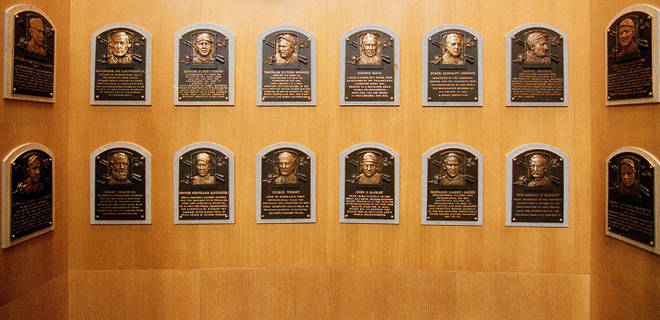
The Hall of Fame Is Not Broken, But It Is Dented

At 2:00 p.m. EST today, the Baseball Writers’ Association of America (BBWAA) announced the winners of its Hall of Fame vote, held by mail in December. The official ballot has been growing in length recently, as the writers have failed to elect or have elected only one former player for several years in a row.

This is because some of the players on the ballot, many of them players with marquee names, are associated with on-the-field performances that may have been influenced by the consumption of performance enhancing drugs (PEDs).

While they were players, Barry BondsRoger ClemensSammy SosaRafael Palmiero (who will not appear on future ballots after today’s vote), Curt SchillingMike PiazzaJeff Bagwell, and Mark McGwire were often described as “first-ballot Hall of Famers,” which is a compliment bestowed on a player to denote not just ordinary Hall of Fame greatness, but the highest level. “So-and-so won’t have to wait to be recognized, he’ll be elected right away.” (The BBWAA voting rules stipulate that five seasons must have elapsed between a player’s final game and their appearance on the ballot.)

Each of the players named above is making a repeat appearance on the ballot. They can never join the pantheon’s pantheon of first-ballot Hall members. They each have one other thing in common: Each one’s name has appeared in either legal documents concerning matters related to PEDs, at worst, or mere blog posts discussing the issue, more frivolously.

Two problems are colliding with the vote this year: 1. The voters are emphasizing one hazily-defined word in their own voting criteria more than they have in the past, and 2.) The BBWAA set an arbitrary rule that voters can only check off a maximum of 10 names on any year’s ballot. (Not that the Hall will limit inductions to a maximum of 10 in a given year–the controversies should there be a tie for tenth place the one time it might happen needed to be avoided–but that any voter, and there are about 550 of them, is limited to voting for a maximum of 10 former players.)

The second problem first: I just listed eight players who are making repeat appearances on the ballot this year, and about four “first-ballot Hall of Fame” players are making their first appearance on the ballot, players whose names have not been associated with PEDs, except in articles in which it is pointed out that their names are not associated with PED use. (The four, according to me, are Greg Maddux, Tom Glavine, Frank Thomas, and either Mike Mussina or Jeff Kent. Look at that “or” there: if I were a voter, I would not be able to limit myself to 10 names.)

The 10-vote maximum rule is an arbitrary one that can easily be remedied if the BBWAA sees fit, and one or two years of allowing more to be included might clear the backlog. The reason(s) for the backlog are not so easily remedied.

The ballot states and has always stated one criteria for election to the Baseball Hall of Fame:

Voting shall be based upon the player’s record, playing ability, integrity, sportsmanship, character, and contributions to the team(s) on which the player played.

Which word do I think is the hazily-defined one? Integrity refers to how the player performed in the game on the field. Did he cheat on the field during games? If a player breaks the integrity of the game in this way, not only will he not get into the Hall, he will more than likely earn a lifetime ban from anything to do with professional baseball, like Pete Rose or the 1919 Chicago White Sox players.

“Character.” I am not the first to consider this word and its place in this particular voting rule. Is the ingestion of PEDs off the field to build up physical strength or speed up recuperation from injuries a character issue? If the chemicals were not taken by every major league player, there is the near-certainty that those players who took PEDs created for themselves an advantage over their rival “clean” players. Further, even if it is a character issue, did it have an impact on the integrity of the games they appeared in?

Many of the baseball writers and Hall voters have found their way into some tangled thickets of logic while trying to connect character and integrity. A few have found integrity by issuing blanket denunciations of the entire “Steroid Era” and not voting for anyone who played in the era. Others have found integrity by voting for the entire slate every year with the reason given that if the entire era was tainted than it was an even playing field for all and certain players excelled to a Hall level on that equal field.

The examples of tangled logic come when certain writers decide to use their ballot to draw distinctions between specific players. I have not yet seen a column or blog post in which someone has written, “Player X is alleged to have only used steroids for three seasons but for the rest of his career he is said to have been clean, while Player Y used them for the majority of his career, so he’s not getting into the Hall,” but they do come close with Barry Bonds.

With Bonds, the standard line has become something like, “He was a Hall of Fame-caliber player before he is alleged to have started using steroids, but then he started using steroids. So he’s out.”

What is a Hall of Fame for? The BBWAA has only one other stipulation about qualification under its “Automatic Election” clause: No election can be based on a single or singular performance, like a perfect game or .400 batting average. That is the only limitation. Other than that, it’s on the field performance. Is a player someone who ticket buyers spent money to see play? (I suggest Nolan Ryan as an example here.) For an extended period of time? If not, did teams keep hiring him to play, season after season for an extended length of time? (Like my pet cause, Tommy John.)

I am in the group that sees the steroid era as having been an even field and am inclined to include in the Hall all the players that excelled in the PED-infested era (which we still appear to be in). All things being equal, certain performers excelled and certain others did not, just like in any other era of the game.

The game’s overseers banned the spitball in the 1920s, as the pitch can give an advantage to the pitcher who uses it over the pitcher who does not. But there are spitball pitchers from the spitball era with plaques in the Hall. It was a different era, so the spitball is handled as a artifact from a period in history that we are no longer in. Sort of like steroids may be in the future.