Daily Prompt: Vote for Not-Him

The WordPress Daily Prompt for August 7 asks, “Tell us about a time you made a false assumption about a person or a place—how did they prove you wrong?”
__________________________________

If you are interested in the horse race nature of American politics, the drop-everything-every-four-years-so-we-can-fill-all-the-jobs-in-Washington portion of our public life, you could do no worse than live in either New Hampshire or Iowa for the year before Election Day. This is because, for reasons I could bore you with but will not, Iowa is the first state in the country to hold a vote for President, in January of election year, and New Hampshire is the second state, usually a week later. (Through the spring and summer of election year, the major political parties conduct state-by-state votes, and the winner of the most votes is sometimes, often, usually that party’s candidate for the national election in November.)

These two states fight very hard every four years to hold their place as first, fight so hard that both states always claim to be first every time, even a week apart, because Iowa uses one type of voting system and New Hampshire a completely different one. So they are both always first. It comes down to money: because they are first, both states receive a quadrennial economic boost unlike any other, with political candidates and their support teams and journalists and their support teams needing food, shelter, television time for months before January. Some nationally famous politicians have rented houses in Iowa to live in and signed year-long leases for the year of door-to-door campaigning they will do. Other states would love to be first in the nation, to attract those millions of dollars, but these two small-population states put up a winning fight with both the Democratic and the Republican parties every four years and get to be first in the nation to cast ballots.

From 2000 to 2004, I lived in Cedar Rapids, Iowa, a city of about 125,000 in a state of three million. A state that is larger than New York State but with one-sixth of the population. So that means that in 2003, I was in the second-largest city in the first of the two “First in the Nation” vote-casting states for Election 2004: Bush v. Kerry. With George W. Bush running for re-election unopposed, it meant that almost every Democrat elected to any office anywhere in the country was campaigning in Iowa.

Cedar Rapids, Iowa. In the foreground is a Quaker Oats factory. My apartment building is the red brick building smack in the middle of the photo, across the highway from Quaker Oats.

Cedar Rapids, Iowa. In the foreground is a Quaker Oats factory. My apartment building is the red brick building smack in the middle of the photo, across the highway from Quaker Oats.

I am a progressive voter, to the left of most Democrats but tending to vote for them. But I also fall head over ballot for every candidate who claims to be the representative from the Land of New Ideas. Rarely do we hear what those New Ideas might be or how much he or she may think they will cost, but I love the idea of New Ideas. Selling New Ideas is an Old Idea, but it gets me every time. And so my life’s list of candidates I have rooted to run for the next office higher than the one they already possessed includes several people named Kennedy, Gary Hart, the late Paul Tsongas, Bill Bradley, and, in 2003, a North Carolina senator named John Edwards. There are others, but I am blushing while typing this.

I should retire my political instincts. Then-Senator Edwards was one of the few politicians I have ever heard speak about rural as well as urban poverty as a blight, a blight because it is a problem that can be tackled. I was inspired. From 2004-’08, it could be said that he pushed the bigger-name candidates to the left (some might think that a good thing), but from 2004-’08 it could also be said that he was doing some other (scandalous) things.

And I met him! And my immediate in-person sense of the man was: “I do not like him.” In January 2004, days before us Democratic Iowans were to cast our first in the nation votes, our so very first votes that New Hampshire was going to be the second first, so stuff it, New England!, just days before that, I saw him speak. Great speech. People are poor. Terrific. Speech over. In the crowded room, we all discovered that that single door entrance over there was now the single door exit for everyone, including the candidate and his handlers, who must hate situations like this in Iowa and New Hampshire. I was next to him for the five minutes it took to leave. He shook my hand—he shook everyone’s hand within reach. I have met a few politicians and I have met quite a few people who ought to run for office, but I have never been rendered invisible quite as quickly as I was by that man. It may qualify as the single most bizarre social encounter I have ever had: I have been dismissed mid-conversation plenty of times, even made to feel that I offended someone, but never looked at like I did not exist.

Perhaps it was the overwhelming crowd and the fact that I did not immediately produce a way out and he was looking for one, or perhaps it was the woman behind me. Or perhaps it was because, a bright man, a good reader of juries in his lawyer life, he felt my instinct to not like him. Or perhaps it was the woman behind me who wanted and received his autograph. I have no idea.

What did I do with this instinct to not like John Edwards? I convinced myself to ignore it and campaigned for him at my caucus site on election night and swung our district over to him. My instinct to ignore my instincts can not be trusted.

News v. ‘News’

The president signed a bill into law today, which is news in and of itself since not much new legislation has made it to his desk in these last two Congresses, but it was the VA bill, a pretty important piece of “gotta fix this now” business. Most news outlets covered the event live, and a live stream even showed up in my Facebook and Twitter feeds (no, not from the White House or the Democrats. From a news organization) so I was aware it was taking place at the moment it was taking place.

It was not so for viewers of one national news channel; that operation had an nearly elderly rock star (Gene Simmons is 64 and is still leading KISS) speaking about global politics, war zones, and the controversial name of an NFL team. I believe “general interest” is what news producers call such a chat, rather than “specific news,” which is what was happening at Fort Belvoir while the president was signing the VA bill there. Simmons was probably on Fox News to plug some book, TV show, or thing, because a Gene Simmons without something to sell is a Gene Simmons we do not see on TV.

And now I have gone and further publicized this by including it in my little blog.

Most news shows tonight will not air the boring footage of a president signing a piece of paper but will instead feature Gene Simmons because he made his points about the name of the Washington Professional Football Team by using some colorful terms, giving us all a “Ha Ha!” moment or a “Shame on Gene Simmons! How old is he nowadays? What color is his hair?” moment. Perhaps someone should get a quote from President Obama about it, in order to keep him in the news.

The Life Cycle of a Retail Idea

The annual corporate image overhaul was usually followed by a frenzy of inaction, no changes outlined or implemented at all. One year, “corporate” decided that its most valuable property was the company’s image as a solution center, the place customers visited to get answers, like spiritual seekers traveling to commune with a lama on a mountaintop. The decades-old reputation of sales associates possessing a broad and deep knowledge base was the asset that was advertised, but the advertising was backed up with no internal education initiatives or local emphasis on, well, anything.

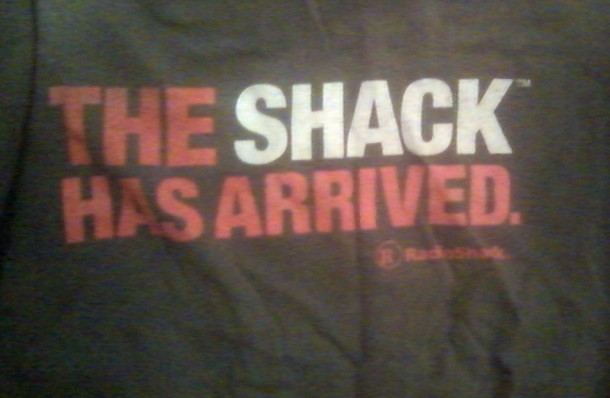
To be a bit nicer about it, I did get a pretty reliable t-shirt that I still wear sometimes, as seen in the photo above.

The latest news from RadioShack—that it is closing about 20% of its stores, that declining sales resulted in a net loss of $400 million in 2013—resulted in a statement that I overheard more than once last week: “Yeah, RadioShack went out of business. They closed yesterday.” It isn’t going out of business, not yet, and not yesterday, but how often do you hear RadioShack’s name come up in water cooler conversation anymore? And if and when you do, for the last several years, the next part of the sentence usually has been “… is going out of business.”

It is difficult to manage news properly when you have spent the last decade attempting to manage expectations.

Like many people, the first personal computer I ever used was a TRS-80 (Tandy Radio Shack-80), on which I learned the BASIC programming language and which we used in some now forgotten way to produce the very first newspaper I wrote, for my junior high school. (We also used a hand-cranked “ditto” machine.) From 1980 till 2005, I did not set foot in a Radio Shack, or give a thought to its stores or its brand. My association with the company was that it was for hobbyists and that I am not one. I bought my first computer from an Apple retailer, my phone from a department store, batteries from the local convenience store. The first and last time that I soldered something, it was not fun and I was a Cub Scout.

Running parallel to my various professional career employments has been my back-up: retail sales associate. In the 1980s, I partly paid for college by working at a Montgomery Ward (now out of business). Through the 1990s, I worked for an independent family-owned bookseller (now out of business). Starting in 2005, I worked at two RadioShacks in two locations, for two very talented managers. I became very fond of RadioShack and its long retail history, and I left the company in 2010. So yes, the only thing these various stores have in common is my employment with them and … well, at least RadioShack is still in business. As of today.

But for how long? In 1986, the Montgomery Ward in which I worked not only sold a lot of everything, but it also had its own cafeteria, so that shoppers, weary of their morning spent spending and ordering and redecorating, did not even have to leave the premises to eat. They could continue shopping after chowing down on a burger. Department store visits were destination shopping experiences, and customers could brand their entire home as Sears or Wards residences; a century ago, one could even buy a house, design plans and material and tools, from those companies’ catalogs. But one could also dash in and pick something up in an emergency—a roll of film or a pack of batteries or light bulbs or a necktie to replace the one with a fresh coffee stain. (I’m just spit-balling ideas here; that never happened to me.)

The malls replaced the department stores as destinations in themselves, plus they threw in a movie theater. Most of the major department stores have closed, except Sears and Kmart, and Sears is considered troubled by analysts and Kmart is continuously restructuring.

For a while, bookstores grew into destination experiences in the way they combined music sections with huge periodical collections and more than a few books. But by the mid-1990s, online retailers were beginning to attract attention—well, Amazon was—as well as a piece of the retail dollar. Many online retailers retain one’s entire purchase history; Amazon shows that my first purchase with it was made in 1998. At around that time, I first heard a customer reply to the information that a book was not in stock with this sentence: “I’ll drive over to Amazon and get it there.” When my colleagues and I would politely offer the information that no such thing as “an Amazon store” existed, they would correct us in return and say that they had been there the night before.

“Amazon” had come to mean “the big Barnes & Noble in the next town” for our customers, and Barnes & Noble was in trouble because of this association, too. Amazon has never had a physical store, and each retail operation that earns all 100 cents of its sales dollar from sales completed in real stores on real streets with real employees and real customers has been flummoxed for 15 years by this fact. Almost every bookstore tried to establish a dot.com enterprise only to discover—shortly after their customers discovered this first—that fulfillment meant getting the book that had been ordered into the store for the customer to pick up. And if the customers were going to visit the store for the privilege of paying shipping for a book that, if only you had stocked it there would have been no shipping charge, well, customers were going to find an alternative, like paying for shipping to their doorstep and not visiting your store.

The speed with which the book selling sector collapsed—Waldenbooks, Borders, hundreds if not thousands of independent booksellers—has only recently been rivaled. By the electronics sector.

And again, it is a combination of what was revolutionary about Amazon (and Walmart) combined with some baffling decisions and perplexing identity crises by electronics stores. The numbers are staggering, as pointed out in this Atlantic Monthly article:

RadioShack’s long slide coincides [with] the steep ascendance of Amazon as America’s great brick-and-mortar destroyer. In 2003, Amazon and RadioShack each had about $5 billion in sales, as WSJ business editor Dennis Berman pointed out. Last year, Amazon had $75 billion to RadioShack’s $3.5 billion.

Some further comparison is illuminating: At the end of 2013, RadioShack had 5,000 brick-and-mortar stores with 27,500 employees and $3.5 billion in sales, which is $127,000 in sales per employee. Its website is the 1,066th most popular in the world. At the end of 2013, Amazon had zero brick-and-mortar stores with 117,300 employees (full- and part-time) and $75 billion in sales, which is $640,000 in sales per employee.

Once upon a time, a decade ago, RadioShack and Amazon were the same size. But RadioShack has had six logos and changed its name twice since the late 1990s. Its annual Christmas advertising blitz has included gimmicks like casting Shaquille O’Neal as a spokesman, promoting itself as the public’s wireless destination, installing Amazon.com “fulfillment lockers” in stores (so Amazon customers who did not want things shipped to their homes could have them shipped to their local RadioShack (!) just to bring customers into the stores), and, it is worth repeating, decisively changing its name to “The Shack” and then decisively back. More than one writer has pointed out that “RadioShack.com” is an oxymoron and is also the history of technology in one mouthful. This year, during the most-watched Super Bowl in history, viewers saw the company make fun of itself in a way that won the company a lot of affection but probably not one single new customer.

In fact, according to the Wall Street Journal’s online publication, MarketWatch, “On March 4, RadioShack’s ‘consumer perception’ among American adults who made a purchase in the store within the previous 90 days was just 8%, according to an analysis carried out for MarketWatch by YouGov BrandIndex.” In English, of those people who recently spent real money in a real RadioShack, only 8% were aware of RadioShack as an anything. For comparison, Best Buy gets a 22% customer perception rating. So the amusing ad did nothing except declare that, yes, we know you know we think we are out-of-touch, but, um, we won’t be like that anymore. “Come see what’s possible when we do things together,” is the new slogan. Are you asking me or telling me? Um, “things?”

What do all the recent headlines generated by the news of RadioShack’s imminent imminence mean, really? What are we telling ourselves about what we think we are (maybe) going to miss, if 92% of RadioShack’s actual money-spending customers were not even aware they spent that money in a RadioShack? Most of the business analyst articles are not about the changing face of retail in the face of a hundred-year-old company’s demise but head-shaking premature obituaries, neither musings about ways forward for the company nor attempts to explain how RadioShack has managed to stay alive after so many previous obits.

RadioShack is the company whose image for more than a decade has been “the store that thinks you need to be reminded of its image.” Sometimes the R is sans serif and sometimes it is serif, sometimes we are “The Shack” and sometimes … when a company does not know why it is in business, just that it wants to remain in business, it closes, sometimes quickly, sometimes slowly.

It will always de-materialize if you don’t work for it.