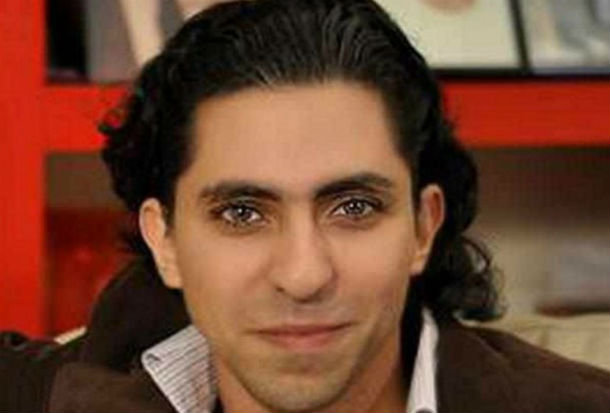
A couple weeks ago I wrote about the plight of an activist and blogger named Raif Badawi, who was arrested and found guilty of insulting his country’s religion and sentenced to 20 straight weeks of public whipping, among other punishments. (“For Raif Badawi.”)
As I wrote nine days ago, the first set of fifty blows against him was delivered three Fridays ago, just before the weekly call to prayers in Jeddah, Saudia Arabia. Cellphone videos showed some of the whipping.
Word is out today that for the second week in a row, the authorities have decided to postpone Friday’s series of fifty lashes. His health may be at risk, according to an update on Amnesty International’s website (“Doctors find Raif Badawi unfit for flogging“), so this week’s flogging has been put off: Read More
41.401884-74.321252
Thank you for sharing this via one of these wonderful services:
The bitter angels of our nature are sometimes easier to hear. Sometimes, the words chosen and spoken by the “better angels of our nature,” the peace-lovers among us, are heard by the bitter angels as bitter. That is insidious.
When President Lincoln delivered his first inaugural address, from which we get the phrase, “better angels of our nature,” there was little he could have said or done that would have averted the Civil War; there was no guarantee the war was going to happen, but enough people were looking for the fight rather than looking for areas of agreement that the war was minutes instead of hours or months away. (Some states wanted to leave—and had already formed a new country—and the remaining states did not want them to leave but did not want them to stay in the Union with slavery as a part of their economy, so there were few areas of agreement.) Once an anti-slavery, pro-Union Republican (a new political party) was elected president, secession began, and war looked ever closer.
Lincoln dedicated his speech to explaining that secession was logically impossible, since a Union is a union, and promising that the federal government would not fire unless fired upon (which happened a couple weeks later, at Fort Sumter).
He concluded his address with an emotionally stirring paragraph, beginning with this plaintive sentence: “I am loath to close.” He did not want to end the speech. It was almost like he believed that, the longer he talked, the longer the Union would remain. But he went ahead and finished with these famous words:
We are not enemies, but friends. We must not be enemies. Though passion may have strained it must not break our bonds of affection. The mystic chords of memory, stretching from every battlefield and patriot grave to every living heart and hearthstone all over this broad land, will yet swell the chorus of the Union, when again touched, as surely they will be, by the better angels of our nature.
There was no response from the states that had seceded, official or otherwise, until the attack on Fort Sumter. That was their reply, and then the war was on. Those southern newspapers that deigned to report on the new president’s first speech focused on his “threats” (their word) to preserve the Union and ignored or insulted the concluding sentences. Northern newspapers apparently highlighted the “better angels” passage.
(I have an acquaintance who believes himself to be a Southerner more than an American and refuses to allow pennies in his house, because “that man” is depicted on them. It would be comical, except for it not being funny at all.)
Selective listening, in effect, means that people hear what they expect and perhaps want to hear. All people listen selectively, hearing only part of any message. In the case of Lincoln’s Inaugural, one could expect a great deal of selective listening because the situation was marked by a high degree of prejudice and because Lincoln had said little to counter these prejudiced views. Many of the editorials evaluating the Inaugural Address support the view that selective listening and selective perception help account for the divergent reactions to the speech. Northern and Southern editorials tended to quote different portions of the speech: Northern editorials usually quoted the speech’s conciliatory peroration, while Southern editorials usually quoted Lincoln’s forceful statements about how he would treat the South.
“Selective listening” is an enormous phrase. I saw it in all its power recently. A friend who was important to me started to express opinions that I found offensive; I struggled to find the words to express my discomfort—this friend was not attacking me personally, after all, so why complain? There must be some reason behind what I felt was ugliness coming from my friend, I thought. I wrote to him, explained that I was not going to attempt to change his opinion, that I did not need an explanation in return nor did I want a debate, but that I simply needed to express my discomfort and for that to be accepted so we could move on to happier conversations. Even if my friend simply expressed discomfort with my discomfort, I would have been fine. (“Agree to disagree,” as they say.)
I hoped my better angels were present. The issue happened to be about social unfairness and race and recent events in the news, an issue I have written about before—in “Guilty of White” —and will again, and my friend responded with a photo of himself with people of color, as if such a thing could even be a response. (I restrained myself and did not write this: “Okay, fine. You have African-American friends. Have you shared with them what I have been reading from you? How well has that been going?”) A joke that I will not reprint followed from my friend; it was at about the same level of emotional maturity as not allowing pennies in one’s house. I have walked away from that friendship, grateful that I learned a lesson, but I am still not certain what that lesson was or is, because this is a friend who tended (tends) to find better angels in almost every circumstance. I was and am confused.
My friend read my expression of discomfort as an attack that needed to be rebuffed; it is sad. Was I selectively hearing his anger as hate? Was he selectively hearing me attacking him? Both at the same time?
There is a line I can not cross just so I can say that I am friends with all sorts of individuals, even intolerant people who insist on being tolerated.
____________________________________________ The WordPress Daily Prompt for January 16 asks, “Do you have a good friend or close relative with whom you disagree on a major issue (political, personal, cultural)? What’s the issue, and how do you make the relationship work?”
A young journalist and activist has been in jail since 2012 for the crime of insulting his country’s official religion. Sadly, that sentence can be written about dozens, perhaps hundreds, of writers worldwide, but only one writer—one writer that we know about—was publicly flogged this weekend.
This was the very same weekend that government leaders from around the world joined a million-person anti-terrorism march in Paris. The march was the emotional punctuation mark that concluded a sad stretch of days in that city. Days earlier, a group of mass murderers who were deluded into thinking that murder is a religious act massacred the staff of an irreverent humor magazine and killed two police officers, one of whom nominally shared the religion of the killers. The killers and the police officer only shared a religion in name, as the killers believed in murder as an act of faith and the police officer did not.
Raif Badawi is the name of the journalist, and he has been living in a Kafka-esque dreamscape of religion-as-part-of-state-bureaucracy since 2008. In May of last year, he was sentenced to ten years in prison and 1000 lashes, which are to be meted out in sets of 50 lashes each Friday for 20 weeks. For over a year, his sentence has been publicly changed multiple times between six years and 600 lashes and ten years/1000 lashes while his case bounced between a higher court and a lower court in his country’s legal system.
His country is Saudi Arabia, and as a citizen of the United States, I am aware that I have no say in the legal system or traditions of another country’s bureaucracy; I can only write this column to implore my government to at least say something to one of its allies in the name of a fellow writer and the freedom of ideas. I have written in the past about things I do not like about my country, its use of capital punishment, for instance, and I vote my conscience on these issues, In another country, I might have been arrested for expressing my views, but it has not happened here.
Amnesty International, Reporters without Borders, the Committee to Protect Journalists, Human Rights Watch, PEN International, and many other organizations have taken up Badawi’s cause, possibly in part because of its clear-cut blatancy: A man is being publicly flogged because he is a writer and has expressed ideas his government would rather he not.
A brief sketch of his journey so far: In 2008, he set up a website, a blog named “Saudi Arabian Liberals,” and he was arrested, questioned, and released. He was then charged with insulting Islam, left the country, was told the charges were being dropped, returned home, and then was blocked from leaving the country again, which is never an indication of good things to come. The web site continued, and he was arrested again in 2012 when a religious leader said that his website “infringes on religious values” and proved that he is an apostate, or one who renounces his religion. Apostasy carries with it a sentence of death, and that legal question—is Raif Badawi an apostate or not?—is what has kept his case bouncing between courts in Jeddah, Saudi Arabia. A lower court declared that it did not have the authority to decide and referred the case to a higher court which decided that the lower court could indeed decide if Badawi is an apostate.
He was cleared of the apostasy charge, which freed the courts to sentence him for the charges he was found guilty of from pretty much the moment he was arrested in 2012: insulting the faith and “going beyond the realm of obedience.” Ten years in prison, 1000 lashes, and a one million riyal fine. And his lawyer, Waleed Abu al-Khair , was arrested and found guilty of setting up a human rights monitor organization, which landed him a 15-year jail sentence.
On Friday, Amnesty International published an in-person account of that day’s flogging:
When the worshipers saw the police van outside the mosque, they knew someone would be flogged today.
They gathered in a circle. Passers-by joined them and the crowd grew. But no one knew why the man brought forward was about to be punished. Is he a killer, they asked? A criminal? Does he not pray?
Raif Badawi had been brought to the square in front of al-Jafali mosque in Jeddah just after midday. There was a huge security presence–not just accompanying Raif but also in the streets and around the mosque. Some roads had also been closed.
Raif was escorted from a bus and placed in the middle of the crowd, guarded by eight or nine officers. He was handcuffed and shackled but his face was not covered – everyone could see his face.
Still shackled, Raif stood up in the middle of the crowd. He was dressed in a pair of trousers and a shirt.
A security officer approached him from behind with a huge cane and started beating him.
Raif raised his head towards the sky, closing his eyes and arching his back. He was silent, but you could tell from his face and his body that he was in real pain.
The officer beat Raif on his back and legs, counting the lashes until they reached 50.
The punishment took about 5 minutes. It was very quick, with no break in between lashes.
When it was over, the crowd shouted, “Allah-hu Akbar! Allah-hu Akbar!”–as if Raif had been purified.
Raif was taken away in the bus, back to prison. The whole scene had lasted less than half an hour.
A brief cellphone video was made public, and it shows that the punishment is almost as much “a ritualized public humiliation as a specifically physical punishment (though it is certainly that),” as Nick Gillespie of Reason put it. The video is brief, and I hesitated to include it because it is disturbing and because if you go to YouTube to view it, people who comment on YouTube videos can be astonishingly disgusting.
The juxtaposition of a nation publicly flogging a prisoner of conscience and that country sending an envoy to Sunday’s anti-terror march was not lost on one journalist, who Tweeted almost two dozen similar examples of irony:
The Washington Post’s editorial page on Saturday pointed out that those who are outraged have limits on what we can do, since:
The Obama administration briefly on Thursday called on Saudi Arabia to cancel the flogging of Mr. Badawi. On Friday the kingdom ignored the plea and carried out the first of the 50 whippings. So much for strong language from the State Department. It had no impact because it came with no consequences.
The editorial suggested an international investigation into Saudi Arabia’s human rights record, which sounds as toothless as anything that will never happen would sound.
But that is the reality: The U.S. government raised its voice to slightly above a whisper on behalf of one man (not a U.S. citizen) in a different country’s bureaucracy and … crickets. Which is the same non-response our government would give (and gives) if that country formally and diplomatically complained about anything in our system of jurisprudence here.
All I can do as one person, one writer is this: Share the story and some web sites with readers in the hope that someone else will also use their writing voice, their platform. The Committee to Protect Journalists reports that last year some 200 reporters were jailed around the world. Many of these reporters are electronic media writers, also known as bloggers, like you and me.
My only hope is that someday Raif Badawi will be able to read the many columns out there like this one and, true to his calling, point out that there are a lot of other reporters around the world who need columns like this one written, marches organized, and petitions circulated about their stories.
____________________________________________ The WordPress Daily Prompt for January 12 asks, “Picture the one person in the world you really wish were reading your blog. Write her or him a letter.”


 The Gad About Town