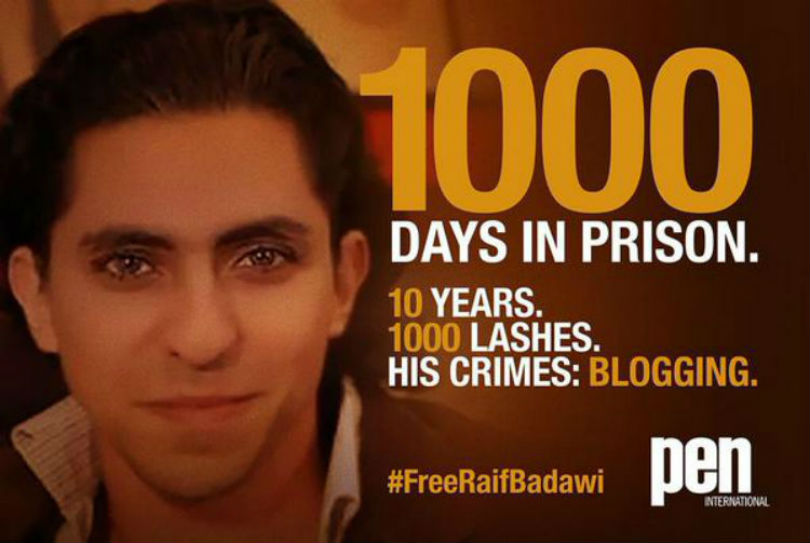
#RaifBadawi and Official Cruelty

The Kingdom of Saudi Arabia gave an official response this week to criticism of its sentence of flogging for writer Raif Badawi. The Kingdom of Saudi Arabia responded to Amnesty International, Prince Charles, the German foreign minister, the Canadian foreign minister, the millions of petition creators and signers around the world, the tens of thousands who have marched in protest of a country’s policy of whipping as a punishment for writing. The Kingdom of Saudi Arabia delivered a response to a young woman and mother of three whose husband has been sentenced to a caning for writing.

The Kingdom of Saudi Arabia wants us to know that it is angry about the criticism, does not like it even one bit, and would like us all to mind our own business. In more diplomatic language, it released an anonymous statement which said in part: “Saudi Arabia expresses its intense surprise and dismay at what is being reported by some media about the case of citizen Raif Badawi and his sentence. Saudi Arabia at the same time emphasises that it does not accept interference in any form in its internal affairs.”

It took a visit from the German foreign minister to elicit this cold response. The only response that could have been even more cruel, a Friday flogging of the writer this morning, the same week as the official statement was released, did not take place:

The fact that I am celebrating the absence of that response this one week, the “see? we told you not to interfere” response that all abusers know to deploy on occasion, underlines the sad state of this affair. Here we see the abuser blame the victim for causing them the hassle of abusing them. Other people were flogged publicly today in Jeddah, Saudi Arabia, some for the crime of having ideas; one writer just happened to not be a part of the parade this morning.
Read More

#RaifBadawi Remains a Prisoner

For the eighth week in a row, Saudi writer, blogger, and activist Raif Badawi was not publicly flogged fifty times today for insulting his home country’s state religion. His official Twitter account broke the news as soon as it was confirmed:

No one is breathing a sigh of relief that this counts as sparing him, or that he is about to be freed. The 31-year-old husband and father has now spent 1000 days and two weeks in jail with little to no contact with the outside world. According to news reports, there was no reason given by Saudi officials for the delay.

Worse, his family is reporting that Raif may be about to face a re-trial on the charge of apostasy (renouncing one’s religion). If found guilty, he is to be publicly executed. Beheaded. He has been found innocent of this charge in the past, which is how and why weekly updates about his punishment for insulting his religion can even be written. Elham Manea, a passionate writer about human rights abuses, released a statement on behalf of his family:

Amnesty International’s press office also reported today that it has been denied access to Raif Badawi:

Read More

‘Day by day’: Rare Disease Day 2015

“Day-by-day, hand-in-hand.” Today, February 28, is International Rare Disease Day, and “Day by day, hand in hand” is this year’s slogan. As slogans go, “#TheDress” might have received more attention today, but tomorrow the world will not remember this week’s Twitter trends and millions of people will still be living day by day with rare diseases.

Rare Disease Day was first established in 2008 by EURODIS, the European Rare Disease Organization. In 2009, the National Organization for Rare Disorders (NORD) in the United States joined the effort to educate the public. This year’s theme is “Living with a Rare Disease.” Some rare diseases are life-shortening, and even kill in infancy. All of them are life-altering.

Once upon a time, rare diseases were called “orphan diseases,” and, really, neither term alone quite conveys the concept. One rare disease may affect only a few individuals, making it something that is rarely seen; diseases and conditions that affect just a few people are sometimes viewed as research dead ends, “orphans” in drug and treatment research. The medical industry wants to aid the greatest number of people, and research money is hard to win for research into a condition that affects only a few thousand individuals.

Rare is not so rare, however. There are about 6000 rare diseases that are officially recognized as such; since each one affects (by definition) fewer than but up to 200,000 people per condition, some researchers estimate that 300 million people around the globe have a rare disease. That is about one in 25 people on the planet.

If you visit a restaurant tonight or go see a movie, a couple of us with a rare disease are hanging out with you. Hello.
Read More