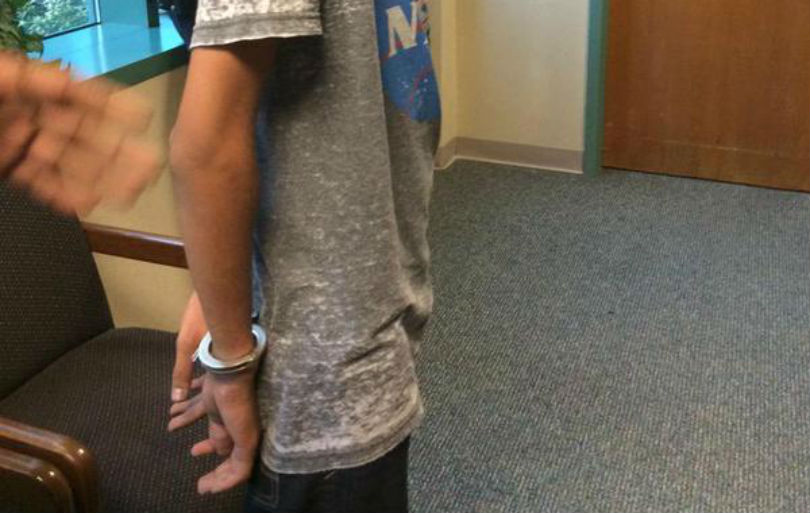
#IStandWithAhmed

They handcuffed the kid.

I for one remember being 14 years old: I spent it overwhelmed. In junior high (7th and 8th grades in my school district at the time), my general proficiency at the whole learning thing bit me where it hurt the most: my ego. My success in 7th grade placed me in advanced classes the next school year that even carried the letter “X” in their name to signify their specialness. “English 8X,” and such.

It overwhelmed me. “Math 8X” was algebra delivered one year early and some geometry offered up two years early, and I nearly flunked. I liked my side projects too much: I wrote all the time, more than was expected or required in my English class by my English teacher, because that is what a 14-year-old who likes a certain subject in school does. I would bring my extra work into class to show my teacher because I could not not think about Math and Science enough that year. My teacher was bright enough to let me read my work in front of class to help me along, because I suspect she knew that my fragile ego needed to know that there indeed were things I could do well.

So I understand Ahmed Mohamed, a 14-year-old at MacArthur High School, near Dallas, Texas. He is the opposite of me: he loves science and engineering and devotes whatever extra time he has to tinkering and building things. On Monday, he brought in to school something he had thrown together in 20 minutes: a clock. He was arrested, led out of school in handcuffs by five police officers, and given a three-day suspension, which he is still serving. He was spared spending any time in jail, but he was fingerprinted and locked up in the Irving juvenile detention center. Here is the moment of his arrest (please notice the NASA t-shirt):
Read More


A Farce in Egypt

The judge “bellowed” the verdict against the three journalists today, according to reports. He announced that the three were found guilty and sentenced them to three years in jail. Mohamed Fahmy, Baher Mohamed, and Peter Greste already spent more than 400 days in prison in Egypt after being arrested for “spreading false news” while working for al-Jazeera English.

The three have already been convicted, retried, acquitted, retried again. Greste, an Australian, was deported last year.

Judge Hassan Farid declared today that the court had determined that the defendants are not journalists as they are not members of Egypt’s “Journalists Syndicate,” nor had they registered with a national agency that grants foreign reporters permits to work in the country. Thus, since they are not officially journalists, they were working against the government. They had been convicted in a first trial in 2014, sentenced to seven years in prison each, retried, acquitted, retried again, and convicted again today. Another retrial is being worked on but the earliest it can start is 2016.
Read More

A Shooting in Virginia

Vulnerable. Reporters are vulnerable. The camera lens and a notepad do not stop bullets. It was the first lesson I learned, inadvertently of course, when I started to work as a newspaper reporter, two decades ago.

By now, the entire country knows what happened today in southern Virginia. In an on-air moment that reads like the script treatment for a prime-time television crime show, a disgruntled former on-air personality barged into live coverage of a minor news story (an anniversary somewhere, a chamber of commerce-type story) that was being broadcast on the local station’s morning news show and shot and killed the on-air reporter and her cameraman and injured the woman being interviewed. From his position on the ground, the fallen cameraman turned his camera to face the shooter, and the image he broadcast made the shooter’s face known; it may be that the mortally injured cameraman’s last living act was one more report from the scene. Morning show viewers saw it live.

In the studio, the broadcast news staff of WDBJ7, a CBS affiliate, watched powerlessly and yet picked up the story, which now had three victims. In shock, they carried on. I watched for about an hour at noon and everyone there was doing amazing work. There will be a news conference at 2:00 p.m.

The reporter was named Alison Parker; she was 24 years old and had recently gotten engaged to be married to another young WDBJ reporter. The cameraman, Adam Ward, was 27. He was engaged to be married as well and today was to be his last day at WDBJ; his fiancee was in the production studio doing her job when she watched her boyfriend get shot.

Read More