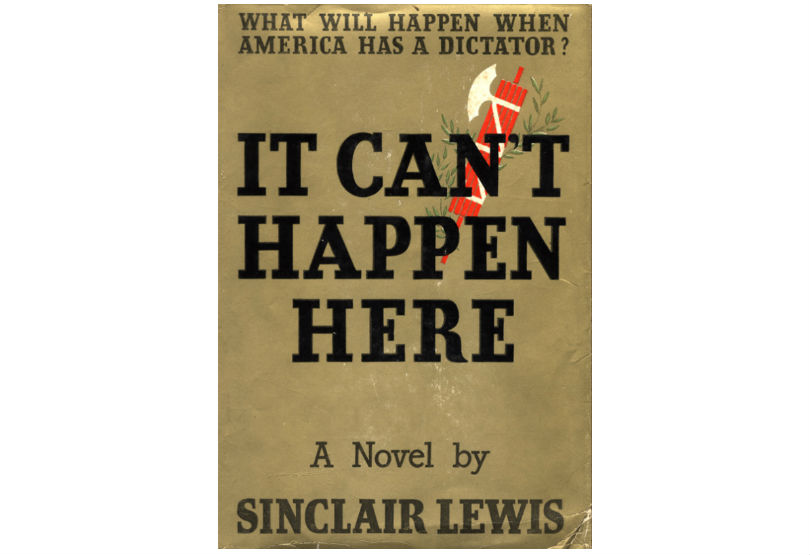
It Can’t Happen Here, Can It?

Certain though Doremus had been of Windrip’s election, the event was like the long-dreaded passing of a friend. “All right. Hell with this country, if it’s like that.”—Sinclair Lewis, It Can’t Happen Here

The title begs the question: what is the “It” that can’t happen here? The free, democratic election of a fascist (lowercase F, even though any difference in degree or style of fascism is truly no difference at all)? Or any movement to resist it after it takes power?

Sinclair Lewis gives one succinct answer at the end of the second chapter of his 1935 novel It Can’t Happen Here: “The hell it can’t.” In the chapter, several of the leading lights of life in fictional Fort Beulah, Vermont, are conversing and considering the campaign promises of U.S. Senator Buzz Windrip, who is considering a run for the Democratic Party nomination against President Franklin Roosevelt.
Read More

I’m with the Banned

Some thoughts on freedom of speech …

In an ideal world, there would be no need for the phrase, “In an ideal world.”

We do not reside in an ideal world.
Read More

A Generous Dose of Hate

“If you’re black and you haven’t been successful in the last 50 years, it’s your own fault. You’ve had every opportunity, it was given to you. You’ve had the same schools everybody else went to. You had benefits to go to college that white kids didn’t have. You had all the advantages and didn’t take advantage of it. It’s not our fault, certainly.”—Kathy Miller, former coordinator for the Donald Trump campaign in Mahoning County, Ohio, this week. She resigned upon being quoted and called her remarks “inappropriate.” (What aspect of the statement qualified it as “inappropriate,” she left a mystery.)

“Look at what’s happening in the world today. The blacks are getting uppity again. I don’t know why, but it’s scary again.”—a personal acquaintance of mine, explaining why he has started carrying a gun again here in Orange County, New York.

Two decades ago, I worked for a weekly newspaper. Even though it was a small-circulation publication, the fact that we ran a “Letters to the Editor” section meant that we received letters. Lots and lots of letters. Our editorial policy was simple: no profanity or personal abuse.

I, a young assistant editor at the time, did not understand this simple policy, because the letters were often awful, hate-filled documents, even when they were free of profanity and free of personal abuse. My boss, the editor of the newspaper, explained that these individuals wanted their thoughts exposed, after all, and we were helping to expose them. “Let them show the world what it looks like,” was her reply to me concerning one letter’s ugly racism. “It is better when they (racists) are out in the open.” Absent profanity, I was not to edit, “clean up,” or not publish the letters.
Read More