2024 (Covid’s Version)

My brain was producing a redacted document, live.

* * * *
There does not need to be a term more precise for the phenomenon of brain fog than “brain fog.” Of course, one may want to quantify things, determine a precise number with a decimal point and a percentage sign to let people know that under this number one does not have brain fog, but above it … hoo boy! Above this percentage point, one should not be able to complete, you know, those things that people write. You know, sentences!

I spent most of 2024 in a case of brain fog. It relented in August, eight months after my first and so far only case of Covid. I do not know how bad a case of post-Covid brain fog I lived with this year, and medicine does not have a firm, numbers-with-a decimal-point-and-percentage mark grasp on the phenomenon at this point anyway. I still have it, a little, and I now consider brain fog to be a part of what I refer to as me, like my gray hair.

Physicians around the world started to publish papers in 2020 that describe and measure cognitive deficits patients encounter thanks to Covid; patients score lower on IQ tests while sick and also after, and some patients of a certain age (around my age: mid-to-late 50s) exhibit symptoms of early-onset dementia post-Covid. Those who have contracted Covid more than once display even more serious cognitive troubles. The library of peer-reviewed articles in medical journals about the nervous system problems experienced during and after Covid grows each day. I do not have a comprehensive list, but there are many social media accounts that compile the articles, and I can direct anyone who is curious to those. The articles are cautious, as they should be, yet all describe a condition that is still only partly understood. Millions of people who have had COVID have suffered cognitive deficits if not declines.

I do not know if I am one of those cases. I only know what I experienced this year. I only know that until August I sometimes had trouble following what people said to me and what I read, and that when I started a sentence, both in conversation and at the keyboard, it felt like an adventure to reach the end.
Read More
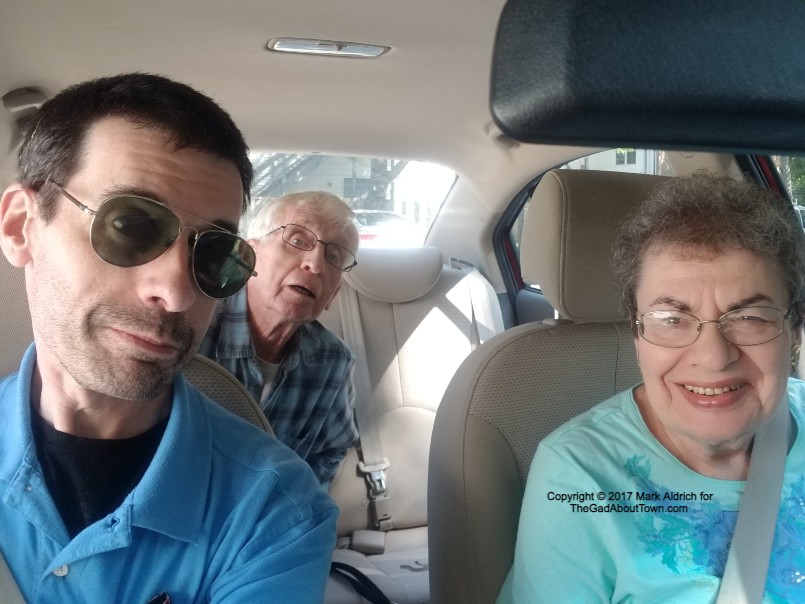
‘In Dreams Begin …’

We tried to take a selfie recently, my parents and I, with a copy of the book, Who We Lost, held in my hand. The book will be published on May 9, and an essay by me appears in it, which marks the first time something I wrote will be published in a book. We were all happy about it. My parents’ pride was palpable.

Each photo we tried to take with my phone presented a new variation on the same problem: my dad was somehow out of the frame each time. We all laughed at this, and then I woke up. Of course my dad cannot appear in a photo with a copy of a book in which his death from COVID on May 10, 2020, is the starting point to my essay in the book. (Spoiler alert, I guess.)

My psychological makeup is deeply literal, even in my dreamlife. “Logic” is one of the words in the phrase, “emotional logic,” after all, and even if I wish I could take a selfie with both of my parents again, I can’t. At the top is a photo of my parents, Bob and Rena, and me from 2017.
Read More

Who We Lost and ‘Who We Lost’

An anthology of essays by individuals who lost loved ones to Covid, Who We Lost, edited by Martha Greenwald, will be published on May 9, 2023, by Belt Publishing. An essay that I wrote specifically for this volume is included. Order your copy now from the publisher and booksellers everywhere. (Support your independent bookseller!)

* * * *
After my father died of COVID-19 in May 2020, I have followed various groups online that advocate for those of us who lost loved ones in the ongoing pandemic and for those who advocate for justice as well as for preparation for the next pandemic, as there certainly will be one.

There are many memorial groups, more than I know of, I think. There is a movement to establish a national Covid memorial day for the victims, on the first Monday each March, which has attracted the support of senators Elizabeth Warren and Ed Markey and representatives including Greg Stanton. There is a design proposal and plan for a gasp-inducing and beautiful virtual Covid monument:

The most effective have been those that collect stories, those that ask us to look beyond the mind-numbing and sometimes overwhelming statistics and instead see that each number is a story of a full life cut short, those that invite us to meet and honor those we lost.
Read More