The WordPress Daily Prompt for August 23 asks, “What’s the first line of the last song you listened to (on the radio, on your music player, or anywhere else)? Use it as the first sentence of your post.” __________________________________
I saw some people starving
There was murder, there was rape
Their villages were burning
They were trying to escape
I couldn’t meet their glances
I was staring at my shoes
It was acid, it was tragic
It was almost like the blues
“Almost Like the Blues” is the first song Leonard Cohen has put out in advance of the release on September 23 of his 13th studio album Popular Problems. Cohen will turn 80 on September 21. No tour has been announced.
Have an enjoyable weekend, friends.
41.402038-74.324319
Thank you for sharing this via one of these wonderful services:
Each one of us is a part of an interest group. This does not mean each of us must carry out the duties of being an official representative of said interest group, but, for example, I might be the only Jewish person you know. As such, I try to be a good guy and hope that this represents.
(I have been that one before, actually—when I lived in the Midwest—and had some fun with it. Not that there are not Jewish people in Iowa, but one couple that I got to know had not met one or claimed to have not. Which makes me a member of another special interest group: I may be the only Jewish person you know who was the first Jewish person someone met!)
I am male, middle aged, half-Jewish, half-Baptist, an alcoholic in recovery, tall, thin, and I have a disease that is disabling me. It might be Friedreich’s ataxia or it might be and probably is spinal muscular atrophy, type 4. Do any of these things merit me tapping on your shoulder and requesting attention from your charitable impulses? Or your attention at all?
The WordPress Daily Prompt for August 20 asks, “The internet has recently been swept up by the ALS Ice Bucket Challenge. Is there a cause—social, political, cultural, or other—you passionately believe in? Tell us how you got involved—or why you don’t get involved.” The Daily Post helpfully provided a link to the ALS web page, but I also linked to an article explaining the “ice bucket challenge.”
I have seen this meme almost as frequently as I have seen videos of people dumping water on their heads. It is an old photo and is often repurposed to make fun of Americans.
This will be remembered as the summer of the “ice bucket challenge,” and after a few weeks of popularity, the backlash has begun. The plethora of videos of people, famous and not, giving a 15-second speech about amyotrophic lateral sclerosis, also known in the US as “Lou Gehrig’s Disease,” and then dumping a bucket of ice cubes and water on themselves “for charity” has led to memes attacking the popularity of the challenge, accusations of “slacktivism,” and some generalized online booing. When we look back at the ice bucket charity awareness campaign, in our heads we will hear someone say, “2014” and “I wonder whatever happened with that? Did they cure … what was it about again?”
Amyotrophic lateral sclerosis (ALS) is a rare disease. There are almost 7000 rare diseases, so approximately 30 million Americans, or 1 in 10, suffer from, cope with, accept, or fight against (sometimes all of these in a matter of an hour) a rare disease. A rare disease, as a concept, is not such a rare thing. If you know 10 people, you know a person with one. Multiple sclerosis and Alzheimer’s are also common rare diseases, a phrase I wish did not exist. And then there are the many, many forms of cancer, a disease that one can not wish—or work—hard enough to make it become rare.
It is not precisely known who started the ice bucket challenge or when, only that it started very recently, in 2014, and it was not about one particular health issue awareness charity. An early version, in New Zealand, was about cancer. (Because it is winter in New Zealand right now, the web site has a warning about doing the challenge outdoors.) A couple people in the United States adapted it to raise funds for ALS research and awareness. It took off from there.
Most of us are not medical researchers but most of us have known or do know someone with a illness or condition. Whether it is cancer, heart disease, or a rare disease, chronic or life-altering illness touches many of us and thus many of us know the powerless feeling that comes upon hearing such a diagnosis. We want to do something about it but we are not doctors. It is frustrating. I have seen the look in my mother’s eyes when talking about my disability. She hates the idea that I have something that she can do nothing about, like cook some chicken soup.
So we raise money for the charities that have been established to support the researchers who might possibly find the cure for the disease that affects your family member or friend. Almost every disease has a support community and researchers devoting time to study—at minimum—palliative care, or to even find cures. And that is where any controversy lies: How do I know that the dollar I donated is going towards a cure instead of merely buying lunch for the people who answer the phones and take the donations? The answer is, you don’t. As long as a charity makes its expenses public, I know that some of my donation may be buying lunch. I hope they are eating healthy. But I also know that some of my donation may be paying for the science-y stuff like test tubes, beakers, and a cure.
As with anything that has become popular suddenly, like a dance craze or a catch phrase, sometimes some part gets overlooked. Is everyone who is posting a video of themselves getting wet and icy explaining how to donate to the charity? Is every video participant in fact donating to the charity that they are raising awareness for? Some are not. Some have misinterpreted the whole thing as, “Get wet to not donate and challenge others to get wet, too.” That is “slacktivism,” but even slacktivism serves a public awareness purpose. There is no such thing as the social media police, even if I wish there was, so some people are simply showing off that they do not know what they are doing. The internet is good for that. The dollar that they do not spend on the charity they are not raising funds for is not a dollar that is making people sicker. They are merely getting wet.
ALS is a progressive, neurodegenerative disease that affects the nerve cells in the brain and spine. These cells deteriorate and die and stop sending messages to muscles anywhere and eventually everywhere in the body. The muscles atrophy and paralysis follows. It can strike at any age, and it can kill quickly.
Here is where my personal special interest group membership comes into play: The motor neurons in my spinal cord are deteriorating and dying and messages are no longer being sent or received in the muscles in my legs, which are slowly atrophying. I have a form of spinal muscle atrophy called “adult onset” or Type 4, and there are many links between SMA and ALS. They are siblings in the motor neuron disease family.
The majority of SMA patients are infants and children, so the majority of SMA patients are voiceless. (Here is a great blog written by a passionate activist with SMA: “Living with Spinal Muscular Atrophy.”) SMA is the number one genetic killer of infants. Few of us are adults. Those of us who are adults owe it to the children born with this disease to help find a cure. Any progress made in finding a cure for SMA will most likely be applicable to also finding a cure for ALS, and vice versa. They are that close in their origin and symptoms.
So if and when someone on Facebook or Twitter challenges you to dump a bucket of ice water on your head for charity, and believe me, they will, take up the challenge, mention ALS and SMA in the same breath, include the websites you want to benefit (ALS and SMA), and dump the water. And then donate to one or to both. Don’t be a slacktivist. Chris Mosher, below, used the challenge to bring attention to both diseases:
41.445927-74.422934
Thank you for sharing this via one of these wonderful services:
The WordPress Daily Prompt for August 17 asks, “Take a look at your bookcase. If you had enough free time, which book would be the first one you’d like to reread? Why?” __________________________________
On re-visiting Cape Cod this weekend, I remembered a favorite book, Henry Beston‘s “The Outermost House,” and decided to re-read it. I have not looked in its pages for 20 years and no longer own a copy. This sad situation was remedied with the money in my wallet being accepted at Yellow Umbrella Books. Since I was on vacation on Cape Cod, finding enough free time to re-read was not an issue.
Beston himself wrote perhaps the best physical description of Cape Cod in the book’s opening lines: “East and ahead of the coast of North America, some thirty miles and more from the inner shores of Massachusetts, there stands in the open Atlantic the last fragment of an ancient and vanished land. For twenty miles this last and outer earth faces the ever hostile ocean in the form of a great eroded cliff of earth and clay, the undulations and levels of whose rim now stand a hundred, now a hundred and fifty feet above the tides. Worn by the breakers and the rains, and disintegrated by the wind, it still stands bold.” He depicts a heroic shoreline, a land that declares its own terms of surrender against a hostile, battering sea. Given that Cape Cod resembles a single raised fist jutting in the air, a heroic, Byronesque, cliff face is only appropriate.
The house itself was a 20 x 16-foot cabin that Beston ordered built on the dunes near Eastham, Massachustts, along the Cape’s forearm, in 1925. It faced the ocean, and its many windows offered him a view of the water that made him feel like he was on a ship. Thus he called the house the “Fo’castle,” but it became known as the “outermost house” for an obvious reason: it sat at what seemed like the end of the earth. Beston never lived full-time in his shanty, but he spent enough time there to write his book which is subtitled, “A Year of Life on The Great Beach of Cape Cod.” Picking epic-seeming events from each of the seasons he experienced gives his “year” an intensity of action and feeling. The book was published in 1928 by Doubleday.
As a young man, I knew that I loved Cape Cod, for reasons of family and fun, but it was not until I devoured this short, 218-page, book, that I found the deeper reasons. It would be beautiful if every place on our planet could have a writer fall so utterly in love with it, as Cape Cod had Henry Beston. Beston’s brief meditation on the slow, usually imperceptible rhythms of nature—imperceptible because few bother to perceive them and communicate them—is written in a muscular language that makes the surf appear to have desires and dreams, the wind have language, the birds individual personalities.
It is not easy to take memorable landscape photos; the camera may capture every detail of a very detailed outdoors scene, but a photographer’s eye and hand is needed to direct our eyes to what he or she finds worth looking at. Otherwise, every beach snapshot is every other beach snapshot; they are alike in their uniqueness of sky and sand. The nature writer has even more difficulties: he could either be yelping on the page, “It was such a stupendous night sky full of stars! You should have seen it,” boring us with banal generalities, or, lurching in the other direction, boring us to tears with specifics. Beston finds the poetry in using the correctly applied terminology of whatever phenomena he describes. This was a revelation to my twenty-year-old self.
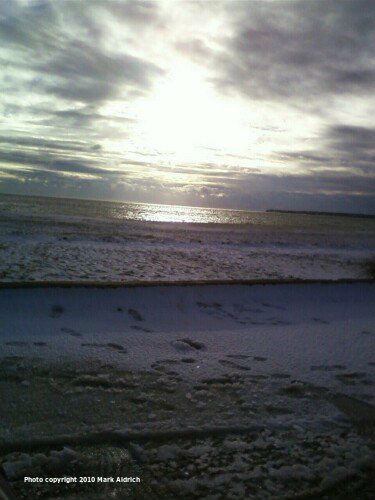
Cape Cod, winter 2010. Photo by The Gad About Town
Winter from atop the dunes is neither “frigid” nor “bitter,” two words that may frequent one’s letters home; rather it is “crystalline” and the snow is dancing and driving:
The snow skirred along the beach, the wind suffering it no rest; I saw little whirlpools of it driving down the sand into the onrush of the breakers, it gathered in the footprints of the coast guard patrols, building up on their leeward side and patterning them in white on an empty beach. The very snow in the air had a character of its own, for it was the snow of the outer Cape and the North Atlantic, snow icy and crystalline, and sweeping across the dunes and moors rather than down upon them.
When the National Park Service was evaluating the arguments for establishing the Cape Cod National Seashore, Beston’s book was cited frequently in the report’s pages. Beston died in 1968, and a sentence from “The Outermost House” is an epitaph: “Creation is still going on, the creative forces are as great and active today as they have ever been, and tomorrow’s morning will be as heroic as any of the world.” The cabin itself was swept away by the Blizzard of 1978, a nor’easter of heroic strength with historic effects; in other words, a storm that Henry Beston would have appreciated. The spot on the beach where the cabin stood, once atop the dunes, is now under the Atlantic Ocean, a portion of the Cape that the sea has claimed for itself.
No single development at any one location on the beach would have phased this wondering, passionate naturalist and writer, though:
And what of Nature itself, you say—that callous and cruel engine, red in tooth and fang? Well, it is not so much an engine as you think. As for “red in tooth and fang,” whenever I hear that phrase or its intellectual echoes I know that some passer-by has been getting life from books. It is true that there are grim arrangements. Beware of judging them by whatever human values are in style. As well expect Nature to answer to your human values as to come into your house and sit in a chair. The economy of nature, its checks and balances, its measurements of competing life—all this is its great marvel and has an ethic of its own. Live in Nature, and you will soon see that for all its non-human rhythm, it is no cave of pain.
* * * * A documentary about Henry Beston and Outermost House is in production: