Daily Prompt: A 1000-Year Project

Five hundred years from now, Jem Finer’s Longplayer project will have recently passed the half-way point in its 1000-year-long performance.

Longplayer is a musical composition that is calculated to take precisely 1000 years to perform from beginning to end and has been in performance in England continuously since midnight on December 31, 1999. This means it has been going nonstop for 14 years and 246 days as of today, September 3, 2014. You can tune in at any hour and listen. In my limited understanding, the composition is six pieces of music that are interlinked, with each one serving as a trigger to start some of the others at set intervals. They overlap. They trigger each other. The calculation provides that these intervals will allow for the first-ever repetition of music at midnight on December 31, 2999.

If you do listen in live, you will notice that you are not encountering anything like a “tune” or a piece of a song; for reasons that are very understandable, this is slow. This is not hum-able. You may only hear a note or two, made by someone touching a Tibetan “singing bowl”—a very ancient instrument—and then a shift up or down from that note. And then that note drifting into silence. It is a human-made project that is attempting to become environmental and outlast its creator(s).

One of the challenges for any 1000-year-long project is the knowledge that we can not anticipate what technologies will be in use a millennium from now, which languages will be common and how they will develop, or how to make certain that the project will not be forgotten, soon or in 1000 years. Less than 15 years after its launch, I currently own a laptop that does not recognize the Longplayer Live app (get on it, Google Store); thus the anticipation of technology is hugely important and it must be ignored all the same.

The anticipation of social customs, too. Five hundred years ago, the English language was undergoing the “Great Vowel Shift,” which brought the language from the Middle English of Chaucer to the Modern English of Shakespeare and Kim Kardashian. “The vowel in the English word ‘same’ was in Middle English pronounced ‘psalm’; the vowel in ‘feet’ was similar to ‘fate’; the vowel in ‘wipe’ was similar to ‘weep’; the vowel in ‘boot’ was ‘boat’; and the vowel in ‘mouse’ was similar to ‘moose.'” English speakers of the era did not know they were a part of a great change; to this day, we still deal with the Great Vowel Shift in some of English’s odd spelling rules and in the accents and dialects that did not shift, such as in Scotland. Linguists did not identify this change until about (“aboot?”) 100 years ago. Might we right now be in the midst of a similar shift in the language, or at the beginning of one, one that linguists will not be able to identify for centuries? Five hundred years from now, will people understand the instructions for performing Longplayer?

To meet the almost certain changes in language and technology, Longplayer’s creators set out to include all such anticipations from the start; they call it a “social and biological strategy of survival.” Whatever new technology comes into existence, the Longplayer project will be available on it (except a Chromebook, obviously). Whatever social rules or laws people of 1000 years live under, if art is still legal, then …

No matter what, the composition is 1000 years long, by design, so if Longplayer is forgotten and then rediscovered, the discovers can pick up the performance from where it ought to be based on calculations.

So can this song to the future that won’t ever leave the here and now last its 1000 years? This is certainly not knowable, but with the amount of attention and support it has gotten in these 14 years, it seems likely it will play continuously for several more generations. Jem Finer has programmed into it as much adaptability as possible.

* * * *
The WordPress Daily Prompt for September 3 asks, “Five-hundred years from now, an archaeologist accidentally stumbles on the ruins of your home, long buried underground. What will she learn about early-21st-century humans by going through (what remains of) your stuff?”

Certain things may last 500, nay 1000, years. My yoking together Shakespeare and Kim Kardashian in a sentence might wind up as one of them.

Daily Prompt: Little ‘Big’ Man

The WordPress Daily Prompt for September 2 asks, “In a reversal of ‘Big,’ the Tom Hanks classic from the 1980s, your adult self is suddenly locked in the body of a 12-year-old kid. How do you survive your first day back in school?”

(Like Hollywood movie makers of the late 1980s, the WordPress Daily Prompt prompters appear to be quite taken with the age-transfer/”Be careful what you wish for” theme.)
____________________________________

Big” came out in the summer of 1988, and that year I was neither 12, Josh’s age in the movie, nor 30, the age of grown-up Josh (Tom Hanks). I was 19 going on 20, so the movie was really made for someone like me.

Like almost every American, I love that movie even though I have seen it only the one time, in a movie theater (the details are perhaps: Poughkeepsie Galleria, probably with a high school friend, $5 for a ticket). It has a 97% positive rating on Rotten Tomatoes. Being almost exactly between Josh’s two ages means that I was adult sized but with no clue what being an adult meant or—and here is the kicker—what it was going to mean. I knew that 19-going-on-20 felt like being Tom Hanks in the movie and 12-pretending-to-be-30, but minus his good looks and charm.

I was still living at home but working for a living and a college student, single but not dating and falling into epic, private crushes; my frustration tolerance levels were at my all-time low, I think. I had a crush on Elizabeth Perkins after “Big,” but she never responded to my never moving to Hollywood.

todd

Orville A. Todd Middle School. It was a junior high, grades 7 and 8 in the early 80s, and is now a 6 through 8 middle school. That tree was much smaller in 1980.

The year that I was 12 was 1980, and it was around then that the attitude that disquieted me into my adult years began to develop; it was the year I discovered that wherever I was I did not want to be. Orville A. Todd Junior High School was the place, and to this day it is one of the school buildings I dream that I am wandering, as I wrote about recently. It haunts me, which is why it is the photo accompanying this. (What do you mean you can’t see the ghosts in the windows? They’re there.) And I think I just figured out why I have dreams in which I am ever searching for something and it is often in this building here: my locker was frequently (okay, always) on the opposite side of the building from classroom I was next due to visit. Todd Junior High was (is, I would surmise) one long, narrow hallway with a couple bends and staircases that bottleneck the traffic. It was a living nightmare and I dreamed logistical dreams about it even back then.

I had as much difficulty talking with 12-year-olds then as I do now (I am not yet a father); it is an age I do not get, and being 12 did not mean that I got it then, just because I was living it. To be clear, I was no help for myself in this matter at all. I was interested in the news, already had a subscription to Time magazine for most of 1980, started a student newspaper, and I remember conducting a poll of my fellow junior high students regarding the upcoming presidential election, Carter vs. Reagan. (I think J.R. Ewing, Reggie Jackson, or Mork won.) I was no help. I was the only correspondent for the publication; something I certainly relate to now.

So the idea of waking up tomorrow nearing the ripe old age of 12, with one hair growing super-long from my chin but the rest of my face peach-smooth (shaving meant lathering my entire face with my dad’s brush, even my forehead, just to get that one long whisker), with thick plastic-frame glasses that were always one growing pains stumble or bullying shove into my locker away from breaking apart on my nose and requiring “nerd” tape to hold them together, which would result in more bullying shoves into my locker, this does not appeal to me. At age 12, I knew that I was already counting down the days to turning 18 and grown-up-hood, much like Josh in the movie, but six years looked like an enormous trek.

I still suffer from not wanting to be wherever I am, though. I am 45 going on 46 now, but 1988 looks like a more plausible date for me to write or look at than 2014.

Daily Prompt: Thank You, Spalding

The WordPress Daily Prompt for August 26 asks, “What’s the best (or rather, worst) backhanded compliment you’ve ever received? If you can’t think of any—when’s the last time someone paid you a compliment you didn’t actually deserve?”
__________________________________

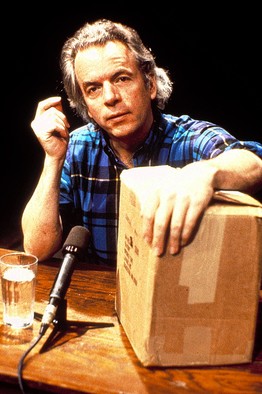
Spalding Gray, 1941-2004

Spalding Gray, 1941-2004

It is one of my favorite star-crush stories, the time I met Spalding Gray. Two friends and I started a theater company in the summer of 1990. Perhaps you have not heard about it; it was kind of not-big deal in Poughkeepsie for almost two weeks in a row. Our endeavor yielded one sell-out performance in the open-air back porch of a bar, a bad review, yet one more (mostly unattended) performance, and a bunch of t-shirts. With grad school beckoning we shut it down, and with time and many residences I lost my only t-shirt and even eventually forgot the name of the “company” we had started.

I found our one playbill at my parents’ house recently. We called ourselves “Fading Gentility,” which is a name some group really ought to be using, as it is a great one; our one play (a one-act that was written by one of us not named me) was titled “The Smoking Car.” Ah, well. Our best work was actually our group-written press release announcing our imminent debut production (the owner of our favorite bar had decided to allow us to try and earn our drinks, which lit a fuse under us)—the three of us took turns writing each sentence under the guidance of a copy of the “I Ching,” just so you know—and that press release got us an interview with our city paper’s entertainment maven. Being featured in the Poughkeepsie Journal’s “Enjoy!” section meant we were either going places, had arrived, or they needed space-filler.

The attention from the local newspaper and our relentless 20-year-oldness landed us a sell-out performance. But one single one-act play that hardly lasts from twilight to night and no other material at all whatsoever will not lead to many drinks or dinners sold, which is the entire point of theater, so we saw few happy returns from the evening.

That same summer, 1990, Spalding Gray was due to appear down the street from our venue, at Poughkeepsie’s historic Bardavon 1869 Opera House. Here was one more opportunity to attract attention for ourselves. Or to speak with an idol. Or to “network” with a theater legend. Or to stare at an idol. His monologue was the first act of a multi-act fundraiser, so after his performance, he was supposed to continue to be available for audience hobnobbing in the lobby, where a temporary bar was set up (the three of us looked at each other and thought aloud, that’s how they do it—even the theaters sell drinks!). We could not, or dared not, get near him.

After the required 20 minutes or so, Gray and his companion, Renee, left the lobby and headed back into the theater. Sometimes one can tell, even in the moment, when something is about to be a memory of a missed opportunity or a genuine, fully realized, missed opportunity. A friend interrupted our gawping from a distance at the famous writer/performer and pushed us towards the door Gray had just walked through. Into the still dark theater we three plunged. I was the only one of us with a loud enough stage whisper: “Spalding!” For some reason, I was calling him quietly, as if he was a cat that had gone hiding. “Spalding? Spalding!”

Spalding Gray stopped and turned. We were all at the front of the house at this point, by the stage. Someone in a position of authority ought to have been there to chase us away, but no one was. “Hi. We’re big admirers and we just wanted to let you know we started a theater company here in Poughkeepsie recently and you are a big inspiration and we just wanted you to have one of our t-shirts.” That all came out as one word, and the way I remember it, each of the three of us contributed at least a couple of syllables to my nervous blast of a star-struck sentence.

Renee reached out a hand and my friend reached under his sweater to pull out the Fading Gentility t-shirt that he had waddled up and smuggled into the theater. She took it and handed it to Spalding. She asked us about the theater scene in Poughkeepsie, something we knew little about, although we were among the leaders of the theater scene in Poughkeepsie that summer. Thus it was a short chat.

Spalding Gray looked at the front of the shirt, the back, the front again, and spoke as if to himself, “I get a lot of t-shirts. People think I like t-shirts. I like t-shirts.” That was all he said to us, though he said it twice. “I get a lot of t-shirts.” Goodbyes were exchanged and we all shook hands.

Many backhanded compliments are statements of plain fact inserted into a conversation at the place where one thinks a reply is required but no compliment is truly possible. Whatever my friends and I desired or rather fantasized would happen from our moment with Spalding Gray—”I must get to know you three. Report to The Wooster Group next week!”—what we got was more valuable: a dose of beautiful reality. “I like t-shirts.”