How to Be a Live TV Audience

Comedy Central’s two main franchise shows are both recorded in a part of New York City called “Hell’s Kitchen,” a section of Manhattan that extends about 25 blocks south and west of Central Park and west of Midtown over to the Hudson River. Most of the buildings in the neighborhood are former walk-ups and townhouses that are now offices for media companies; “The Colbert Report’s” studio looks like it was a house or storefront once upon a time.

The Thursday, September 18, 2014, broadcast of “The Colbert Report” was a very special one because I was in the audience, as I wrote yesterday, in “Four Minutes and 24 Years.” Terry Gilliam, the legendary film and theater director (the list is epic and includes: “Time Bandits,” “Brazil,” “The Fisher King,” “Fear and Loathing in Las Vegas,” “The Zero Theorem”) and Monty Python animator and cast member, was the guest.

The studio is on the same level as the street outside, but it takes a lifetime to get there. Sorry, that was a sentence from a television ad for a college course in broadcasting that I am working on. We should go back outside.

The tickets for live-on-tape broadcasts are free, because these shows need a full and loudly enthusiastic house for each and every show and the producers do not want people who feel that sense of hostile proprietorship that can come with a ticket purchase. (They do not want an audience of people with crossed arms and an attitude of, “Entertain me.”) A theatrical performance in front of an empty house could nonetheless be great but a television show performed to silence and a performer feeding off the silence could be horrifying to watch unfold. (Only Johnny Carson seemed to be able to work with a not-yet-impressed audience.)

The producers also do not want an audience of people off the street, happy to receive free things, but not aware of how to be an audience. Talk with a stage actor sometime. He or she will tell you stories of the weirdest things that have happened during performances: cell phones going off, of course, but also people taking the phone call; people walking across the stage (especially in theaters with the stage and seats on the same level) looking for a restroom; audience members yelling at or asking questions of the characters as if they are in their easy chair yelling at a TV screen; babies crying. The audience is supposed to be separate from the performance, with some exceptions. A live television show audience is not at a stage show; the audience is a part of the show: the audience is the soundtrack.

Thus, the audience is coached on this point by producers before the taping begins. And then re-coached. The performance at first felt like a pop quiz to gauge how well we had absorbed the coaching. It also felt like if we were insufficiently enthusiastic, we would be escorted back out to 54th Street.

The process of acquiring these free tickets varies from show to show but all of the shows use the method to establish that the audience is made up of fans. (Willing to be loud. Happy to pretend to not be faking enthusiasm.) Some shows use online trivia contests to winnow out the casual fans. My method was the easiest for me: I have a friend who has done this before (he attended “The Daily Show”) and wanted to do it again and invited me.

(Would that we had attended “The Daily Show” last Thursday; former President Clinton was there that day.)

The tickets one receives for registering online for a television taping are not tickets as one usually thinks of them. They do not guarantee a seat. They guarantee a spot on line, in a covered alleyway where one waits for the doors to open. We arrived early, chatted with the show assistants, and waited some more. The assistants are talented at a particular task: they quickly learn who is with whom, names, who has special needs. My friend’s wife sat with me at a coffeeshop for a few minutes while he held our group spot on line, then they traded: she went back and he sat with me. When he and I rejoined the line we found that we could not see her; one of the assistants got our attention (not vice versa, They. Ran. Us. Down), gave us our seat tickets, and ushered us into a room in the building, where she already was.

My thumb.

My thumb.

In that room, one goes through a security checkpoint and then waits. For over an hour. It is a square room, maybe 25 X 25 feet, extraordinarily air conditioned. Several monitors play old Colbert shows on a “Best of” loop. The walls are plastered with Colbert memorabilia. Over the next few minutes, the entire audience-to-be was herded into this room, which made clear the need for extreme air conditioning. Seeing I walk with a cane, one assistant walked me through the crowd to a bench.

Twice an assistant addressed the crowd. Both times the message was: “This is very special. Stephen is going to chat with you before the show, so have some questions ready.” (Perhaps he does this every show and they tell the audience it is special.) “When you’re watching the show at home, you only chuckle at the jokes because you’re thinking about your own life and you hear the audience in your TV laughing uproariously. You’re the audience in someone’s TV now. Whatever you’re going to laugh at, laugh loudly.”

The doors to the set were opened and people were ushered in by ticket number but in small groups; my group of four friends went in together. The bleachers do not have banisters, something which I was anxious about as a person with spinal muscular atrophy and thus almost no balance on stairs, even with a death grip on a railing. One of the assistants saw my cane and the four of us were thus seated in the front, over by the interview table. The stage manager and then the warm-up act coached us some more in the finer points of yelling our laughter. (Since all of you have heard my voice in an earlier post, you should be able to hear me clearly if you watch the show. Of course.)

Contrary to what I thought, the show is not taped in real time; Colbert made one verbal typo and they recorded a do-over, the commercial breaks were over ten minutes each, the interview with Terry Gilliam was over 15 minutes, of which about not quite 10 made the show. The affection between Colbert and his staff was obvious: at one point, while a hairdresser was combing his hair, he started pretending to comb hers. He indeed took questions before the show and again after. All told, we were in the studio for a bit over an hour for a 21-minute show.

The broadcast will be available for free on the website for the rest of this week, so here is the link: The Colbert Report with Terry Gilliam. And here is the 60 second edit:

It was a fun day and night in NYC, thanks to Gerry, Theresa, Ron, Bob and Kevin, and all of New York City. Even the panhandler on the train from Secaucus.

* * * *
The Gad About Town is on Facebook! Subscribe today. Daily facts (well, trivia) about literature and history plus links to other writers.

____________________________________________
The WordPress Daily Prompt for April 9 asks, “If you could learn a trade—say carpentry, electrical work, roofing, landscaping, plumbing, flooring, drywall—you name it—what skill(s) would you love to have in your back pocket?” TV host. I am heading to NYC today with my one and only, Jen, to view tonight’s taping of “The Nightly Show,” starring Larry Wilmore. It is in the same theater as “The Colbert Report” was recorded each night. That is the reason for re-running this column from September. Tune in tonight at 11:30 EST on Comedy Central to see if you catch a glimpse of me and my love. Full updates tomorrow.

Daily Prompt: Four Minutes and 24 Years

The benches in front of 1 Penn Plaza, along West 34th Street, are lively at lunchtime and look like they remain so long after lunch, as deliverymen pick up and drop off all day long and limo drivers waiting for their VIPs kibitz with one another and with passersby who want to know how famous the person about to become their next brush with fame is and whether he or she is worth pausing for on their way to their next New York City attraction.

There was no reason for me to be in front of the famous skyscraper to make this observation last Thursday afternoon. Five minutes before passing the limo drivers and their VIPs and the lunchtime crowd, I was finishing up being lost in Penn Station, the renowned train- and bus- and everything else station (flying saucers will someday land there because it is shaped like one). Ten minutes before that, frustrated that I could not find a sign directing me to exactly where I was going, many many blocks away, I reasoned that any door with sunlight coming through it and people’s shadows walking past must lead to the outside and a street, any street, and the possibility that, once there, I would be able to figure out where I am. In New York City, on the streets, I am (usually) okay, since it is one of the easiest cities to negotiate on foot. It’s a grid. (Mostly.)

That hunch led me up one staircase to plate glass doors that entered into Madison Square Garden. I headed back down that staircase.

Out on the street, I made my way back around MSG to the front of Penn Station and then onward, north along 8th Ave. to have coffee with a college classmate and then meet up with other friends to attend a taping of “The Colbert Report.”

The college classmate and I had not seen each other in almost 24 years, when I had thrown a post-graduation party he attended; thoughts and memories of this party were on my mind while I strolled up 8th. Cars were blocking the crosswalk, so instead of waiting to cross, I turned right and started over to 7th, where I would continue my northward stroll.

This is how small a moment any moment can truly be. Had the crossing been available, I would have continued on 8th. But sitting on a bench on 34th Street at that moment was another college classmate, in fact the co-host of that post-graduation party, someone I have not seen or spoken with in three years and who did not know I was in New York City. He has an office in 1 Penn Plaza and was on his lunch break, people-watching.

Had I walked past ten minutes earlier, I would have missed him, but I had just spent those ten minutes escaping from Penn Station.

“Is that … Kevin? Really?” I thought to myself. Can’t be. I was not going to say anything; I was going to walk past the person who I assumed was a merely a stranger with a familiar face, since how could it be that I would bump into a long-ago friend in this giant city; a hunch had just now almost gotten me lost in Madison Square Garden. I had better leave the hunching business to others, I thought.

“Mark?” That settled it; it was my old friend. With one friend waiting for me in a restaurant in midtown and about 20 more blocks to walk, I had about four minutes to bring my graduate school housemate up to date. He had the same four minutes to bring me up to date. What was I doing in the city. What was he doing on that bench. Our relationship statusi, our work situations, my physical condition. How long it had been since. How utterly baffling the fact of what we were experiencing right then was. Why I was not taking the subway instead of walking 20-plus blocks. We finally, after all these years, exchanged phone numbers.

“How long has it been?” That was my other friend’s first question as I walked in the restaurant, a few minutes later. I reminded him: 24 years. And an extra 10 minutes because I had run into someone. He, too, was on his lunch break, so we had limited time in which to reacquaint each other with each other. Relationships, work, life.

How much time does it really take to tell someone what you’ve done and seen? Maybe it only takes about four minutes to (re)establish who you are and the rest is elaboration with anecdotes.

Who am I? Someone who takes 10 minutes to get out of a wide-open train station but is happy at the social accident that was thus made possible.

* * * *

colbert ticket2

My thumb.

__________________________________
The WordPress Daily Prompt for September 22 asks, “You’re about to enter a room full of strangers, where you will have exactly four minutes to tell a story that would convey who you really are. What’s your story?”

To Be Brief … No Such Thing in Some Books

Most copies of “Tristram Shandy” by Laurence Sterne are about 600 pages long. The book is a fictional autobiography in which Tristram, the not-quite hero of a story that is not quite his own, attempts to tell us about his life from birth onward. However, he does not even begin to begin telling us about his birth and his first day on earth until the fourth volume because, like his own conception on page 1, his story is much interrupted.

(On page one, at the very moment Tristram is to be conceived, his mother asks his father if he remembered to wind the clock, an ill-timed interruption that, according to Tristram, produced an author who is incapable of telling a story straight to its end without breaks, questions, and digressions.)

The full title of Sterne’s masterpiece is “The Life and Opinions of Tristram Shandy, Gentleman,” and it was published over almost eight years from 1759 to 1767. It made the Irish writer world-famous and wealthy.

At the end, one more character brings in one more story and Tristram’s mother asks, “L–d, what is all this story about?” It is the second-to-last sentence in the book and it is also the question most readers ask as they conclude reading Sterne’s great comic novel. “Tristram Shandy” is one of the most entertaining novels in English because it never gets to its point.

Christopher Ricks once described Sterne’s novel as “the greatest shaggy-dog story in the language.” By the end of all these pages Tristram has only brought us all the way into his own toddlerhood, leaving with us the thought that, should he continue the attempt to tell his life-story, he will never catch up to himself.

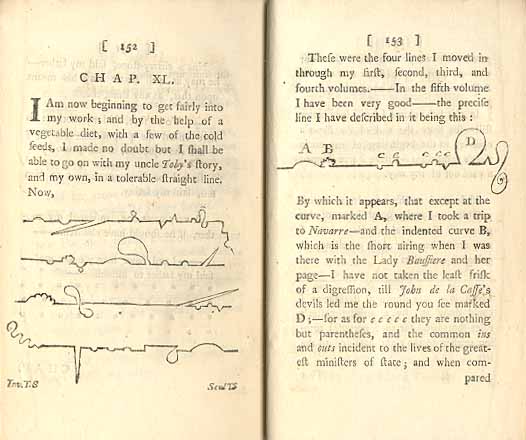
Thus, not much of Tristram Shandy’s life nor many of his opinions appear in the book, but many other characters—and their opinions—do. The title is the novel’s first joke. Tristram Shandy is not a character in his own story. He often criticizes himself for his many digressions and his way of not getting to the meat of his story very quickly, but he always steps away from criticizing himself, and he even sets out in one chapter to finally tell his own story in a “tolerable straight line,” but not before drawing his narrative schemes for the volumes we have just read in a series of diagrams:

tristram

He opens a chapter in which he promises a straight story with an interruption about how hard it is to do that. He identifies for us which interrupting anecdote corresponds to which bend away from the “tolerable straight line” and defends the sections that he labeled with “ c c c c c ” as “nothing but parentheses, and the common ins and outs” of life. Several paragraphs later, Tristram lays out an estimate for us: If he writes two volumes a year for the next 40 years, he will be all caught up … to where he is now, 40 years before that imagined future, at which time he would have written thousands of pages yet have decades of life yet to tell us about.

Tristram recognizes that his own storytelling method has created a paradox for himself: If it took him one year to bring himself in his own story to one full day old, yet he lived 364 additional days in that writing process, that means that 364 days have been added to his job, 364 days that he did not write about because he had not yet gotten to them in the process of getting to be one day old in the narrative. “… [A]t this rate I should just live 364 times faster than I should write”—just?! that implies he might slow down!—”It must follow, an’ please your worships, that the more I write, the more I shall have to write—and consequently, the more your worships read, the more your worships will have to read.”

Sterne’s Shandy is self-entrapped in an ever-present present which interferes in real time with his recounting of the past. And Sterne loved finding every conceivable method to interrupt his character’s storytelling. Shandy wants desperately to be brief, but how brief should he be? How brief can he be? If an experience takes X amount of time to live through, and if a story about that experience takes more than X amount of time to tell—because listeners need the context and background—then every story in a life takes longer to tell than however much time it took to live it. Every writer will live forever by that logic.

Tristram’s mother asks at the end, “What is all this story about?” At the moment, Obadiah has been complaining about a cow that will not give birth, perhaps because the Shandy bull was not successful in impregnating it. He thinks he is owed a calf. Tristram’s mother asks her question and the answer is about both Obadiah’s story and the book we are have been reading: “‘L–d! said my mother, what is all this story about?—’ ‘A Cock and a Bull, said Yorick—And one of the best of its kind, I ever heard.'”

Cue the rimshot. A “cock and bull story” is a derogatory term for a fanciful tale; Obadiah’s complaint was literally an accusation having to do with that phrase. It also describes the book in the reader’s hands. Sterne’s punchlines are brief, as they always should be, but there are many of them in Tristram Shandy, as he builds joke after joke, scene after scene, chapter upon chapter.

__________________________________
The WordPress Daily Prompt for September 20 asks, “‘I would have written a shorter letter, but I did not have the time.’—Blaise Pascal. Where do you fall on the brevity/verbosity spectrum?”
There is an expression, “Brevity is the soul of wit.” And another: “The more the merrier.” As in “Tristram Shandy,” the punchlines and wit should be quick and brief, but plentiful.