Two Awards in One Day

Two fellow bloggers separately named “The Gad About Town” as a winner of the “Lovely Blog” award today. That is as cool as it gets.

Both are blogs that I enjoy reading regularly, by two very different writers in different parts of the world: Tidlidim and The Reluctant Baptist. Thank you both. Both writers have strong personal voices in their work and sometimes include their own photos.

In the blogging world, there are some rules of etiquette in the form of paying forward the “lovely” attention. Here are the rules:

1. Thank the person who nominated you for the award.
2. Add the “One Lovely Blog” logo to your post. Display the award on your blog—by including it in your post and/or displaying it using a “widget.”
3. Share 7 facts/or things about yourself.
4. Nominate 15 bloggers you admire and inform nominees by commenting on their blog.

The last one first. I have been participating for the last 10 weeks in responding to our WordPress service’s Daily Prompt, which has helped spur my most prolific period of writing since graduate school. (This prolific-ness is a good thing, too, because I am working on a terrific project, due out soon, with another blogger.) Most of the writers with whom I have been communicating regularly, several of whom ask me questions and give me applause every single day, I met via that service. My subscribers have doubled and so has the number of blogs that I subscribe to. Go to the Daily Prompt any day and you will see the several dozen blogs that I read and often like every day.

I fear I will leave someone out, is all I am confessing.

Several random facts about me:

1. The number four is my lifelong “secret lucky number.” (Anyone who has gambled with me knows about this. Read: The Gad About Town: Against NYS Proposition 1.) Now, I know that in most of the world’s luck traditions, if one declares out loud that something is secret and lucky, one has immediately kiboshed all secrecy and luck out of that thing’s existence, but that is the beautiful thing about my “secret lucky number 4”: It remains lucky and maybe even grows in power every time I speak of my special relationship with it. Maybe.

2. I left New Paltz in 1995 to work in Narrowsburg, NY, and moved back to New Paltz in 1997. I left New Paltz again in 2000 to work in Cedar Rapids, Iowa, and returned to New Paltz in 2006. (There are legends about New Paltz and eternal return and gazing upon the nearby Wallkill River—I am legend, I suppose.) And then I had to move again, this time to Goshen, NY.

3. Depending on my relative levels of optimism or pessimism, I may refer to my spinal muscular atrophy as an “illness” versus a “condition.”

4. I pretended to write before I knew how to write. There may even now be pieces of furniture at my family’s house with my crayon scribblings on them and in them—I did not draw, I wrote, wavy lines that I would then inform my parents was a story. I’ll guess I was about three or … four. See? It must have been a lucky number.

5. I am very audiologically sensitive (I do not know if that is even a term). I can identify voiceover actors, even when famous ones are used anonymously. The downside of this is a sensitivity to certain noises … if the faucet in your kitchen sink is dripping, I will excuse myself from your living room to see if the tap can be tightened or if the faucet swung away from any container under it. Bloop bloop bloop. Sadly, this sensitivity does not translate to any musical ability. I have none, just an appreciation for music and performance.

6. I see words as I speak them.

7. My favorite animals growing up were dinosaurs. My favorite dinosaur was the triceratops. In the children’s books about dinosaurs, the triceratops always seemed to get into a tangle with the fearsome T-Rex and walk away, unscathed.


http://thereluctantbaptist.com/2014/10/07/and-the-nominees-are/

http://tidlidim.wordpress.com/2014/10/07/grouping-two-lovely-blog-awards-into-one/

Some Time Travels

In his “Confessions,” St. Augustine writes, “What then is time? If no one asks me, I know; if I wish to explain it to one that asks, I know not.” He decides that time is an idea, unique to humans, and also unique in that we can simultaneously grasp the past in memory, the present by attention, and the future by expectation. In our minds, but only there, we are not locked to one perception of one reality.

Yesterday, I deleted everything that I had written up to that point by dragging my unbuttoned shirtsleeve across my laptop’s touchpad while reaching for my coffee. (No, I can not replicate the results in an experiment; yes, like an idiot, I have attempted to replicate these results in an experiment.) In a feat of memory, I retyped all that I had written to that point; simultaneously I remembered what I had written, was super-present and typed it attentively, and expected a future in which I regularly saved my work, a lesson I first learned, oh, 20 years ago. I was in three specific time-experiences at once, and all of them sucked.

* * * *
For decades, it has been known that subatomic particles can be in two places at the same time. In yet more recent (2014) experiments, physicists have “simulated” time travel. Science reporters tell us that time travel is in the “near future,” or, more prosaically, “just around the corner.” If this is so, no one from the future has yet visited us, because if it truly is something that we will invent or discover in the future (near or not-so) we would know all about it already. This is because, oh, you get it.

Many therapy techniques suggest remembering oneself in a childhood moment and reaching out to that younger self; the thought is that we carry every self we have yet been forward into our psychological present and can communicate something of a healing nature to those past selves. Whenever I have attempted anything of this sort, I have cried. I have received no reports from the younger self about what he made of the unexplained appearance of an older man leaning on a cane.

* * * *

How the false truths of the years of youth have passed!
Have passed at full speed like trains which never stopped
There where I stood and waited, hardly aware,
How little I knew, or which of them was the one
To mount and ride to hope or where true hope arrives.
— “I Am A Book I Neither Wrote Nor Read,” Delmore Schwartz

* * * *
The thought experiment of time travel has a long history in popular culture. Fantasists invent tools (a jet-pack in every garage) in novels and movies, tools which actually only address the needs of the present moment and do not attempt to imagine the future needs that will be answered by the future tools. In almost every science fiction work that uses the device of time travel, the several paradoxes of “a visitor from the future would influence current history and thus change their present” or “if I go back in time and change a mistake, erase an error, will I not change who I am now?” are addressed.

Many of the heroes decide or discover that the path that brought them to where they are and to the person they are now was always worth taking, errors and all. As long as one is breathing, lessons can be applied. (Ebenezer Scrooge, for example.)

It is a seductive thought experiment, though. Offer a person a time machine to return to a specific moment in the past and take up residence there, from that moment onward, and relive one’s life so one can fix whichever errors and enhance whichever successes that followed, well, it is seductive. Offer a person life from a future moment from which they can see it all unfold, … well.

* * * *

delmoreschwartz

Delmore Schwartz

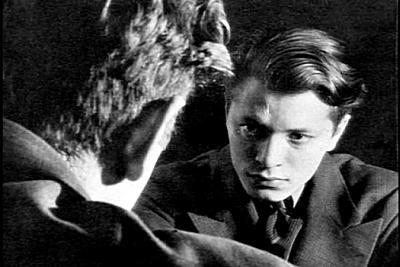
Delmore Schwartz’s heart-rending short story, “In Dreams Begin Responsibilities,” opens with the narrator in a movie theater as he realizes the feature is his parents on their first date; he becomes frantic and yells at the screen, “Don’t do it!” and gives a list of reasons. (Oh, to have been Delmore’s mother. He was 21 when the story was published.) The audience hisses him down, as he is ruining the movie for them, but he knows how it ends.

My father tells my mother how much money he has made in the week just past, exaggerating an amount which need not have been exaggerated. But my father has always felt that actualities somehow fall short, no matter how fine they are. Suddenly I begin to weep. The determined old lady who sits next to me in the theatre is annoyed and looks at me with an angry face, and being intimidated, I stop. I drag out my handkerchief and dry my face, licking the drop which has fallen near my lips. Meanwhile I have missed something, for here are my father and mother alighting from the street-car at the last stop, Coney Island.

At the end, the narrator is thrown out of the movie theater while on screen his father is refusing to have his fortune told by a Coney Island fortune teller. And then he awakens to “the bleak winter morning” of his 21st birthday. It was all a dream.

* * * *
As Augustine saw, way back in the 4th century, we always live in the three time zones of our experience and psyche simultaneously: past, present, and future. Always.

I no more wrote than read that book which is
The self I am, half-hidden as it is
From one and all who see within a kiss
The lounging formless blackness of an abyss.

How could I think the brief years were enough
To prove the reality of endless love?
— “I Am A Book I Neither Wrote Nor Read,” Delmore Schwartz

* * * *
Neat Thing of the Day: Lou Reed reading “In Dreams Begin Responsibilities” (Reed had been a student-mentee of Schwartz’s at Syracuse University): In Dreams Begin Responsibilities.

____________________________________________
The WordPress Daily Prompt for October 7 asks, “Congrats! You’re the owner of a new time machine. The catch? It comes in two models, each traveling one way only: the past OR the future. Which do you choose, and why?”

Your Inner Bliss Moonlight and Madness: Follow It

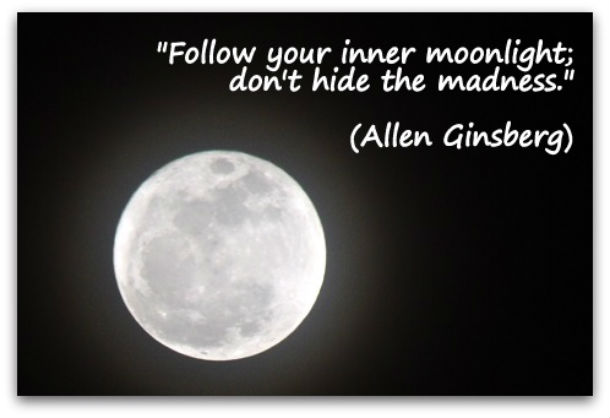
In his published works, Allen Ginsberg wrote not one single thing about moonlight and madness, yet there is a popular Internet meme—an Internet poster—usually seen with a handsome photo of our moon and the rousing declaration credited to him that you should “Follow your inner moonlight; don’t hide the madness.” (See above.)

It is a Bizarro World version of a speech given by a football coach at halftime. “Follow your inner moonlight, boys, and let’s win one for State! Don’t hide the madness!” (The team huddles together and starts to chant, quietly and slowly at first, but then they build it to a hypnotic intensity: “Don’t. Hide. The. Madness. Don’t. Hide. The. Madness.”)

But did Ginsberg, the bard of the Beats, ever write or say such a thing? Yes, no, and yes. According a post in the blog The Allen Ginsberg Project, exactly 25 years ago Ginsberg’s biographer Michael Schumacher interviewed Ginsberg about writing and inspiration and submitted the answer to a Writer’s Digest publication, “On Being a Writer,” which was a book that read more like a calendar of daily inspirations than a book. The writer at The Allen Ginsberg Project did the footwork and even wrote to Schumacher in the search for an answer, so credit must be given to that blog. The full piece is here: “The Mystery of the Inner Moonlight.”

What Ginsberg wrote to Schumacher was:

“It’s more important to concentrate on what you want to say to yourself and your friends. Follow your inner moonlight; don’t hide the madness. Take [William Carlos] Williams: until he was 50 or 60, he was a local nut from Paterson, New Jersey, as far as the literary world was concerned. He went half a century without real recognition except among his friends and peers.
“You say what you want to say when you don’t care who’s listening. If you’re grasping to get your own voice, you’re making a strained attempt to talk, so it’s a matter of just listening to yourself as you sound when you’re talking about something that’s intensely important to you.”

Long before, he had used one half of the declaration and wrote “Don’t hide the madness” in a poem in 1954. While he was editing William S. Burroughs’ novel “Naked Lunch” with Jack Kerouac, Ginsberg wrote “On Burroughs’ Work”:

On Burroughs’ Work
The method must be purest meat
and no symbolic dressing,
actual visions & actual prisons
as seen then and now.

Prisons and visions presented
with rare descriptions
corresponding exactly to those
of Alcatraz and Rose.

A naked lunch is natural to us,
we eat reality sandwiches.
But allegories are so much lettuce.
Don’t hide the madness.

For a writer who found his voice in compound nouns and lists of the super-specific details of his humdrum day (some graduate student must have tallied up the many grocery and other kinds of bills that he so frequently includes in his work; perhaps they won an assistantship), the minutiae of his existence, “reality sandwiches” was a great turn of phrase, so good it appears to have surprised the poet. He brings the work to its swift conclusion right there, lest he pile on some allegorical lettuce and bury the meat.

But moonlight? “Inner moonlight,” no less? That was a new one. In 1955, he had already written his best known, best regarded, poem, the long “Howl,” which was published the next year. Its opening line, “I saw the best minds of my generation destroyed by madness,” seems to tell of a hard-earned caution about the lunacy of following any moonlight, inner or not. But the madness in “Howl” is the pain of those “best minds” attempting to fit in with repressed and repressive society and finding their outlet in self-inflicted agony, trying to find a fix.

By 1989, Ginsberg knew that a phrase like “inner moonlight” voiced a sentiment akin to the similar—and similarly purposefully over-simplified— “follow your bliss” of Joseph Campbell. Both are inscribed in the long history of mal-understood phrases used by people to excuse bad, or self-centered, behavior. Neither one deserves that fate; neither phrase deserves many of the people who declare them as personal credos. (I am happy to report that every post I read in response to this question was an example of a writer genuinely not declaring anything, not anything at all. Writers follow their bliss and do not need to tell the world that they are doing so.)

A writer’s life is not often a conventional one and a writer’s wisdom is often a hard-earned one. Any writing that declares its “wisdom” as “hard-earned” or to be the product of following an inner blissful moonlight is usually missing its own point, and is thus conventional enough to be put on an Internet poster. But the “crazy wisdom” that Ginsberg and Corso and many of the Beats did manage to sometimes touch upon and stare directly at and give to their readers, that is always worth encountering for the first time over and over again.

* * * *
What did Allen Ginsberg’s voice sound like, his poet’s voice? Here is a recording, with music said to be by Tom Waits underneath.

____________________________________________
The WordPress Daily Prompt for October 3 asks, “‘Follow your inner moonlight; don’t hide the madness.’—Allen Ginsberg. Do you follow Ginsberg’s advice—in your writing and/or in your everyday life?”