
My Thinking Makes It So
In Act 2, Scene 2, of Hamlet, the doomed Rosencrantz and Guildenstern are chatting with the prince. They are old college buddies of Hamlet’s, and King Claudius (Hamlet’s step-father) and Queen Gertrude (his mother) have sent for them to learn what is bothering the young man, who has been acting with an “antic disposition” and saying strange things, half to himself and half to no one can tell who.
Hamlet greets them and speaks in the same riddling manner that he has been using with the rest:
HAMLET: Let me question more in particular, my good friends, what you have done to deserve such fortune, that she sends you to prison hither?
GUILDENSTERN: Prison, my lord?
HAMLET: Denmark’s a prison.
ROSENCRANTZ: Then the world is one.
HAMLET: A goodly one; in which there are many confines, wards, and dungeons, Denmark being one o’ the worst.
ROSENCRANTZ: We don’t think so, my lord.
HAMLET: Why, then ’tis none to you; for there is nothing either good or bad but thinking makes it so. To me it is a prison.
Hamlet quickly determines that they are not merely dropping in to talk about sports and the weather but are spies. Ultimately, he manages to have them both killed.
Shakespeare’s quip about how one’s thinking determines a thing’s relative goodness or badness has lived on through the centuries, but in most peoples’ recitations it carries about the same weight now as a Twittering teenager’s hashtagging of “YOLO.” Perhaps this is because it is delivered by a character who is speaking in riddles and jests and pretending to be mad. (“What are you reading?” “Words, words, words.”)
Four hundred years after Hamlet was first performed, “Nothing (is) either good or bad but thinking makes it so” is spoken as a longer, more profound-sounding, version of, “Don’t sweat the small stuff.” “The rain is uncomfortable for you but it’s good news for the farmers,” says the profound thinker who apparently wants me to punch him. (I once replied to this with a “Do you know any farmers? We live in the suburbs. If you do, see if they’re carrying umbrellas, too.” The person walked away, which of course was the only proper reply to my being a jerk.) (We are still friends. I have my good points.)
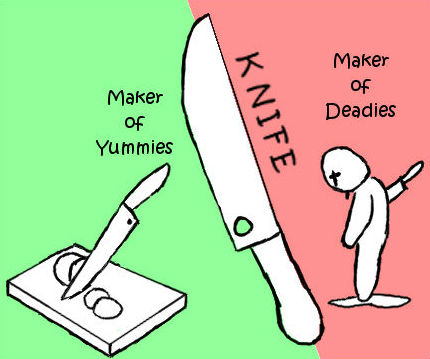 Many people resist strongly and vocally when it is suggested that, taken existentially, Shakespeare and/or Hamlet is right. Our perception is all that defines good from bad. A happy event, in and of itself, is not inherently a good thing. A tragic happening is not by definition evil. There is a deep commitment to the idea that there is evil in the universe as well as good; that good inheres in things we like and love and that evil is a containable reality. This is because most of us combine and conflate the notions of sad with bad and happy with good.
Some of the saddest things that I have seen have had positive things follow them, possibly as a result of reactions to the sad thing. (I am disabled and that sucks, and I would not wish the experience on people I dislike, but being disabled gives me an income, a teeny-tiny one, which gives me time to write; a small example, that, but reality resides on a spectrum and not in an either-or zero-sum playhouse.) And some of the best things that I think I have done may turn out to have terrible consequences. Sadness exists. Tragedy is a reality. So is happiness.
Are there people who do wrong in this world? People who introduce sadness into peoples’ lives or who work for their own personal gain to the detriment of others around them? Of course. Hamlet was no murderer but he had Rosencrantz and Guildenstern killed. (Fictional characters, of course.) Hitler existed. If evil is inexplicable, well, then, so is good. We want all matters to be explicable, however, so we deploy terms like “good” and “evil” as if they are tools that explicate.
Further, our minds want there to be someone to credit or something to blame behind the good or the evil thing. There must be an explanation, goes the thinking. Thus, there must be a find-able motivation animating even the explicably good thing or evil person. The great journalist Ron Rosenbaum explores this in his famous book, “Explaining Hitler,” which confronts the book buyer from the start, the front cover. Hitler’s baby picture sits there. Historians have searched for decades for the clues to pinpoint the moment baby Adolf became Hitler. What was the cause? The explanation? It seems that it is not okay if there is not one. But “here there is no why,” as Martin Amis writes of Auschwitz.
Rosenbaum interviewed Alan Bullock, one of Hitler’s biographers. “‘Some days, I ask God,’ Bullock told me, his voice dropping to an impassioned whisper, ‘If You were there, why didn’t You stop it?’ And then he added the sad lesson of a lifetime spent attempting to explain Hitler: ‘Never believe God is omnipotent.'”
Boom! Is the Holocaust, or a holocaust, a man-made political rampage, something so far outside human imagination when it is always and only the product of human imagination?
Yehuda Bauer, a Holocaust Studies scholar, replies to Rosenbaum’s question, “Will there ever be a why?” “Bauer told me that he believes it is theoretically possible. ‘But the fact that something is explicable doesn’t say that we have explained it.'”
Terrible acts and tragedies are the horrible outliers of most human experiences. The beautiful thing is that love, great love and small love, is not. And it is just as inexplicable … until I gaze in my beloved’s eyes.
____________________________________________
The WordPress Daily Prompt for December 3 asks, “What’s the best piece of advice you’ve ever received that you wouldn’t give to anyone else? Why don’t you think it would apply to others?”
* * * *
Please subscribe to The Gad About Town on Facebook: http://www.facebook.com/thegadabouttown

 The Gad About Town