What I Did for Like

In this social media-saturated (and media-about-media-saturated) era, in which both of my parents, one of them an octogenarian, have active Facebook accounts, and in which people who have told me to my face that they do not understand Twitter themselves have a couple thousand followers apiece on that service, drawing attention to one’s writing or art or craft or charitable work without purchasing advertising time on the radio to scream for 30 continuous seconds can seem difficult. For me, a naturally quiet sort, sharing the publication of a new piece feels unnatural, like actually recording that 30-second Janovian advertisement. Screaming is so unseemly.

(Perhaps I will go ahead and record that.)

In the Peter Cook-Dudley Moore film, “Bedazzled,” poor Stanley Moon (Moore) wants the affection of Margaret (Eleanor Bron). The Devil, George Spigott (Peter Cook), offers him seven wishes to win her. In one, Stanley is a gold-lamé-costumed rock star whose new hit song “Love Me!” drives all the young women, including Margaret, wild. The lyrics, and Moore’s performance, are little more than him yelling, “Love Me!”

The very next act, Drimble Wedge and the Vegetations, wins the entire screaming audience over to the Devil, George, as he speak-sings his dripping contempt for their affections. “I’m self-contained. Leave me alone,” goes the new hit, and his dry loathing for them makes the women in the audience desire him all the more. Stanley gets run over by the crowd that once briefly adored him as it rushes to the Devil at the end of his song. (The video clip that follows below the fold here both takes up too much space and is set too loud. Brace your ears.)
Read More

I Leave Me No Choice

In Act 2, Scene 2, of Hamlet, the doomed Rosencrantz and Guildenstern are chatting with Prince Hamlet. They are his old college buddies, and King Claudius (Hamlet’s step-father) and Queen Gertrude (his mother) have sent for them to attempt to learn what is bothering the young man, who has been acting with an “antic disposition” and saying strange things, half to himself and half to, well, no one can figure out who.

Hamlet greets them and speaks in the same riddling manner that he has been using with the rest:

HAMLET: Let me question more in particular, my good friends, what you have done to deserve such fortune, that she sends you to prison hither?
GUILDENSTERN: Prison, my lord?
HAMLET: Denmark’s a prison.
ROSENCRANTZ: Then the world is one.
HAMLET: A goodly one; in which there are many confines, wards, and dungeons, Denmark being one o’ the worst.
ROSENCRANTZ: We don’t think so, my lord.
HAMLET: Why, then ’tis none to you; for there is nothing either good or bad but thinking makes it so. To me it is a prison.

Hamlet quickly determines that they are not merely dropping in to talk about sports and the weather or to compare Klout scores but are indeed spies. Ultimately, he manages to have them both killed.
Read More

Pippa’s Song

The year’s at the spring
       And day’s at the morn;
       Morning’s at seven;
       The hillside’s dew-pearled;
       The lark’s on the wing;
       The snail’s on the thorn:
       God’s in His heaven—
       All’s right with the world!
—Robert Browning, “Pippa’s Song” from his verse play “Pippa Passes”

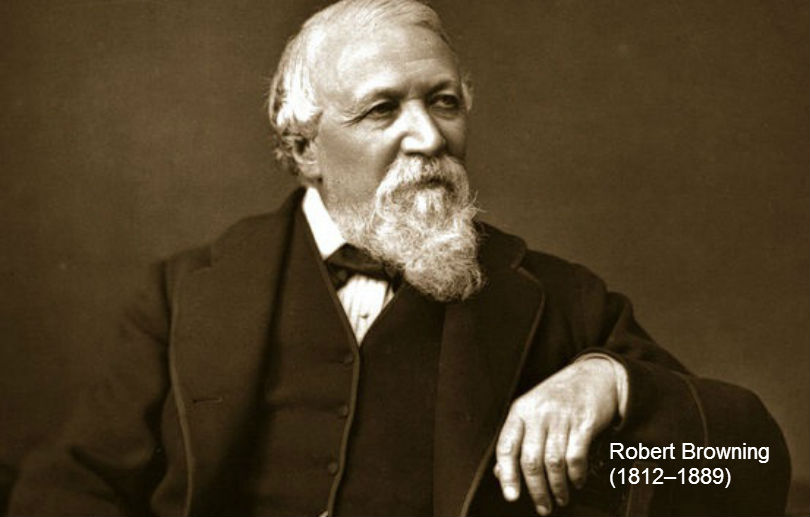
Robert Browning‘s long poem, “Pippa Passes,” published in 1841, is a verse drama, which means it was not written with the intention of any person staging a performance of it, and life ever since has fulfilled that lack of intention. The poem-as-play has not been performed by any notable theater company in more than a century. “Pippa Passes” is remembered for two things. Well, three things.

For one, it is remembered for not being remembered, for not living on in culture’s memory at all, even though at the time critics were quick to count it among Browning’s masterworks. Also, it is remembered because Browning accidentally used a vulgarity in it because he thought the slang word he used referred to a part of a nun’s habit. This was pointed out to him in his lifetime, and even though he made emendations in 1849 and 1863, he chose not to correct the one glaring one, and insisted that if he did not know it was a vulgarity, how was it a vulgarity?

Last, one line from it, a single line, lives on to this day as an expression we might hear more than once every day: “God’s in His heaven/All’s right with the world.” Young Pippa sings it.

(Shall I discuss the vulgarity below the fold?)
Read More