The First Paintings

The aurochs is an extinct form of cattle that overlapped with humans for tens of thousands of years. It lived in Europe, North Africa, and western Asia; the last one died in 1627. We domesticated it: Our modern-day beef cattle and dairy cows are descended from the aurochs and some of them bear a deep resemblance to the extinct animal. (Picture a bull in a bullfight, but make the animal taller and even more muscular; this would have made a bullfight a bit more even.) The reason for the extinction of the aurochs is the all-too familiar one, and it can be summed up as: Humans have enjoyed beef for a very long time.

Early modern humans, homo sapiens, showed up around 100,000 years ago, and we really started to leave a mark on the landscape around 40,000 years ago. This is deep in our prehistory, and no one knows what our Upper Paleolithic ancestors were thinking. It just appears that thinking is something they were doing.
Read More

A Moonless Night

At once sarcastic and tender, W.H. Auden’s “The More Loving One” asks us to imagine a night sky empty of stars:

Looking up at the stars, I know quite well
That, for all they care, I can go to hell,
But on earth indifference is the least
We have to dread from man or beast.

 
How should we like it were stars to burn
With a passion for us we could not return?
If equal affection cannot be,
Let the more loving one be me.

 
Admirer as I think I am
Of stars that do not give a damn,
I cannot, now I see them, say
I missed one terribly all day.

 
Were all stars to disappear or die,
I should learn to look at an empty sky
And feel its total dark sublime,
Though this might take me a little time.
— “The More Loving One,” W.H. Auden, 1957

I might very well like a starless sky and call it sublime or subtle in its black-on-black nuance, the poet declares, and not mourn the sight of a supernova, which is after all the explosive death of a star, and I may not notice the absence of one should it simply blink out, but in all matters, “If equal affection cannot be,/Let the more loving one be me.”

In all matters attracting my human attention, be it the night sky or my beloved’s face, let the more loving one be me.
Read More

An Untold Story

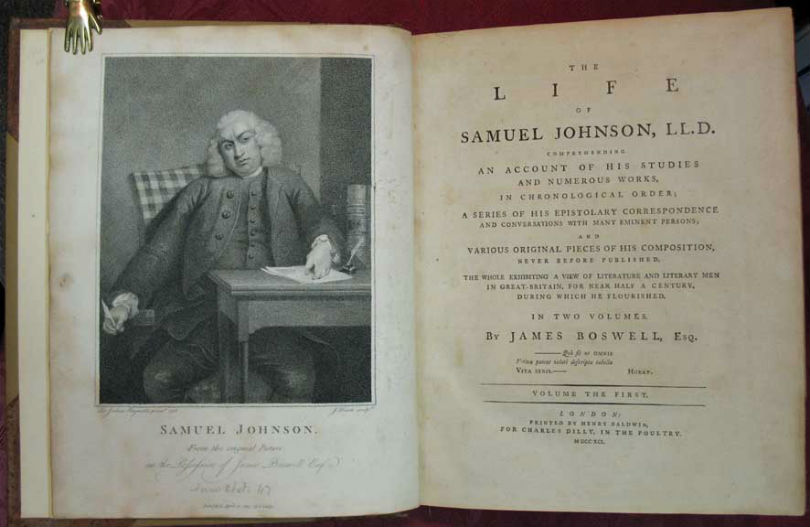
“We cannot tell the precise moment when friendship is formed. As in filling a vessel drop by drop, there is at last a drop which makes it run over; so in a series of kindnesses there is at last one which makes the heart run over.”—James Boswell, The Life of Samuel Johnson, LL.D.

Boswell’s “Life of Johnson” was published in 1791, a little more than six years after Johnson’s death. It is not a biography as readers may think of a biography: the recounting of incidents from a life of action. The poet W.H. Auden said that writers are “makers, not doers” and thus he, Auden, was not going to write his memoirs. We need biographies of the doers in order to learn what was happening behind the scenes, how close the men of action came to disaster and saved their (and sometimes, our) day, he suggested. Johnson’s life was the life of a man of letters, a life spent writing plays, compiling the first major English dictionary, compiling an edition of Shakespeare’s plays, writing weekly columns on every topic his extraordinary mind could entertain. He was a maker.
Read More