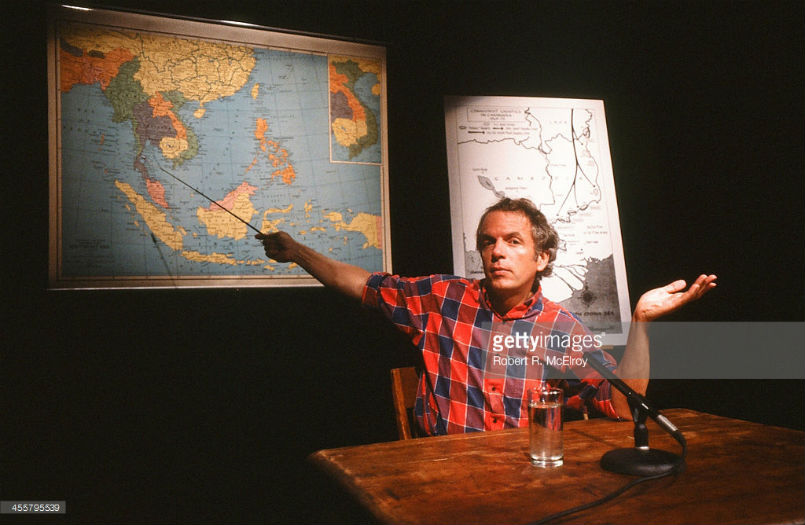
Meeting Spalding Gray

“I began to realize I was acting as though the world were going to end and this was helping lead to its destruction. The only positve act would be to leave a record. To leave a chronicle of feelings, acts, reflections, something outside of me, something that might be useful in the unexpected future.”—Spalding Gray, 1970, The Journals of Spalding Gray

Two friends and I started a theater company in the summer of 1990. Perhaps you have not heard about it; it was kind of a not-at-all-big deal in Poughkeepsie, New York, for almost two entire weeks. Call it ten days.

Our endeavor yielded one sell-out summer night’s performance in the open-air back porch of a bar, a bad review in our local daily newspaper, yet one more (mostly unattended) performance, and a bunch of t-shirts. With grad school beckoning we shut it down, and with time and many residences I lost our newspaper clippings and even eventually forgot the name of the “company” we had started.

My one t-shirt wound up in Spalding Gray’s hands. Spalding Gray was born 75 years ago today, which prompted this recollection of one of my more awkward moments with celebrity.
Read More

A Flying Circus

The only circus I have attended made its debut on the BBC on October 5, 1969. I was less than a year old that day and more than seven or eight years away from encountering it for the first time, on American television, PBS to be exact.

PBS, America’s Public Broadcasting Service, is a non-commercial broadcaster, and its hundreds of member stations must each do what they can to fill the broadcast day. This is less true for New York City’s PBS station, the famous Channel 13, or Los Angeles’s PBS station, as these two have many subscribers and can afford to create their own programs.

When the BBC started to make its programs available for sale in the 1970s, episodes of Monty Python’s Flying Circus started to appear on American television sets. On PBS stations, because the BBC was selling the rights for not very much money at all, as I understand it. As a viewer of Channel 13 when I was a pre-teen, because it aired many (inexpensive to produce) children’s television shows, I wound up seeing Monty Python’s Flying Circus at perhaps too young an age. Seven or eight. Perhaps my parents thought something along the lines of “It’s on Channel 13, and it says it is a ‘circus,’ so it must be a kid’s show.” To this day, I sometimes watch episodes of Monty Python with that thought—it’s a kids’ show—in mind.
Read More

‘Space Is the Place’

“Why did you stop playing the sax?” I asked a friend one day. He had been a Bebop player of growing reputation back in the ’50s but ended that career to become a poet.

“It never stopped sounding like a saxophone, no matter what I did,” was his reply. As a writer, he could transform things into words and words into things and essences into essentials, and also none of the above.
Read More