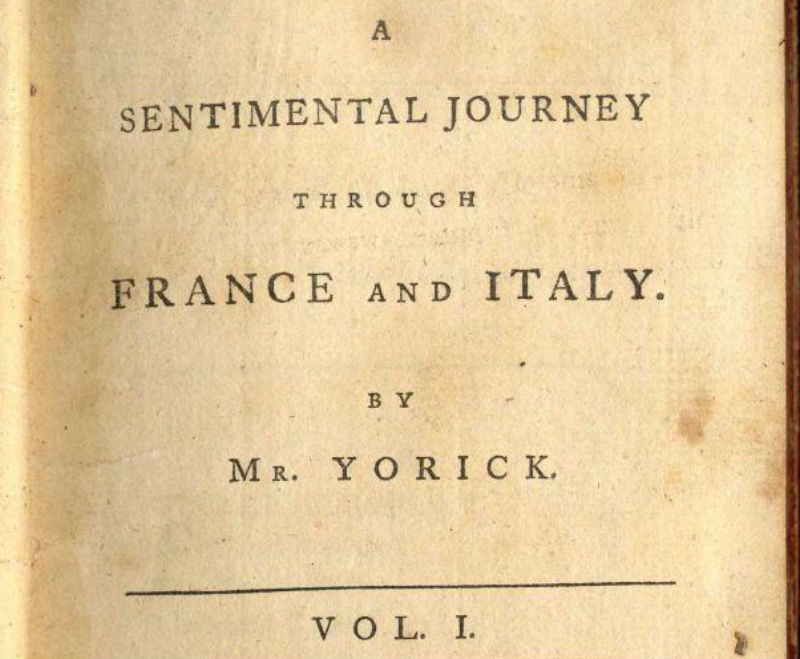
Sentimental Journeys

Laurence Sterne was dying of consumption, the polite yet dramatic term that people used to employ for pulmonary diseases, especially tuberculosis. He had contracted it by 1740, when he was still in his 20s, and he fought for his every breath for his remaining three decades of life.

In 1765, he left England in search of better breathing, and he traveled abroad to France and Italy. He was a surprise best-selling author by this point, a clergyman who had decided on a whim to start telling the life story of a character but by not telling it in a straightforward manner, to comically digress his way through The Life and Opinions of Tristram Shandy, Gentleman. One of the earliest novels in English or any language, “Shandy” was an instant success when its first two volumes started appearing in 1759.

The genre we call “travel writing” was not as common in the 1760s as it is now, and most works in that genre at that time were quite unsentimental: verbal pictures of natural phenomena and wonders of the man-made world and warnings-slash-complaints about the foreignness of foreigners on their strange home turf. In his 1765 journey, Sterne encountered fellow novelist Tobias Smollett, and the stern, dry Smollett left such an impression on the always amused Sterne that in his book, A Sentimental Journey Through France and Italy, he based a character named “Smelfungus” on Smollett. Nice revenge.
Read More

Starved for Attention

What I Did for ‘Like’

* * * *
In this social media-saturated (and social-media-about-social-media-saturated) era, in which both of my parents, one of them an octogenarian, have active Facebook accounts, and in which people who have told me to my face that they do not understand Twitter themselves have a couple thousand followers apiece on that very service, drawing attention to one’s writing or art or craft or charitable work without purchasing advertising time on the radio to scream for 30 continuous seconds can seem daunting. For me, a naturally quiet sort, sharing the publication of a new piece feels unnatural, like actually recording that 30-second Janovian advertisement. Screaming is so unseemly.

(Perhaps I will go ahead and record that.)

In the Peter Cook-Dudley Moore film, “Bedazzled,” poor Stanley Moon (Moore) wants the affection of Margaret (Eleanor Bron). The Devil, George Spigott (Peter Cook), offers him seven wishes to win her. In one, Stanley is a gold-lamé-costumed rock star whose new hit song “Love Me!” drives all the young women, including Margaret, wild. The lyrics, and Moore’s performance, are little more than him screaming for 30 seconds, “LOVE ME!”

The very next act, Drimble Wedge and the Vegetations, wins the entire screaming audience over to the Devil, George, as he speak-sings his dripping contempt for their affections towards him. “I’m self-contained. Leave me alone,” goes the new hit, and his dry loathing for them makes the women in the audience desire him all the more. Stanley gets run over by the crowd that once briefly adored him as it rushes to the Devil at the end of his song. (The video clip that follows below the fold here both takes up too much space and is set too loud. Brace your ears.)
Read More

Little Glass Houses

The architect Philip Johnson would have been 110 yesterday. He died in January 2005 at the age of 98, at his residence for the previous five decades: his famous Glass House (above), which he built in 1949.

The idea behind the house is intricately simple: walls are an interference (obviously) between us and the world. What if the views on your property provided your home’s natural walls? Of course, my cynical brain brings me to memories of neighborhoods in which I would have happily lived without any windows, where “the view” (not the TV show) was exactly what I did not want to see. Heck, my cynical brain brings me back to apartments in which there were not enough walls between me and … me.
Read More