Your Inner Bliss Moonlight and Madness: Follow It

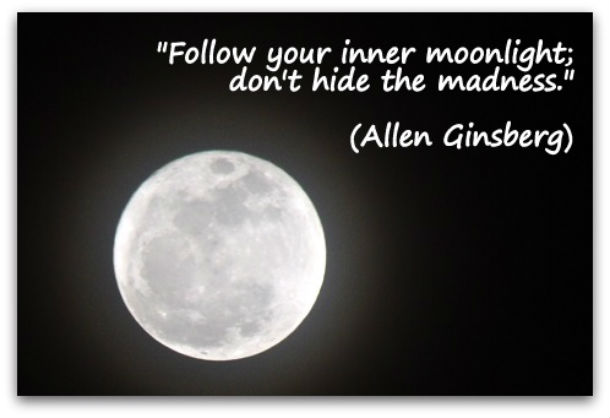
In his published works, Allen Ginsberg wrote not one single thing about moonlight and madness, yet there is a popular Internet meme—an Internet poster—usually seen with a handsome photo of our moon and the rousing declaration credited to him that you should “Follow your inner moonlight; don’t hide the madness.” (See above.)

It is a Bizarro World version of a speech given by a football coach at halftime. “Follow your inner moonlight, boys, and let’s win one for State! Don’t hide the madness!” (The team huddles together and starts to chant, quietly and slowly at first, but then they build it to a hypnotic intensity: “Don’t. Hide. The. Madness. Don’t. Hide. The. Madness.”)

But did Ginsberg, the bard of the Beats, ever write or say such a thing? Yes, no, and yes. According a post in the blog The Allen Ginsberg Project, exactly 25 years ago Ginsberg’s biographer Michael Schumacher interviewed Ginsberg about writing and inspiration and submitted the answer to a Writer’s Digest publication, “On Being a Writer,” which was a book that read more like a calendar of daily inspirations than a book. The writer at The Allen Ginsberg Project did the footwork and even wrote to Schumacher in the search for an answer, so credit must be given to that blog. The full piece is here: “The Mystery of the Inner Moonlight.”

What Ginsberg wrote to Schumacher was:

“It’s more important to concentrate on what you want to say to yourself and your friends. Follow your inner moonlight; don’t hide the madness. Take [William Carlos] Williams: until he was 50 or 60, he was a local nut from Paterson, New Jersey, as far as the literary world was concerned. He went half a century without real recognition except among his friends and peers.
“You say what you want to say when you don’t care who’s listening. If you’re grasping to get your own voice, you’re making a strained attempt to talk, so it’s a matter of just listening to yourself as you sound when you’re talking about something that’s intensely important to you.”

Long before, he had used one half of the declaration and wrote “Don’t hide the madness” in a poem in 1954. While he was editing William S. Burroughs’ novel “Naked Lunch” with Jack Kerouac, Ginsberg wrote “On Burroughs’ Work”:

On Burroughs’ Work
The method must be purest meat
and no symbolic dressing,
actual visions & actual prisons
as seen then and now.

Prisons and visions presented
with rare descriptions
corresponding exactly to those
of Alcatraz and Rose.

A naked lunch is natural to us,
we eat reality sandwiches.
But allegories are so much lettuce.
Don’t hide the madness.

For a writer who found his voice in compound nouns and lists of the super-specific details of his humdrum day (some graduate student must have tallied up the many grocery and other kinds of bills that he so frequently includes in his work; perhaps they won an assistantship), the minutiae of his existence, “reality sandwiches” was a great turn of phrase, so good it appears to have surprised the poet. He brings the work to its swift conclusion right there, lest he pile on some allegorical lettuce and bury the meat.

But moonlight? “Inner moonlight,” no less? That was a new one. In 1955, he had already written his best known, best regarded, poem, the long “Howl,” which was published the next year. Its opening line, “I saw the best minds of my generation destroyed by madness,” seems to tell of a hard-earned caution about the lunacy of following any moonlight, inner or not. But the madness in “Howl” is the pain of those “best minds” attempting to fit in with repressed and repressive society and finding their outlet in self-inflicted agony, trying to find a fix.

By 1989, Ginsberg knew that a phrase like “inner moonlight” voiced a sentiment akin to the similar—and similarly purposefully over-simplified— “follow your bliss” of Joseph Campbell. Both are inscribed in the long history of mal-understood phrases used by people to excuse bad, or self-centered, behavior. Neither one deserves that fate; neither phrase deserves many of the people who declare them as personal credos. (I am happy to report that every post I read in response to this question was an example of a writer genuinely not declaring anything, not anything at all. Writers follow their bliss and do not need to tell the world that they are doing so.)

A writer’s life is not often a conventional one and a writer’s wisdom is often a hard-earned one. Any writing that declares its “wisdom” as “hard-earned” or to be the product of following an inner blissful moonlight is usually missing its own point, and is thus conventional enough to be put on an Internet poster. But the “crazy wisdom” that Ginsberg and Corso and many of the Beats did manage to sometimes touch upon and stare directly at and give to their readers, that is always worth encountering for the first time over and over again.

* * * *
What did Allen Ginsberg’s voice sound like, his poet’s voice? Here is a recording, with music said to be by Tom Waits underneath.

____________________________________________
The WordPress Daily Prompt for October 3 asks, “‘Follow your inner moonlight; don’t hide the madness.’—Allen Ginsberg. Do you follow Ginsberg’s advice—in your writing and/or in your everyday life?”

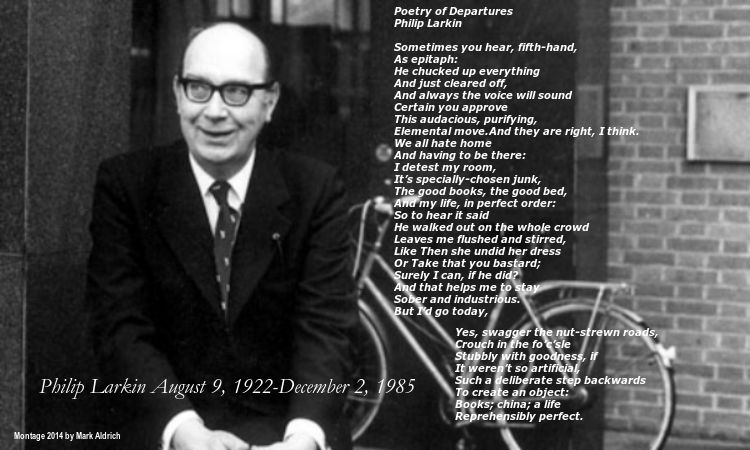
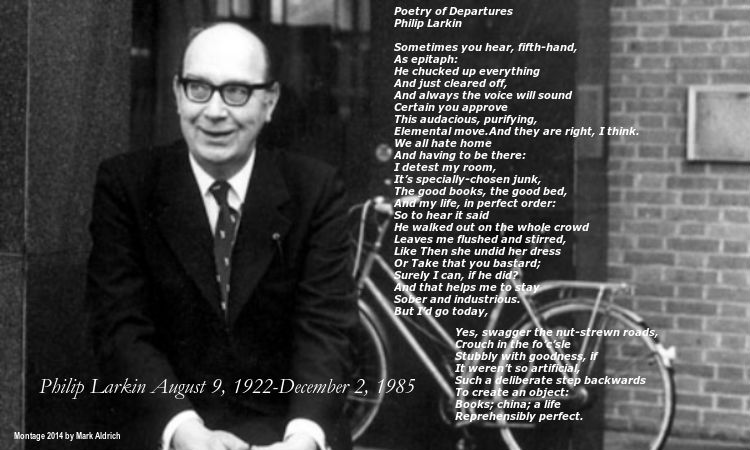
Philip Larkin, August 9, 1922–December 2, 1985

Philip-Larkin montage

Auden’s Decency

In the documentary, “Tell Me the Truth About Love,” W.H. Auden’s friend Thekla Clark recounts the story of one of Auden’s lovers complaining to him that he thought Auden would be more “romantic,” being a poet, after all. “But you aren’t romantic,” Clark quotes the lover telling the poet. “You aren’t romantic at all.”

“If you want romance,” Clark quotes Auden replying, “screw a journalist.” (Except she does not say “screw.”)

Auden was not one for ruining a good line—or a good night—by spending it explaining the difference between romance and sentimentality.

Auden’s poetry, often about love, derived from an almost clinical study of his own personal history and emotions. A professional poetic detachment yielded a poetry that was undisturbed by sentimentality. Yet Auden is also the least cynical and one of the most humane of the great poets.

One can not declare oneself humble. Humility and decency do not allow for advertising. The moment one discusses one’s virtues, one yields them. In the same documentary, “Tell Me the Truth About Love,” Auden tells the talk-show host Michael Parkinson that “a writer is a maker, not a man of action” so everything he writes is an autobiography, is his history of his experience transformed in his senses, and that, no, he would not be writing his memoirs. The autobiography of a man of action—a politician or general or activist—may be necessary to understand them.

(The clip starts around minute three. The documentary, which first aired on the BBC in 2000, is full of interviews with Auden and his circle. Once upon a time, talk shows featured literary figures; Michael Parkinson was the Johnny Carson or Dick Cavett of Britain, minus the jokes. Actually, Dick Cavett was the Parkinson of America.)

Auden learned the difference between a man of action and a maker early on, and he learned how tempting it could be to confuse the two. In the 1930s, while a young writer, he was made into a hero of the British left, and moved to America to reacquire his privacy. Edward Mendelson quotes Auden in “The Secret Auden,” in the current issue of the New York Review of Books: “I suddenly found I could really do it, that I could make a fighting demagogic speech and have the audience roaring … . It is so exciting but so absolutely degrading; I felt just covered with dirt afterwards.”

By the 1960s, both his politics (left) and his religion (he returned to the Anglican Church of his youth in 1940) were publicly known, but he was no longer a speech maker and never was a proselytizer. From Mendelson’s article:

When he felt obliged to stand on principle on some literary or moral issue, he did so without calling attention to himself, and he was impatient with writers like Robert Lowell whose political protests seemed to him more egocentric than effective. When he won the National Medal for Literature in 1967, he was unwilling either to accept it in Lyndon Johnson’s White House during the Vietnam War or “to make a Cal Lowell gesture by a public refusal,” so he arranged for the ceremony to be held at the Smithsonian, where he gave an acceptance speech about the corruption of language by politics and propaganda.”—The Secret Auden,”

To accept an award from one’s adopted country and relocate the ceremony from the heart of power to the nation’s museum, and then to turn the ceremony into a lecture about corruption is, when available, a different sort of bravery than an attempt to make one’s absence into a loud presence.

Edward Mendelson is Auden’s literary executor, and in the New York Review article, he reveals that he is still learning of some of Auden’s acts of decency, 40 years after the poet’s death. Charities he quietly funded, a manuscript donated for a sale to pay for a friend’s surgery, a prisoner who wrote him once and began a lifelong correspondence course in literature. Even the story of a woman from his congregation in Manhattan who “was suffering night terrors, so he took a blanket and slept in the hallway outside her apartment until she felt safe again.”

There is even this story, revealed last year in a letter to the Times of London:

Sixty years ago my English teacher brought me to London from my provincial grammar school for a literary conference. Understandably, she abandoned me for her friends when we arrived, and I was left to flounder. I was gauche and inept and had no idea what to do with myself. Auden must have sensed this because he approached me and said, “Everyone here is just as nervous as you are, but they are bluffing, and you must learn to bluff too.”

Auden knew, Mendelson writes, that good and evil exist, but that human beings fall on a spectrum between the two. Most are not evil people attempting to be saintly but good people striving to become better. There “are those who, like Auden, sense the furies hidden in themselves, evils they hope never to unleash, but which, they sometimes perceive, add force to their ordinary angers and resentments, especially those angers they prefer to think are righteous. On the other side are those who can say of themselves without irony, ‘I am a good person,’ who perceive great evils only in other, evil people whose motives and actions are entirely different from their own. This view has dangerous consequences when a party or nation, having assured itself of its inherent goodness, assumes its actions are therefore justified, even when, in the eyes of everyone else, they seem murderous and oppressive.” When one’s nation declares itself a force for good in the world, maybe one should make sure the passport is up-to-date. Auden once wrote, “Many a sore bottom finds/A sorer one to kick.”

We do not practice what we thoroughly possess. We say we “practice” kindness because we do not possess it, not to the degree that makes us kind. We practice love because we are not loving but can always be more so. The humble acts of decency and kindness may not change the universe, but they may change an individual’s universe. In the often misquoted line from his amused and amusing 1957 poem, “The More Loving One,” Auden says, “If equal affection cannot be,/Let the more loving one be me.”

* * * *
Mendelson mentions Thekla Clark in his New York Review article, in one more anecdote about Auden’s quiet defense of doing the right thing, and adds that he learned of this “in a documentary film, ‘Wystan: The Life, Love and Death of a Poet,’ by Michael Buergermeister, which had its premiere in Oxford last year.” It is the only mention I have found of this documentary. On Buergermeister’s own website, only this trailer for the film appears:

It is tantalizing.