Poetry
‘Dulce et decorum est’: Veterans Day 2014
“Their life consisted wholly and solely of war, for they were and always had been front-line infantrymen. They survived because the fates were kind to them, certainly—but also because they had become hard and immensely wise in animal-like ways of self-preservation.”—Ernie Pyle, World War II journalist, writing about what he saw at the front. Killed in action April 18, 1945.
(This is a revision of a column I first wrote a year ago.)
I do not come from a family that talks much about its military service. My father was drafted in 1958, served his two-year-long tour, and then came back home to a job that had been held for him. This was during the Cold War, so he did not see action but he did see more of the world than he had up till then, or since. He served in the U.S. Army in Germany during the Cold War as a calculator tasked with determining missile flight paths. (I believe he worked with the Atlas missile, an early ICBM model.)
His older brother, my uncle Richard, was a lifelong Army man who served from the 1950s into the ’70s. Richard was a combat veteran, but he never spoke of his experiences in Vietnam with any family member; my understanding is he would go silent for long periods so his letters home were not sent from Vietnam or associated military mailboxes in order to protect his family from the fear that he was in a dangerous combat zone.
Their father, my grandfather, was too young to enlist for action in the First World War, and by December 7, 1941, he was the father of four young sons and nearly 40, so our country did not call on him.
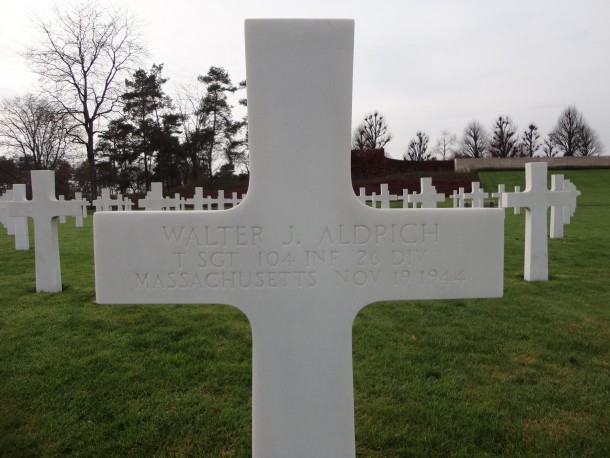
His younger brother, my great-uncle Walter, died in action in France in 1944. (My dad has been producing a family history and I did not know this fact until recently. At the top of this article is a photo from Find A Grave.com of Walter Aldrich’s gravestone in Lorraine American Cemetery, near Metz, France, one of 10,000 Americans buried in that cemetery. It is the largest American World War II cemetery in Europe.)

Purple Heart
The 104th Infantry Regiment, an element of the 26th Division, is one of the oldest in the country, having first been mustered in 1639 in Springfield, Massachusetts. This is the area of the country my part of the Aldrich family comes from. (It is a line that can be traced directly to the first Aldrich in America.) The 104th saw action at the Battle of Bunker Hill and at Gettysburg and is also known as the “Yankee” Division. Technical Sergeant Walter J. Aldrich, killed November 19, 1944, was awarded a Silver Star and a Purple Heart. (Here is a PDF of the division’s battle casualties. If you do not have Adobe Acrobat or if your browser does not open PDFs, do not click on it.)
According to an online history of the 26th Infantry “Yankee” Division: “On 15 November, after an intensive shelling, the Regiment took Marsal and Harracourt and assembled in the Foret de Bride et de Koecking to establish a defense along the Lindequin-Dieuze Road. In driving for the towns immediately east of the Foret de Bride et de Koecking to cut off railroad arteries that fed Metz, the Division ran up against a strong defensive position.” In some way, my great-uncle played a part in the fight for Metz, which the Allies re-took on November 17, and where he is buried.
My father wrote in his family history that Walter “enlisted in the Army on March 10, 1941. I remember Uncle Walter visiting us in South ‘Derry while wearing his uniform prior to being sent overseas. I wish now that when I was in the Army in 1958–1960 and stationed in Germany, I had known where he had been buried in France. I went to Paris, France, on a long weekend pass and would have gone to the cemetery to see his grave.”
There is a National Purple Heart Hall of Honor in New Windsor, NY, near where I live, but Walter Aldrich is not on their roster.
On my mother’s side of the family, my great-uncle Louis Miller also served in the Army in Europe in World War II, and he saw the concentration camps, a solemn thing for a American-born Jew to witness.
When I was 18 and struggling with the identity issues that 18-year-old boys are supposed to struggle with, but a bit more loudly than the New England side of my family was accustomed to witnessing, my Uncle Richard had some advice: “Take one step forward and raise your right hand.” Military service was what I needed, he made clear in his loving but curt way, and he was the only family member, friend, or guidance counselor in my life to offer this advice. A couple decades later and a few mistakes along the way, I wonder if he might not have been correct, but only because I remember that at the time, we were not at war.
* * * *
War is one of the least common shared experiences but is the one that writers and other artists most desire to capture in the moment, to make it seem a common shared experience. Many great works are the result of the attempt to make war real for those, like me, who have not and probably never will witness combat.
Each new generation at war masters new technologies for waging war and new ways to describe it. The Civil War brought new fighting machines and battlefield photography; the Second World War debuted mass anonymous bombing runs and heroic, large-scale battles—it was the war for novelists and filmmakers; the First World War was the war of chemical attacks, soul-crushingly slow trench warfare, and new mechanical technologies of death-creation sadly under-anticipated by those who were planning for yet another war fought in straight lines.
World War I was the absurd war, fought for reasons so complicated and obscure to the common fighting man that for Christmas Day 1914, an unofficial truce was declared by the soldiers on the battlefields of the Western Front and there, on the fields, carols were sung, holiday cards were exchanged between enemies, and joint burials of the battlefield dead were conducted by the opposing sides. It was the war for poets.
Wilfred Owen’s “Dulce et Decorum Est” (Latin for “it is sweet and right”) is a poem that attempts to capture a small moment of death in the large landscape of a battlefield shrouded in mustard gas. It calls the Horatian declaration that closes the poem, “Dulce et decorum est/Pro patria mori” (“Sweet and right it is to die/for one’s country”), “the old Lie,” and there the reason for the poet’s close study of a fellow soldier’s violent death is delivered. For Owen, there is no great message to be gleaned from recounting his comrade’s gurgling death other than the sad, empty absence of any message. You would not tell children eager for heroic tales, he concludes, you would not tell them of great glory, if you were to see and hear the “smothering dreams” of death that he has seen.
If any members of my family carried such “smothering dreams” in them from the military portions of their lives, they certainly did not attempt to convince any of us in the next generation of the beauty of “patria mori.” I suppose that that is an honorable silence. My uncle’s Vietnam combat stories were only for the ears of his VFW buddies and hunting partners.
Owen himself died on November 4, 1918, one week before peace was declared, on November 11. So I honor our patriots this Veterans Day by reading a poem that reminds us of the absence in the grit of war of any heroic message, a poem that some 96 years after it was composed probably better describes the unconventional battlefields seen in our current conflicts than many attempts today.
Dulce et Decorum Est—Wilfred Owen
Bent double, like old beggars under sacks,
Knock-kneed, coughing like hags, we cursed through sludge,
Till on the haunting flares we turned our backs
And towards our distant rest began to trudge.
Men marched asleep. Many had lost their boots
But limped on, blood-shod. All went lame; all blind;
Drunk with fatigue; deaf even to the hoots
Of tired, outstripped Five-Nines that dropped behind.Gas! Gas! Quick, boys!—An ecstasy of fumbling,
Fitting the clumsy helmets just in time;
But someone still was yelling out and stumbling
And flound’ring like a man in fire or lime…
Dim, through the misty panes and thick green light,
As under a green sea, I saw him drowning.In all my dreams, before my helpless sight,
He plunges at me, guttering, choking, drowning.If in some smothering dreams you too could pace
Behind the wagon that we flung him in,
And watch the white eyes writhing in his face,
His hanging face, like a devil’s sick of sin;
If you could hear, at every jolt, the blood
Come gargling from the froth-corrupted lungs,
Obscene as cancer, bitter as the cud
Of vile, incurable sores on innocent tongues,—
My friend, you would not tell with such high zest
To children ardent for some desperate glory,
The old Lie: Dulce et decorum est
Pro patria mori.
____________________________________________
The WordPress Daily Prompt for November 10 asks, “Fill in the blank: ‘Life is too short to _____.’ Now, write a post telling us how you’ve come to that conclusion.”
* * * *
Please subscribe to The Gad About Town on Facebook: http://www.facebook.com/thegadabouttown

A Work of Art That Is Both and Neither
Objects do not often speak for themselves. It takes the right artist or poet to find the voice the object demands.
I wish I still possessed a copy of my one published academic paper. I remember its subject but not its point. The late Thomas M. Greene was rumored to have liked it; he may have told someone who told another who eventually (a year later) mentioned to me that he considered my work “unique.” (In academia, “unique” is not always not a back-handed compliment, and if he had been my professor he might have asked me to make it a bit less unique.) Professor Greene was an invited guest to a symposium my graduate studies department was holding; I was one of about ten speakers. My work, unique or not, was not invited to Yale, which Professor Greene called home. I was working on George Herbert and Arcimboldo, who had little to do with one another but were both looking for that moment when a work of art transcends work or art.
George Herbert was an early 17th century poet and Anglican priest, though he might have flipped that order to tell you about himself. In a handful of poems, he gives voices to objects by shaping the poems. Each word is not merely necessary for the sake of meaning, it is needed for the poem to make sense visually. In his poem, “The Altar,” each word is a stone making up the altar that the poem is conceived as being:
A broken ALTAR, Lord, thy servant rears,
Made of a heart and cemented with tears;
Whose parts are as thy hand did frame;
No workman’s tool hath touch’d the same.
A HEART alone
Is such a stone,
As nothing but
Thy pow’r doth cut.
Wherefore each part
Of my hard heart
Meets in this frame
To praise thy name.
That if I chance to hold my peace,
These stones to praise thee may not cease.
Oh, let thy blessed SACRIFICE be mine,
And sanctify this ALTAR to be thine.
One word, a single syllable, too many or one word mislaid or deleted, and there is no altar there. It is an altar made of words but no less central to the life of a church than an altar made of stone. The poem appears in the only book of poems that he compiled himself, a book titled “The Temple,” which walks the reader, a “dejected poor soul,” through a church. Thus, the altar, “The Altar,” is central.
In later eras, poems like this came to be called shape or pattern or emblem poems. They are sometimes used to get elementary school students interested in, captivated by, poetry, the potential playfulness and the playful potentials of poetry. “The Altar” is not one of those poems given to elementary school kids with that playful ambition.
It is an altar, however. A “broken altar,” because words are shards of meaning like pieces of stone fitted together to make the church structure. A heart is the only perfect, unbroken, stone for worship, is the only true altar. But all that his heart can make is something out of these pieces of meaning, words, and if he can get out of his own way (“if I chance to hold my peace”), these words as assembled here only exist to worship and love. They are what they are, words, and the words each on their own are not an altar, and a spoken version of this poem is not an altar, either. When is an altar an altar? At what point is a poem something other than, more than, words on a page?
Printed on the page (or screen), it is an altar for Herbert’s church in book form. “The Temple” is like a 17th Century pop-up book for Anglican communicants.
Just before Herbert was writing his worshipful shape poems, an Italian painter named Guiseppe Arcimboldo was working in Milan. Arcimboldo died the year Herbert was born, 1593, and it is extremely unlikely Herbert ever heard of or saw replicas of Arcimboldo’s paintings. He may have understood them better than many contemporaries—by 1633, the year of Herbert’s death, Arcimboldo was already a forgotten figure in art, out of style, passé.
Arcimboldo openly toys with the conceit that what one is looking at is the thing it is depicting. His subject as an artist is the idea that a painting is only a painting and that you the viewer really do most of the work of “believing” that one is looking at something, some thing. This idea is similar to Herbert’s altar of words serving as an idea of an altar and as an altar at the same time.
When is a face a face and when is it a bowl of root vegetables? When is a painting a painting and something greater than a collection of chemicals on canvas?
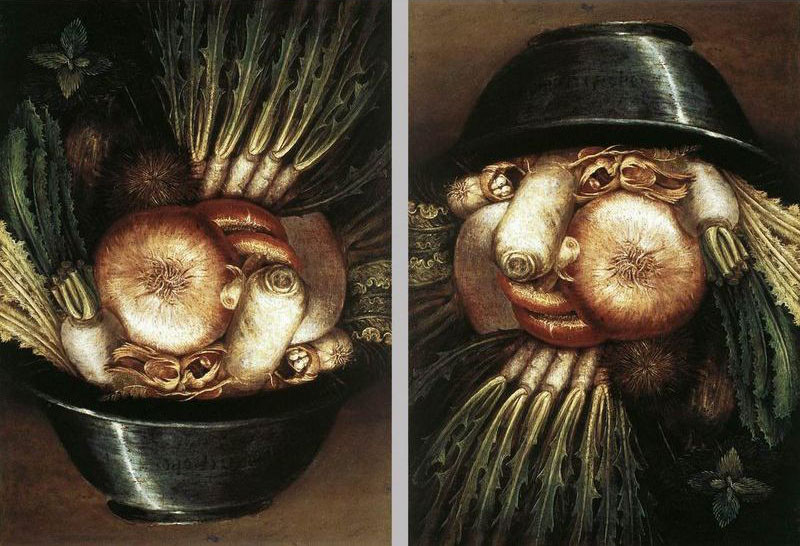
Vegetables In A Bowl, Or, The Gardener
As with Herbert’s “Altar,” one word, one vegetable, too many or one item mislaid, and there is no face there. It is as carefully assembled as all works of art that appear to be casually thrown together are. If only he had included the actual vegetables in the paints he used …
The Surrealists rediscovered Arcimboldo for themselves in the 1920s and ’30s, and his paintings have been popular ever since. Herbert never went out of fashion, because he was never a fashion. They are each the most humble of flashy artists, taking themselves out (“hold my peace”) of the way in the name of depicting an idea about ideas. An idea that was revolutionary in the 20th Century, that art did and did not depict anything and was its own thing, had precursors centuries earlier. A gardener is his vegetables, an altar has a worshipful voice; art is self-conscious in its forgetting of self.
____________________________________________
The WordPress Daily Prompt for November 7 asks, “Yesterday, your pet/baby/inanimate object could read your post. Today, they can write back (thanks for the suggestion, lifelessons!). Write a post from their point of view (or just pick any non-verbal creature/object).”
* * * *
Please subscribe to The Gad About Town on Facebook: http://www.facebook.com/thegadabouttown
 The Gad About Town