Words and Things

The only message worth devoting much time and effort to communicating is love. Today, a sad news day, is a good day to remember that.

A few months ago I wrote about two artists who played with the question of whether what they are depicting is anything more or less than words on a page or paint on a surface. Both George Herbert and Arcimboldo (and Andy Warhol, in his own way) make art of the question, What is art? Is it what it depicts, an idea about what it depicts, both at the same time (which makes it a third option), or something less than? Is art, by definition, always a misfire, in that a depiction of a thing is not the thing and never can be?

Arcimboldo painted portraits of character types rather than individuals; for instance, a librarian composed entirely of books or a gardener made of vegetables in a bowl. That latter painting depends on the viewer to decide to see the bowl filled with veggies or a human “face.”

When is a face a face and when is it a bowl of root vegetables? When is a painting a painting and something greater than a collection of chemicals on canvas?
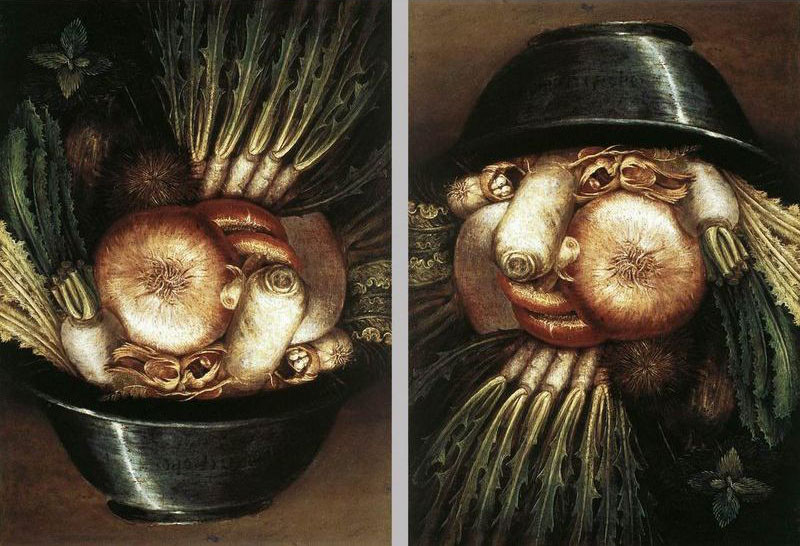
Vegetables In A Bowl, Or, The Gardener

George Herbert wrote poems about the only idea that he deemed to be worth considering: The eternal love of his Christian God and man’s time-and-space-and-language-constrained attempt to return that love. Two of his poems are written in the shape of what they are about. Like Arcimboldo painting a root vegetable for a nose, Herbert uses words to build an item; in one, “The Altar,” each word is a “stone” making up the altar that the poem is conceived as being:

A broken ALTAR, Lord, thy servant rears,
Made of a heart and cemented with tears;
Whose parts are as thy hand did frame;
No workman’s tool hath touch’d the same.
A HEART alone
Is such a stone,
As nothing but
Thy pow’r doth cut.
Wherefore each part
Of my hard heart
Meets in this frame
To praise thy name.
That if I chance to hold my peace,
These stones to praise thee may not cease.
Oh, let thy blessed SACRIFICE be mine,
And sanctify this ALTAR to be thine.

One word, a single syllable, too many or one word mislaid or deleted, and there is no altar there. It is an altar made of words but no less central to the life of a church than an altar made of stone. The poem appears in the only book of poems that he compiled himself, a book titled “The Temple,” which walks the reader, a “dejected poor soul,” through a church. Thus, his altar, “The Altar,” is central in the book. (At Herbert’s request, the book was published posthumously, with his stated desire that it might bring “consolation of [to] any dejected poor soul.”)

It is probably an untranslatable poem, in fact if not sentiment. (Indeed, an admittedly brief survey has not yielded one.) The shape of the poem is dictated by the number of syllables in his choice of words; it is a translation of an object, a real thing, into words anyway, and as such is forever a failure. It is a “broken altar.” The human heart is the only perfect, unbroken, stone for worship, is the only true altar. All that his mind can make is something out of these pieces of meaning, words, and if he can get out of his own way (“if I chance to hold my peace”), these words as assembled here only exist to worship and love. They are what they are, words, and the words each on their own are not an altar, and a spoken version of this poem is not an altar, either. When is an altar an altar? At what point is a poem something other than, more than, words on a page?

However well-constructed it may be—it looks like an altar, for crying out loud—it does not matter. It is no altar. Not even a photorealistic painting of an altar would be an altar. Further, no altar is truly an ALTAR, as no earthly object is made of the only stone of faith that exists: the human heart “cut” by God.

Herbert’s faith was that of a man for whom questions about faith were a part of it. His worship and his poetry exist in a space of failure, where a poem of an altar is not an altar but is a sort of altar, an attempt at one. His poetry depicts a figure who is struggling in every way to comprehend and return eternal love and who is met every time by a figure who replies that it is all a bit easier than he is making it. But all I have is language, Herbert’s speakers proclaim: “We say amiss / This or that is: / Thy word is all, if we could spell.”—”The Flower.”

Herbert often describes the moment when the perceiving of love comes easily, and it is always sensuous, often reads as if it is written to a new love:

Who would have thought my shriveled heart
Could have recovered greenness? It was gone
Quite underground; as flowers depart
To see their mother-root, when they have blown
—”The Flower”

But Herbert’s worshipper is always doubting himself, his faith, whether his faith is correct or not. In “Love (iii),” Herbert’s speaker is an unworthy guest in God’s (Love’s) home, but his host is gently persistent:

Love bade me welcome: yet my soul drew back.
Guiltie of dust and sinne.
But quick-ey’d Love, observing me grow slack
From my first entrance in,
Drew nearer to me, sweetly questioning
If I lack’d anything.

A guest, I answer’d, worthy to be here:
Love said, You shall be he.
I the unkinde, ungrateful? Ah, my deare,
I cannot look on thee.
Love took my hand, and smiling did reply,
Who made the eyes but I?

Truth Lord, but I have marr’d them: let my shame
Go where it doth deserve.
And know you not, sayes Love, who bore the blame?
My deare, then I will serve.
You must sit down, sayes Love, and taste my meat:
So I did sit and eat.

So if poetry is always at best an approximation of True Love, why not try to sing this struggle, as well? The “cheerfully agnostic” (which pretty much describes me, as well) English composer Ralph Vaughan Williams created five songs out of four Herbert poems a little over a century ago. The suite is called “Five Mystical Songs,” and one, “Love Bade Me Welcome,” is a setting of “Love (iii).” Some churches use the last song, “Antiphon,” as a hymn sung by the congregation.

Here is Sir Thomas Allen performing the set (in two sections) with the BBC Symphony Orchestra:

____________________________________________
The WordPress Daily Prompt for December 16 asks, “You have to write a message to someone dear to you, telling that person how much he/she means to you. However—instead of words, you can only use 5-10 objects to convey your emotions. Which objects do you choose, and what do they mean?”

* * * *
Please subscribe to The Gad About Town on Facebook: http://www.facebook.com/thegadabouttown

Bring Back the ABCs

About fifteen years ago, give or take, some friends and I started exchanging by email these twenty-six-word-long prose-poems which one of us took to calling “abecedarians,” because that is what they are called.

In Merriam-Webster, an abecedarian (noun) is a novice learning the rudiments, the beginning steps, of something. (How does one learn the alphabet?) My friends and I were turning an adjective into a noun: an “abecedarian sequence” is a set of things arranged alphabetically; we were writing abecedarians, twenty-six word paragraphs that sometimes almost meant something. It was our own invention.

(Actually it was not. Robert Pinsky, the former poet laureate, wrote an ABC poem, appropriately called “ABC”:

Any body can die, evidently. Few
Go happily, irradiating joy,

 
Knowledge, love. Many
Need oblivion, painkillers,
Quickest respite.

 
Sweet time unafflicted,
Various world:
X=your zenith.

And he found a terrible solution to the X Challenge, which confronts every pursuer of the perfect abecedarian. “X=your zenith.” Oh, sweet honey and the rock, that’s awful, but most of them are.

As my friend John, who started the thing off, wrote, “They are awfully fun to speed-write stream of consciously while at work or elsewhere.” Yes, at work. At the time, I was creating instruction manuals that had parts labeled A, B, and C on our illustrations (one had so many parts that it went around the alphabet and even used AA, BB, CC), so I could claim my abecedarians as work-related research.

Here are a few, which all date from spring 2001 and my work email account:

Alan’s bountiful charms developed even further God’s handiwork. “It justifies knives, leaving me nearly … oh, perfect. Questions? Rotten stuff, that ugliness.” Vigorously wiggles. “XXX!’ (Youth’s zenith.)

 
I have not included my friends’ offerings because they ought to be under their copyright, should they wish to ever use them. All of these are mine.
 

A bistro coffee (decaf) eventually forces growing humility: “It’s just Kona.” Let me notice our position: “Quality really sucks. Totally.” Underlined violently. Wow. Xed-out of your Zagats.
 
“Alright, boisterous Charles, dedicated event financier, go have imagined justice, Korean laughter. Man no open parapets! Question revolutions solving truth! Until vile wishes X-tend, Yours, Zebediah.”
 
Another behemoth cooed delightedly, elevating Father Gordon H. Ionesco’s jowls kinkily. “Lovely monster.” “Next opinion?” pressed Questa Rodriguez-Sanchez, totally unimpressed Vice-Warden. “X- X- X-” yammered Zionist.
 
Ambient balloons clownishly detour eccentric focaccia; gorgeous Hellespont invokes judicious knowledge; lovely millionaire Newton optimistically predicts qualm-free results, sending trivial ultimatums violently wandering; “‘xtraordinary,” yawns Zeus.
 
August Browning captures Dardanelles easily from Germany. He insists jokingly kangaroos leave momentarily; nodding openly, primly querying “Really? So they …”, urging Victor Watson: “X-coordinate! You Zed!”
 
A broken cut developed easily from goring hunters into juicy Kosciusko-less millions now, or perpetually, quelling righteous salves thick under victory while xaviering your zoo.
 
All boyos consider donuts easy food, guessing heavy-duty, intelligent judges know leisure-time munching no-way offers possible questions re: sluggish, tortoise-like, useless, vitamins, where X-Street’s youths zip by.

The abecedarian pieces filled my email world for a couple of months, with even my mother and sister joining the fray. According to my email account (my Yahoo mail, which is no longer my main email, but I keep it active as it is a historical record of fifteen-plus years of historical records), I attempted to revive the phenomenon five years later, which is now almost nine years ago. There were no takers. The abecedarian moment had been a flash in the pan.

One final piece of history: Some who are students of religion will remember that there was once a sect of Anabaptists in 16th Century Germany who called themselves “Abecedarians.” The Anabaptists did not call themselves this term, which roughly translates from Greek as people who “baptize twice.” They were ridiculed and worse, persecuted, for baptizing adults who had been baptized in infancy, but that was their point: Infants can not confess their faith, so they are not candidates for true baptism. Belief comes from within and baptism is for those who can understand. The Abecedarians took this further and held that all human knowledge is an impediment to being saved, that to even know the letters of the alphabet is to consciously block God’s word from the human heart. Hence their name.

A new one:

About Butch Cassidy Don English found good heightened information: Just knowing lies makes not one person quite really sated. Try under “Violence,” William Xavier. Yours, Zara

____________________________________________
The WordPress Daily Prompt for December 13, 2014, asks, “Write down the letters of the ABC. For each one, choose a word that begins with that letter. Now, write a post about anything—using all the words you’ve selected.”

* * * *
Please subscribe to The Gad About Town on Facebook: http://www.facebook.com/thegadabouttown

The One Who Got Away

More so for Sylvia Plath than many other writers, readers develop protective feelings for her. Many openly express the idea that “only they” get her or are her best reader. Reading biographies of the dead poet, one encounters language akin to a lover describing the one who got away. Plath, a suicide, is a love who got away, for reader after reader.

The other Plath scholars or even her casual readers (if such readers exist) are viewed as rival suitors, as dead wrong for her, as individuals mishandling her bones. Some biographers refer to her by her given name, “Sylvia,” rather by than her personal and professional name, Plath, thus treating her as a familiar. Others are deeply offended by this practice, which does indeed appear to be something reserved for this poet alone. It has the effect of making her the star of a soap opera that she never cast herself in.

(Until her death in 1995, I was friends with and a student of a Sylvia Plath scholar at SUNY New Paltz, Dr. Carley Bogarad. If ghosts existed, I wish hers was looking over my shoulder today.)

In a letter that she never sent to one of her lovers, Richard Sassoon, Plath wrote, “Perhaps when we find ourselves wanting everything, it is because we are dangerously close to wanting nothing.” The sentence was unseen by anyone, including Sassoon, until it was published in 2000, when her unabridged journals were finally published. (Thus Kris Kristofferson did not know he was echoing Sylvia Plath in his song, “Me and Bobby McGee.”) Since its publication, it has become a ubiquitous Tumblr meme, always attributed to Plath but rarely given in context. Did a character in her one novel, “The Bell Jar,” enunciate this emotional equation? Or did she, herself?

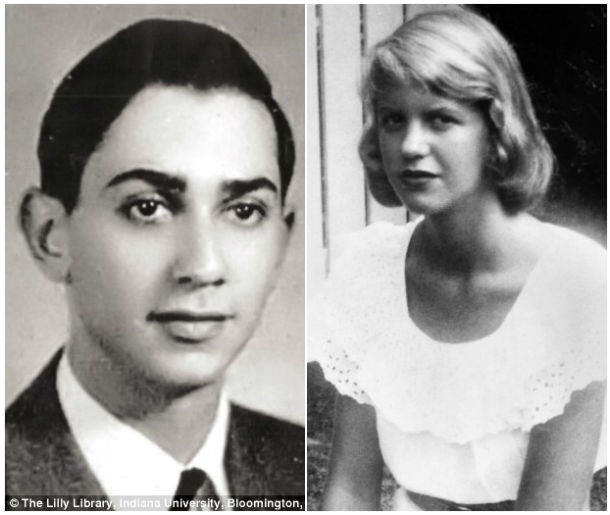
In the photo at top, Sassoon is seen as Plath would have known him, in the mid-1950s; next to him is a famous photo of Plath, also from that era.

Richard Sassoon was one of Plath’s lovers before her marriage to Ted Hughes. They met in 1954 and broke up a few years later. A literature student at Yale and a British citizen, Sassoon was different from the American boyfriends she had spent time with so far: He could keep up with her, intellectually and in other ways. In the official Plath list of lovers, he is “the one who got away,” as it was his absence that “catapulted” Plath onto the path that led her to Ted Hughes. (In Plath’s words, Hughes “blasted” Sassoon from her.)

At the beginning of 2013, two new biographies were published on the occasion of the 50th anniversary of her death. In both, Sassoon plays a spectral role in Plath’s story, but one of the biographers managed to contact him. Andrew Wilson wrote “Mad Girl’s Love Song: Sylvia Plath and Life Before Ted,” in which he argues that, had Sassoon not left Paris when Plath hunted him down to confront him over his feelings for her, she would not have returned to Hughes. Wilson at least made contact with Sassoon, who made it clear that he has not yet and will never speak of his long-dead lover. According to Wilson, Sassoon found Plath “as various as the sea.”

A professional biographer named Carl Rollyson published “American Isis: The Life and Art of Sylvia Plath” at the same time. (The first part is an unfortunate title in today’s international climate.) Wilson’s book is about Plath’s life before Hughes and Rollyson’s book is about her last days and the long fight over her works, legacy, and image fought between Hughes, Plath scholars (my teacher among them), and Hughes and Plath’s children. Rollyson has written many many biographies, mostly about movie stars (Marilyn Monroe) and literary figures (Plath, Susan Sontag); his own website makes it sound like he is interested in making the lives of literary figures seem more like those of movie stars and the movie stars appear more like literary figures. Since sex is a universal experience, period, it is certainly universal in these biographies.

But it is in Rollyson’s book that one finds something that almost could be a reply from Sassoon to Plath’s unsent letter and thus unenunciated thought about the closeness between wanting everything and wanting nothing. On page 79, he writes, “The arch and elusive Sassoon could be quite a trial at times. Here is trying to placate Plath:

‘Please do not say you do not know me. That has depressed me a little. … And do you think I know myself well enough to tell you? … I have said much about the world—surely not without some self-revelation. And I have made you smile, I have made you laugh—perhaps I have even made you cry—was this not me! and me alone?'”

She never sent the letter anyway, and Sassoon’s plea (which does not strike my ears as making him a “trial”) reveals a man who could live in the gray shades of life, embrace and be frustrated by the small smiles and cries, to a lover who lived with an all-or-nothing perspective. Her tempestuous life continued with another lover, Hughes.

In “The Bell Jar,” Plath’s heroine Esther Greenwood—who is often described by critics as Plath’s “alter ego”; the authorial fallacy seems to always be excused when discussing Plath’s works, but sometimes a writer’s creations are just that—Greenwood closes her narrative with another famous Plath quote: “I took a deep breath and listened to the old brag of my heart. I am, I am, I am.”

Plath’s writing remains vibrant and scary and vital. Its heart does indeed continue on.

____________________________________________
The WordPress Daily Prompt for December 9 asks, “‘Perhaps when we find ourselves wanting everything, it is because we are dangerously close to wanting nothing.’—Sylvia Plath”

* * * *
Please subscribe to The Gad About Town on Facebook: http://www.facebook.com/thegadabouttown