
Daily Prompt: Falling in Love with Falling in Love with a Place
The WordPress Daily Prompt for August 17 asks, “Take a look at your bookcase. If you had enough free time, which book would be the first one you’d like to reread? Why?”
__________________________________
On re-visiting Cape Cod this weekend, I remembered a favorite book, Henry Beston‘s “The Outermost House,” and decided to re-read it. I have not looked in its pages for 20 years and no longer own a copy. This sad situation was remedied with the money in my wallet being accepted at Yellow Umbrella Books. Since I was on vacation on Cape Cod, finding enough free time to re-read was not an issue.
Beston himself wrote perhaps the best physical description of Cape Cod in the book’s opening lines: “East and ahead of the coast of North America, some thirty miles and more from the inner shores of Massachusetts, there stands in the open Atlantic the last fragment of an ancient and vanished land. For twenty miles this last and outer earth faces the ever hostile ocean in the form of a great eroded cliff of earth and clay, the undulations and levels of whose rim now stand a hundred, now a hundred and fifty feet above the tides. Worn by the breakers and the rains, and disintegrated by the wind, it still stands bold.” He depicts a heroic shoreline, a land that declares its own terms of surrender against a hostile, battering sea. Given that Cape Cod resembles a single raised fist jutting in the air, a heroic, Byronesque, cliff face is only appropriate.
 The house itself was a 20 x 16-foot cabin that Beston ordered built on the dunes near Eastham, Massachustts, along the Cape’s forearm, in 1925. It faced the ocean, and its many windows offered him a view of the water that made him feel like he was on a ship. Thus he called the house the “Fo’castle,” but it became known as the “outermost house” for an obvious reason: it sat at what seemed like the end of the earth. Beston never lived full-time in his shanty, but he spent enough time there to write his book which is subtitled, “A Year of Life on The Great Beach of Cape Cod.” Picking epic-seeming events from each of the seasons he experienced gives his “year” an intensity of action and feeling. The book was published in 1928 by Doubleday.
As a young man, I knew that I loved Cape Cod, for reasons of family and fun, but it was not until I devoured this short, 218-page, book, that I found the deeper reasons. It would be beautiful if every place on our planet could have a writer fall so utterly in love with it, as Cape Cod had Henry Beston. Beston’s brief meditation on the slow, usually imperceptible rhythms of nature—imperceptible because few bother to perceive them and communicate them—is written in a muscular language that makes the surf appear to have desires and dreams, the wind have language, the birds individual personalities.
It is not easy to take memorable landscape photos; the camera may capture every detail of a very detailed outdoors scene, but a photographer’s eye and hand is needed to direct our eyes to what he or she finds worth looking at. Otherwise, every beach snapshot is every other beach snapshot; they are alike in their uniqueness of sky and sand. The nature writer has even more difficulties: he could either be yelping on the page, “It was such a stupendous night sky full of stars! You should have seen it,” boring us with banal generalities, or, lurching in the other direction, boring us to tears with specifics. Beston finds the poetry in using the correctly applied terminology of whatever phenomena he describes. This was a revelation to my twenty-year-old self.
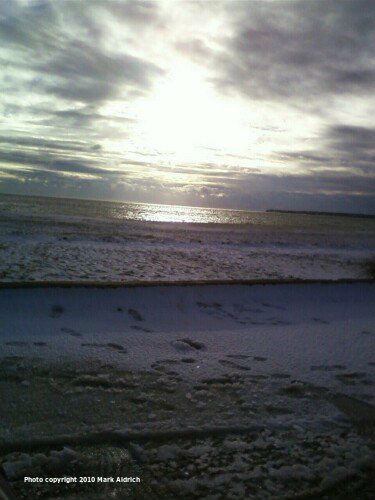
Cape Cod, winter 2010. Photo by The Gad About Town
Winter from atop the dunes is neither “frigid” nor “bitter,” two words that may frequent one’s letters home; rather it is “crystalline” and the snow is dancing and driving:
The snow skirred along the beach, the wind suffering it no rest; I saw little whirlpools of it driving down the sand into the onrush of the breakers, it gathered in the footprints of the coast guard patrols, building up on their leeward side and patterning them in white on an empty beach. The very snow in the air had a character of its own, for it was the snow of the outer Cape and the North Atlantic, snow icy and crystalline, and sweeping across the dunes and moors rather than down upon them.
When the National Park Service was evaluating the arguments for establishing the Cape Cod National Seashore, Beston’s book was cited frequently in the report’s pages. Beston died in 1968, and a sentence from “The Outermost House” is an epitaph: “Creation is still going on, the creative forces are as great and active today as they have ever been, and tomorrow’s morning will be as heroic as any of the world.” The cabin itself was swept away by the Blizzard of 1978, a nor’easter of heroic strength with historic effects; in other words, a storm that Henry Beston would have appreciated. The spot on the beach where the cabin stood, once atop the dunes, is now under the Atlantic Ocean, a portion of the Cape that the sea has claimed for itself.
No single development at any one location on the beach would have phased this wondering, passionate naturalist and writer, though:
And what of Nature itself, you say—that callous and cruel engine, red in tooth and fang? Well, it is not so much an engine as you think. As for “red in tooth and fang,” whenever I hear that phrase or its intellectual echoes I know that some passer-by has been getting life from books. It is true that there are grim arrangements. Beware of judging them by whatever human values are in style. As well expect Nature to answer to your human values as to come into your house and sit in a chair. The economy of nature, its checks and balances, its measurements of competing life—all this is its great marvel and has an ethic of its own. Live in Nature, and you will soon see that for all its non-human rhythm, it is no cave of pain.
* * * *
A documentary about Henry Beston and Outermost House is in production:
Henry Beston Documentary Trailer : Cape Cod from Mooncusser Films LLC on Vimeo.
 The Gad About Town