
Good Old Days Ahead, Right Behind You

In 1926, Henry Watson Fowler published “A Dictionary of Modern English Usage,” a book that has remained in print ever since. (The first edition and the second edition use Fowler’s sentences; the third edition, which was published in 1996, is a substantial rewriting of the classic and uses the Fowler name as a form of brand.) Fowler’s book is not a dictionary of definitions, like Johnson’s or Webster’s, it is a usage dictionary, an instructional manual for better using this beautiful tool we have devised called the English language.

Its entries give instructions on pronunciation, offer the pros and cons of employing a variety of idiomatic expressions, and argue again and again for simplicity in expression. Many style guides have followed—the MLA, the AP, the Chicago Manual—and each one is more useful in answering day-to-day questions about one’s writing than is Fowler but none is as entertaining as his. His fight was a fight against cliché, obfuscation, and empty rhetoric.

He fought against pointless rules. One might think from the description of his work that he is the reason for the commonplace rule against ending a sentence with a preposition. The opposite is true. In a two-page essay on the topic (two pages!), titled, “Preposition at end,” he writes:

It was once a cherished superstition that prepositions must be kept true to their name and placed before the word they govern in spite of the incurable English instinct for putting them late (‘They are the fittest timber to make great politics of,” said Bacon; and ‘What are you hitting me for?’ says the modern schoolboy). ‘A sentence ending in a preposition is an inelegant sentence’ represents what used to be a very general belief and it is not yet dead. […] The fact is that the remarkable freedom enjoyed by English in putting its prepositions late and omitting its relatives is an important element in the flexibility of the language.

Fowler then gives many examples (two pages!) of worse blunders made by pointlessly hewing to this nonexistent “prepositions go here” rule. And the way he uses his examples, for instance his pairing of the Renaissance philosopher Francis Bacon with generic “modern schoolboy,” displays his desire to keep a light hand on one’s writing.

His entry on the use of the word “literally” anticipates the world in which we now live, a world in which that word means almost nothing in the way we use it:

We have come to such a pass with this emphasizer that where the truth would require us to insert with a strong expression, ‘Not literally, of course, but in a manner of speaking,’ we do not hesitate to insert the very word that we ought to be at pains to repudiate. Such false coin makes honest traffic in words impossible. (Emphasis mine.)

The “literally” problem has literally bedeviled anyone who cares about precision in language for almost a century.

Fowler wanted writers to avoid using the obscure metaphor merely because it is commonly employed. Hence his entry on the idiomatic expression, “salad days”:

Salad days (one’s raw youth) is one of the phrases whose existence depends on single passages (see Antony and Cleopatra, ‘My salad days when I was green in judgement’). Whether the point is that youth, like salad, is raw, or that salad is highly flavoured and youth loves high flavours, or that innocent herbs are youth’s food as milk is babes’ and meat is men’s, few of those who use the phrase could perhaps tell us; if so, it is fitter for parrots’ than for human speech.

Avoid the empty turn of phrase unless one is making a point of the phrase’s emptiness.

Fowler died on Christmas Day 1933, at the age of 75. He had recently completed his work on the first edition of the “Shorter Oxford English Dictionary,” a two-volume version of the full, twenty-volume, 20,000-page, Oxford English Dictionary. In 1928, a few years before his death, Oxford offered to pay the wages of a servant to help him speed the work along (dictionaries always take longer to put together than first supposed) and he refused the help in a memorable letter. At age 68, he described his day thus:

My half-hour from 7:00 to 7:30 this morning was spent in (1) a two-mile run along the road, (2) a swim in my next-door neighbor’s pond—exactly as some 48 years ago I used to run round the Parks and cool myself in Parson’s Pleasure (an Oxford locale). That I am still in condition for such freaks I attribute to having had for nearly 30 years no servants to reduce me to a sedentary and all-literary existence. And now you seem to say: Let us give you a servant, and the means of slow suicide and quick lexicography. Not if I know it: I must go my slow way.

Help meant a slow suicide but a faster dictionary. Fowler needed no cliché to tell Oxford that he was living in his “salad days” in the here and right-now. If the friend I quoted above had not overlapped with H.W. Fowler on this planet for a year or so, and if reincarnation was an actuality … well, it would appear they were cut from a similar cloth.

For most of us—not all of us, certainly, because sadness and horror and terror are ever-present and ever-possible, but for most of us—these are the good old days. And “tomorrow is just your future yesterday,” as one former late-night host once sang it.

____________________________________________
The WordPress Daily Prompt for November 18 asks, “Is there a period in your own personal life that you think of as the good old days? Tell us a story about those innocent and/or exciting times (or lack thereof).”

* * * *
Please subscribe to The Gad About Town on Facebook: http://www.facebook.com/thegadabouttown
‘The Stuff That Dreams Are Made Of’

Alfred Hitchcock is credited with coining the term “MacGuffin,” but not the thing itself, which has been around since people started telling stories to each other. In plot terms, but not theological ones, the apple in Genesis is a MacGuffin.

Neither of the two most famous examples of a MacGuffin in film history appear in Hitchcock films, but he used the device quite frequently in his many movies (he directed more than 50 films from the 1920s through the ’70s).

In 1962, his fellow film director François Truffaut interviewed Hitchcock. The interviews were recorded and transcribed into a book, “Hitchcock/Truffaut,” published in 1967, and the subject came up:

You may be wondering where the term [MacGuffin] originated. It might be a Scottish name, taken from a story about two men on a train. One man says, “What’s that package up there in the baggage rack?” And the other answers, “Oh, that’s a MacGuffin”. The first one asks, “What’s a MacGuffin?” “Well,” the other man says, “it’s an apparatus for trapping lions in the Scottish Highlands.” The first man says, “But there are no lions in the Scottish Highlands,” and the other one answers, “Well then, that’s no MacGuffin!” So you see that a MacGuffin is actually nothing at all.

One wonders where Hitchcock had ever heard this story or if he merely invented it, since “two strangers meet on a train” could serve as a Movie Guide description for several of his plots. Hitchcock loved floating plot ideas and ideas of plots inside plots in interviews and pursued several dozen into film immortality. One has always stayed with me and I think I read it in the “Hitchcock/Truffaut” interview.

As I recall the scene he described, his lead character, played Cary Grant or James Stewart (of course) would meet with a man who runs a factory, an automated car assembly line. In a single-camera shot, the two men would walk along the line, discussing whatever it is that Grant or Stewart is searching for, and alongside them for the whole chat would be a car as it is assembled from frame to finished vehicle. The audience is supposed to barely notice the car or that the two men have been talking alongside only one car as it has acquired an engine, a roof, doors, mirrors. At the end of the line, Cary Grant happens to open the driver’s door and a body falls out. We’ve seen the same car all the way through, from when there was no place to hide a body all the way to completion, and … I think Hitchcock dismissed it in the interview with Truffaut as being an awful lot of work with too distracting a payoff.

In “Pulp Fiction,” what is inside Marcellus Wallace’s briefcase? We never find out. Perhaps it is a “royale with cheese.” Everything in that movie has to do with getting, delivering, or protecting that case. What is Charles Foster Kane’s “Rosebud” in “Citizen Kane”? In one movie, the question is answered and in the other it is not, and one could argue that neither movie would be fundamentally different if this statement was reversed. Remember how “Star Wars” starts to unfold, what it is “about”: getting R2-D2 to Obi-Wan Kenobi because there is a message from Princess Leia hidden inside.

Complications ensue.

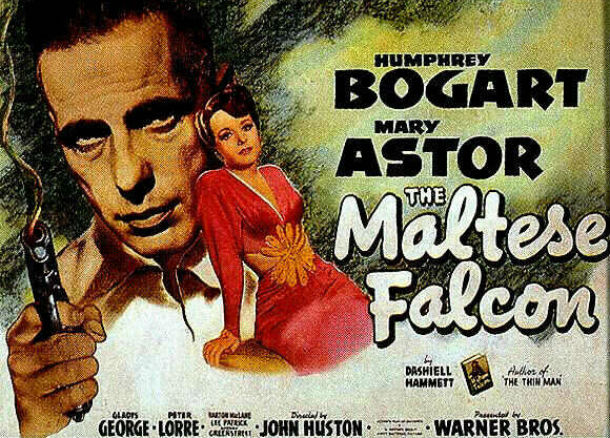
A MacGuffin is the reason or, really, excuse, for all the characters to be in the movie (even if one of the characters is a MacGuffin him or herself) and for all of or most of the action in the plot, but it is not what the movie is about. The “holy grail” is literally not the “Holy Grail.” In “The Maltese Falcon,” Mary Astor’s character Brigid O’Shaughnessy asks Sam Spade if he would (be doing what he is about to do) if (money had possibly been acquired). (How was that for avoiding a spoiler?)

The falcon, jewel-encrusted treasure of centuries past, or not, is an innocent bystander for the entire movie. It sure looks like it is worth multiple lives, double- and triple-cheating, the sacrifice of love both real and imagined. As Det. Polhaus says in the second-to-last line, it sure is “heavy. What is it?” Sam Spade replies, and this is no spoiler even though it is the final line, “The, uh, stuff that dreams are made of.”

In any movie, if there is a box or a room that has remained locked or hidden in plain sight, the movie really is about the drive to unlock it or the search for a key and what a character might be willing to endure to acquire that key. The reward is in the journey and whatever it is you think the key is unlocking, it isn’t. In the broadest sense, having a story line at all is something of a MacGuffin.

____________________________________________
The WordPress Daily Prompt for November 17 asks, “You’ve been given a key that can open one building, room, locker, or box to which you don’t normally have access. How do you use it, and why?”

* * * *
Please subscribe to The Gad About Town on Facebook: http://www.facebook.com/thegadabouttown

‘Dulce et decorum est’: Veterans Day 2014

“Their life consisted wholly and solely of war, for they were and always had been front-line infantrymen. They survived because the fates were kind to them, certainly—but also because they had become hard and immensely wise in animal-like ways of self-preservation.”—Ernie Pyle, World War II journalist, writing about what he saw at the front. Killed in action April 18, 1945.

(This is a revision of a column I first wrote a year ago.)

I do not come from a family that talks much about its military service. My father was drafted in 1958, served his two-year-long tour, and then came back home to a job that had been held for him. This was during the Cold War, so he did not see action but he did see more of the world than he had up till then, or since. He served in the U.S. Army in Germany during the Cold War as a calculator tasked with determining missile flight paths. (I believe he worked with the Atlas missile, an early ICBM model.)

His older brother, my uncle Richard, was a lifelong Army man who served from the 1950s into the ’70s. Richard was a combat veteran, but he never spoke of his experiences in Vietnam with any family member; my understanding is he would go silent for long periods so his letters home were not sent from Vietnam or associated military mailboxes in order to protect his family from the fear that he was in a dangerous combat zone.

Their father, my grandfather, was too young to enlist for action in the First World War, and by December 7, 1941, he was the father of four young sons and nearly 40, so our country did not call on him.

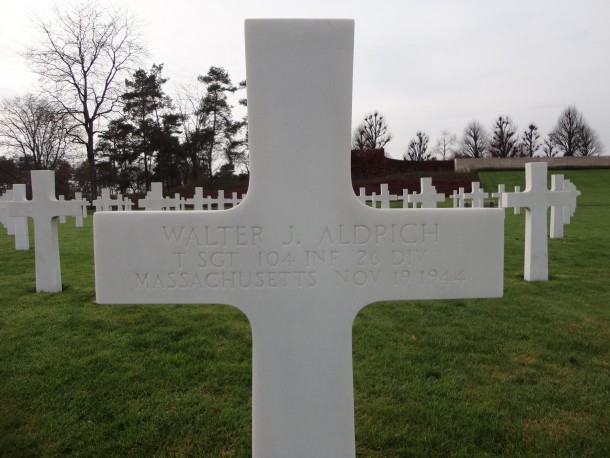
His younger brother, my great-uncle Walter, died in action in France in 1944. (My dad has been producing a family history and I did not know this fact until recently. At the top of this article is a photo from Find A Grave.com of Walter Aldrich’s gravestone in Lorraine American Cemetery, near Metz, France, one of 10,000 Americans buried in that cemetery. It is the largest American World War II cemetery in Europe.)

Purpleheart

Purple Heart

The 104th Infantry Regiment, an element of the 26th Division, is one of the oldest in the country, having first been mustered in 1639 in Springfield, Massachusetts. This is the area of the country my part of the Aldrich family comes from. (It is a line that can be traced directly to the first Aldrich in America.) The 104th saw action at the Battle of Bunker Hill and at Gettysburg and is also known as the “Yankee” Division. Technical Sergeant Walter J. Aldrich, killed November 19, 1944, was awarded a Silver Star and a Purple Heart. (Here is a PDF of the division’s battle casualties. If you do not have Adobe Acrobat or if your browser does not open PDFs, do not click on it.)

According to an online history of the 26th Infantry “Yankee” Division: “On 15 November, after an intensive shelling, the Regiment took Marsal and Harracourt and assembled in the Foret de Bride et de Koecking to establish a defense along the Lindequin-Dieuze Road. In driving for the towns immediately east of the Foret de Bride et de Koecking to cut off railroad arteries that fed Metz, the Division ran up against a strong defensive position.” In some way, my great-uncle played a part in the fight for Metz, which the Allies re-took on November 17, and where he is buried.

My father wrote in his family history that Walter “enlisted in the Army on March 10, 1941. I remember Uncle Walter visiting us in South ‘Derry while wearing his uniform prior to being sent overseas. I wish now that when I was in the Army in 1958–1960 and stationed in Germany, I had known where he had been buried in France. I went to Paris, France, on a long weekend pass and would have gone to the cemetery to see his grave.”

There is a National Purple Heart Hall of Honor in New Windsor, NY, near where I live, but Walter Aldrich is not on their roster.

On my mother’s side of the family, my great-uncle Louis Miller also served in the Army in Europe in World War II, and he saw the concentration camps, a solemn thing for a American-born Jew to witness.

When I was 18 and struggling with the identity issues that 18-year-old boys are supposed to struggle with, but a bit more loudly than the New England side of my family was accustomed to witnessing, my Uncle Richard had some advice: “Take one step forward and raise your right hand.” Military service was what I needed, he made clear in his loving but curt way, and he was the only family member, friend, or guidance counselor in my life to offer this advice. A couple decades later and a few mistakes along the way, I wonder if he might not have been correct, but only because I remember that at the time, we were not at war.

* * * *
War is one of the least common shared experiences but is the one that writers and other artists most desire to capture in the moment, to make it seem a common shared experience. Many great works are the result of the attempt to make war real for those, like me, who have not and probably never will witness combat.

Each new generation at war masters new technologies for waging war and new ways to describe it. The Civil War brought new fighting machines and battlefield photography; the Second World War debuted mass anonymous bombing runs and heroic, large-scale battles—it was the war for novelists and filmmakers; the First World War was the war of chemical attacks, soul-crushingly slow trench warfare, and new mechanical technologies of death-creation sadly under-anticipated by those who were planning for yet another war fought in straight lines.

World War I was the absurd war, fought for reasons so complicated and obscure to the common fighting man that for Christmas Day 1914, an unofficial truce was declared by the soldiers on the battlefields of the Western Front and there, on the fields, carols were sung, holiday cards were exchanged between enemies, and joint burials of the battlefield dead were conducted by the opposing sides. It was the war for poets.

Wilfred Owen’s “Dulce et Decorum Est” (Latin for “it is sweet and right”) is a poem that attempts to capture a small moment of death in the large landscape of a battlefield shrouded in mustard gas. It calls the Horatian declaration that closes the poem, “Dulce et decorum est/Pro patria mori” (“Sweet and right it is to die/for one’s country”), “the old Lie,” and there the reason for the poet’s close study of a fellow soldier’s violent death is delivered. For Owen, there is no great message to be gleaned from recounting his comrade’s gurgling death other than the sad, empty absence of any message. You would not tell children eager for heroic tales, he concludes, you would not tell them of great glory, if you were to see and hear the “smothering dreams” of death that he has seen.

If any members of my family carried such “smothering dreams” in them from the military portions of their lives, they certainly did not attempt to convince any of us in the next generation of the beauty of “patria mori.” I suppose that that is an honorable silence. My uncle’s Vietnam combat stories were only for the ears of his VFW buddies and hunting partners.

Owen himself died on November 4, 1918, one week before peace was declared, on November 11. So I honor our patriots this Veterans Day by reading a poem that reminds us of the absence in the grit of war of any heroic message, a poem that some 96 years after it was composed probably better describes the unconventional battlefields seen in our current conflicts than many attempts today.

Dulce et Decorum Est—Wilfred Owen
Bent double, like old beggars under sacks,
Knock-kneed, coughing like hags, we cursed through sludge,
Till on the haunting flares we turned our backs
And towards our distant rest began to trudge.
Men marched asleep. Many had lost their boots
But limped on, blood-shod. All went lame; all blind;
Drunk with fatigue; deaf even to the hoots
Of tired, outstripped Five-Nines that dropped behind.

Gas! Gas! Quick, boys!—An ecstasy of fumbling,
Fitting the clumsy helmets just in time;
But someone still was yelling out and stumbling
And flound’ring like a man in fire or lime…
Dim, through the misty panes and thick green light,
As under a green sea, I saw him drowning.

In all my dreams, before my helpless sight,
He plunges at me, guttering, choking, drowning.

If in some smothering dreams you too could pace
Behind the wagon that we flung him in,
And watch the white eyes writhing in his face,
His hanging face, like a devil’s sick of sin;
If you could hear, at every jolt, the blood
Come gargling from the froth-corrupted lungs,
Obscene as cancer, bitter as the cud
Of vile, incurable sores on innocent tongues,—
My friend, you would not tell with such high zest
To children ardent for some desperate glory,
The old Lie: Dulce et decorum est
Pro patria mori.

____________________________________________
The WordPress Daily Prompt for November 10 asks, “Fill in the blank: ‘Life is too short to _____.’ Now, write a post telling us how you’ve come to that conclusion.”

* * * *
Please subscribe to The Gad About Town on Facebook: http://www.facebook.com/thegadabouttown