Dulce et Decorum Est

“Their life consisted wholly and solely of war, for they were and always had been front-line infantrymen. They survived because the fates were kind to them, certainly—but also because they had become hard and immensely wise in animal-like ways of self-preservation.”—Ernie Pyle, World War II journalist, writing about what he saw at the front. Killed in action April 18, 1945.

Read More

The Greatest Story Never Told

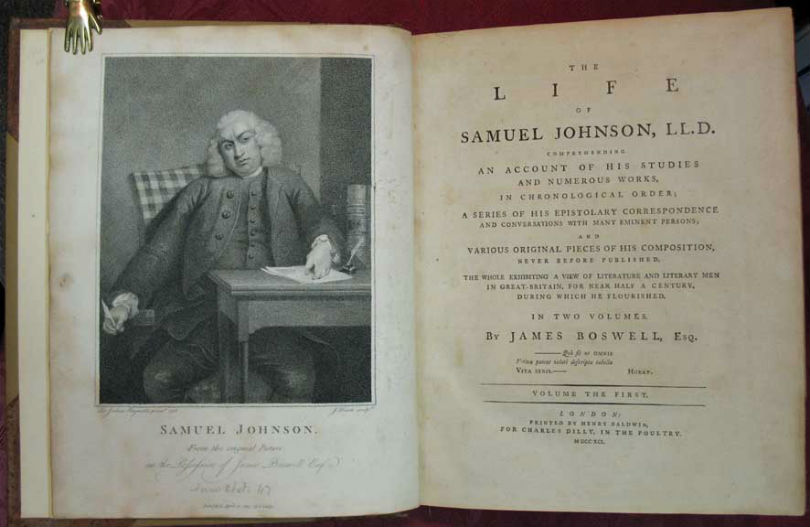
“We cannot tell the precise moment when friendship is formed. As in filling a vessel drop by drop, there is at last a drop which makes it run over; so in a series of kindnesses there is at last one which makes the heart run over.”—James Boswell, The Life of Samuel Johnson, LL.D.

Boswell’s “Life of Johnson” was published in 1791, a little more than six years after Johnson’s death. It is not a biography as readers may think of a biography: the recounting of incidents from a life of action. The poet W.H. Auden said that writers are “makers, not doers” and thus he, Auden, was not going to write his memoirs. We need biographies of the doers in order to learn what was happening behind the scenes, how close the men of action came to disaster and saved their (and sometimes, our) day, he suggested. Johnson’s life was the life of a man of letters, a life spent writing plays, compiling the first major English dictionary, compiling an edition of Shakespeare’s plays, writing weekly columns on every topic his extraordinary mind could entertain. He was a maker.
Read More

Moon Swoon June

In October, I wrote this:

The belief that there is a connection between things that happen on Earth and things that happen at around the same time in the night sky is such a seductive one that it has transcended human eras, societies, religions, and politics. Dictators and democrats alike have believed in auspicious and inauspicious times to begin initiatives or end policies. (Or lives.)
 
It is understandable that we humans would think of ourselves so non-humbly, that we would see ourselves not only as the conclusion to nature’s long, almost-eternal, statement, one that seems to have led to us, but that we would view ourselves as not merely a conclusion to nature’s statement, a period mark, but as THE conclusion, an exclamation point. To paraphrase a TV show: “We are the one who knocks.” We aren’t much, but we’re all we think about.
 
In the universal scheme of things, however, humanity’s history may not even show up as a comma in eternity’s sentences.
 
And this is just fine. Nature or the Big You Know Who Upstairs granted us a wonderful gift, life, for no reason at all, which is the definition of grace. And humans, many humans, were granted consciousness, which also was undeserved.— “‘The Way’,” October 28, 2014

Read More