No Mystery

We are speaking of the summer of 1976, when I was a seven-year-old hidden from myself, a summer I remember for being the Bicentennial, for being sunny every single day, and for the work of Leslie McFarlane, who around that time had published a book revealing he was the author of my favorite books. That book landed with a thud that did not reverberate into my world: as far as I was concerned, “Franklin W. Dixon” and not Leslie McFarlane was my favorite writer, and The Hardy Boys were the older brothers I did not have.

Books 1 through 22 of The Hardy Boys series were written between 1927 and 1947 by a Canadian writer who was desperate for income, Leslie McFarlane, and even though Grosset & Dunlap only paid him $85 per book with no royalties, he discovered that this was $85 per book that he could count on as long as he kept typing. He wrote the first eight in just over two years, just as the Great Depression was consuming all it could.
Read More

Make a Wish, Already

The Wikipedia disambiguation page for the commonplace partial phrase “rule of three” lists nine items. Actually it lists 10, the tenth not being an example of the concept of the rule of three in day-to-day life but the title of a play; it may have been added by an editor simply to amuse himself or herself. (It was not me.)

It would be a perfect example of the rule of three to have three sets of three things make up the possible definitions of the phrase; it is comic to have 10 instead. So, why three wishes? Why do we knock on wood three times for good luck? (Does anyone knock for bad luck? There are a lot of people on our planet and even more have existed and departed; someone must have.)
Read More

Song of Myself

I celebrate myself, and sing myself,
And what I assume you shall assume,
For every atom belonging to me as good belongs to you.
 
I loafe and invite my soul,
I lean and loafe at my ease observing a spear of summer grass.
 
My tongue, every atom of my blood, form’d from this soil, this air,
Born here of parents born here from parents the same, and their parents the same,
I, now thirty-seven years old in perfect health begin,
Hoping to cease not till death.
 
Creeds and schools in abeyance,
Retiring back a while sufficed at what they are, but never forgotten,
I harbor for good or bad, I permit to speak at every hazard,
Nature without check with original energy.
—Section 1, “Song of Myself,” Walt Whitman, 1855

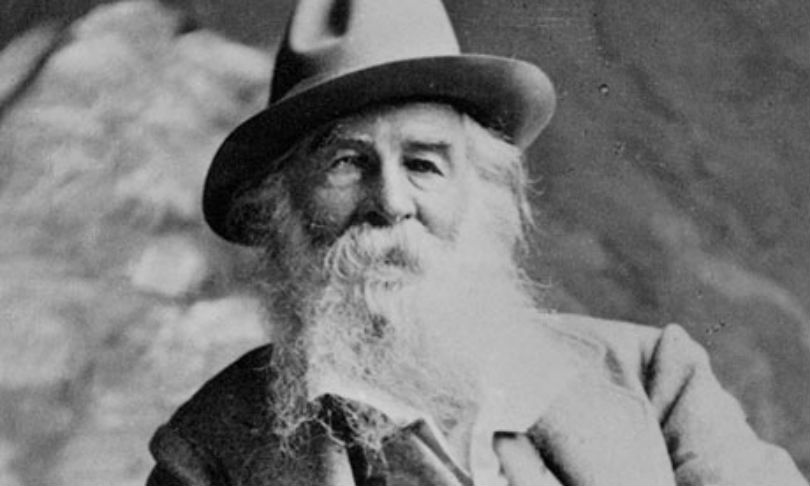
By the end of his life in 1892, Walt Whitman had published eight revised editions (eight or so; there is some debate on this matter) of his major volume of poems, “Leaves of Grass,” culminating in a ninth edition, what he himself called the “deathbed edition.”

“L. of G. at last complete—after 33 y’rs of hackling at it, all times & moods of my life, fair weather & foul, all parts of the land, and peace & war, young & old,” he wrote a friend. He was only 72 when he died, but with his white beard and self-presentation as a man who had existed for the entire country’s history, he seemed older.

It all started on the 4th of July. On this date 160 years ago, Whitman published the first edition of “Leaves of Grass,” a book that contained twelve poems, each without a name, and starting with the opener, a poem that became known over time as “Song of Myself.”
Read More