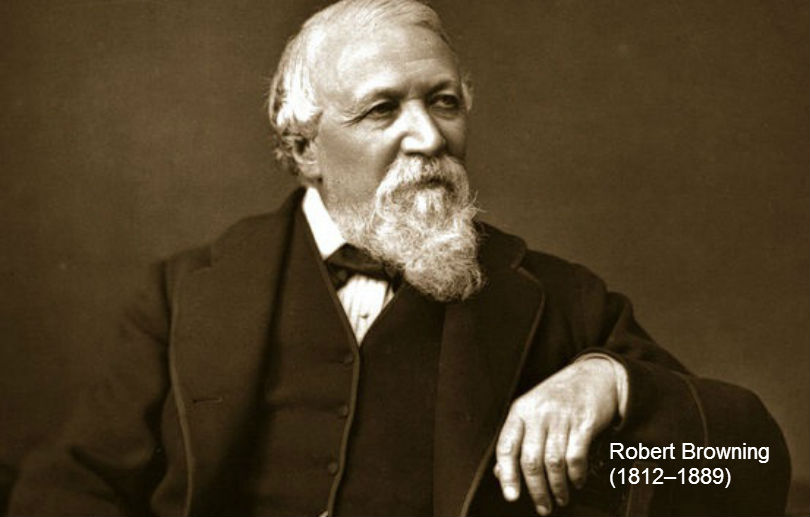
Pippa’s Song

The year’s at the spring
       And day’s at the morn;
       Morning’s at seven;
       The hillside’s dew-pearled;
       The lark’s on the wing;
       The snail’s on the thorn:
       God’s in His heaven—
       All’s right with the world!
—Robert Browning, “Pippa’s Song” from his verse play “Pippa Passes”

Robert Browning‘s long poem, “Pippa Passes,” published in 1841, is a verse drama, which means it was not written with the intention of any person staging a performance of it, and life ever since has fulfilled that lack of intention. The poem-as-play has not been performed by any notable theater company in more than a century. “Pippa Passes” is remembered for two things. Well, three things.

For one, it is remembered for not being remembered, for not living on in culture’s memory at all, even though at the time critics were quick to count it among Browning’s masterworks. Also, it is remembered because Browning accidentally used a vulgarity in it because he thought the slang word he used referred to a part of a nun’s habit. This was pointed out to him in his lifetime, and even though he made emendations in 1849 and 1863, he chose not to correct the one glaring one, and insisted that if he did not know it was a vulgarity, how was it a vulgarity?

Last, one line from it, a single line, lives on to this day as an expression we might hear more than once every day: “God’s in His heaven/All’s right with the world.” Young Pippa sings it.

(Shall I discuss the vulgarity below the fold?)
Read More

‘September 1, 1939’

Shortly before his death, the poet W.H. Auden told talk-show host (and former politician) Richard Crossman, “Nothing I wrote prevented one Jew from being gassed or stalled the war for five seconds.”

At first glance, this places the bar very high for the role of a writer in the affairs of the world, but it is simply a stark assessment of the reality that a writer has no say in the practical matters of life and death. He is not saying that words do not matter but is instead drawing the boundary between where they do matter and where they can not. Writers are makers and not doers, not “men of action,” Auden also liked to say.

One of his most famous poems is September 1, 1939, written to mourn the outbreak of World War II. The title is of course the date Germany invaded Poland. It was written quickly, allegedly that day, was not heavily edited, and published in The New Republic soon after. Auden came to reject the poem and he refused three times to include it in the three editions of his Collected Poems that he oversaw.

He told Crossman that the poem possessed rhetoric that was “too high-flown.”
Read More

A Farce in Egypt

The judge “bellowed” the verdict against the three journalists today, according to reports. He announced that the three were found guilty and sentenced them to three years in jail. Mohamed Fahmy, Baher Mohamed, and Peter Greste already spent more than 400 days in prison in Egypt after being arrested for “spreading false news” while working for al-Jazeera English.

The three have already been convicted, retried, acquitted, retried again. Greste, an Australian, was deported last year.

Judge Hassan Farid declared today that the court had determined that the defendants are not journalists as they are not members of Egypt’s “Journalists Syndicate,” nor had they registered with a national agency that grants foreign reporters permits to work in the country. Thus, since they are not officially journalists, they were working against the government. They had been convicted in a first trial in 2014, sentenced to seven years in prison each, retried, acquitted, retried again, and convicted again today. Another retrial is being worked on but the earliest it can start is 2016.
Read More