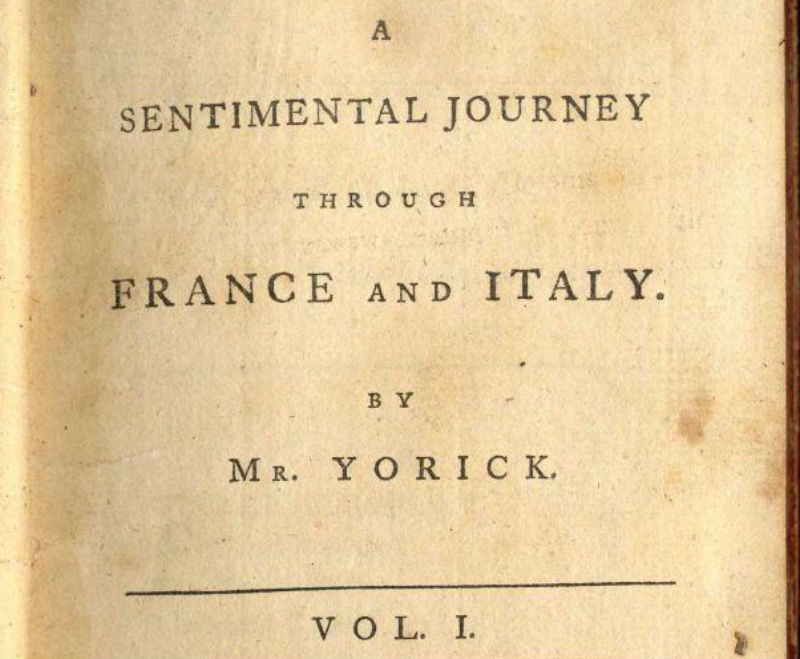
A Sentimental Journey Through …

Laurence Sterne was dying of consumption, the polite yet dramatic term that people used to employ for pulmonary diseases, especially tuberculosis. He had contracted it by 1740, when he was still in his 20s, and he fought for his every breath for his remaining three decades of life.

In 1765, he left England in search of better breathing, and he traveled abroad to France and Italy. He was a surprise best-selling author by this point, a clergyman who had decided on a whim to start telling the life story of a character but by not telling it in a straightforward manner, to comically digress his way through “The Life and Opinions of Tristram Shandy, Gentleman.” One of the earliest novels in English or any language, “Shandy” was an instant success when its first two volumes started appearing in 1759.

The genre we call “travel writing” was not as common in the 1760s as it is now, and most works in that genre at that time were quite unsentimental: verbal pictures of natural phenomena and wonders of the man-made world and warnings-slash-complaints about the foreignness of foreigners on their strange home turf. In his 1765 journey, Sterne encountered fellow novelist Tobias Smollett, and the stern, dry Smollett left such an impression on the always amused Sterne that in his book, “A Sentimental Journey Through France and Italy,” he based a character named “Smelfungus” on Smollett. Nice revenge.
Read More


‘Hearing’ ‘Voices’

The poet and critic John Greening sums up the career of James Merrill, who conversed with the inhabitants of other planes of reality, in a 2010 essay, “Ouija”:

James Merrill made a point of breaking all the rules, of remaining recklessly formal when all about him were casting off their chains, of being incorrigibly discursive and elitist, shunning the rhythms of speech for something more refinedly musical, and unswerving in his determination to squeeze every last pun out of a line.—John Greening, “Ouija,” The Dark Horse, Summer 2010

Merrill was a rebel in his adherence to rules in a rule-breaking era. He wrote dazzling, perfect poems, and he employed almost every verse form available to him, as an actor might use accents. Greening quotes George Bradley: “Reading James Merrill is enough to make the rest of us suspect we’re not smart enough to write poetry.” Even at his smartest, he is engaging and not impenetrable. His pleasure in the sounds of words and the poetic effects he creates and his many puns are always evident. He compliments his readers in his implied assumption that we must know what he is writing about at least as well as he does.
Read More

‘We must be still and still moving …’


     Home is where one starts from. As we grow older
The world becomes stranger, the pattern more complicated
Of dead and living. Not the intense moment
Isolated, with no before and after,
But a lifetime burning in every moment
And not the lifetime of one man only
But of old stones that cannot be deciphered.
There is a time for the evening under starlight,
A time for the evening under lamplight
(The evening with the photograph album).
Love is most nearly itself
When here and now cease to matter.

 
Old men ought to be explorers
Here and there does not matter
We must be still and still moving
Into another intensity
For a further union, a deeper communion
Through the dark cold and empty desolation,
The wave cry, the wind cry, the vast waters
Of the petrel and the porpoise. In my end is my beginning
.
—T.S. Eliot, the conclusion of “East Coker”

Just a few weeks ago, he and I were talking about his daughter, my girlfriend. I do not remember every syllable of the conversation, and I wish I did remember each syllable right now, but I declared, “All I know is that it took me an awful long time to find The One for me, and I’m lucky I waited for someone so …”

“Passionate.” He finished the sentence. He chose that word. “She’s full of life,” he added. It was a happy surprise to hear Jen’s father say it himself. He was smiling.
Read More