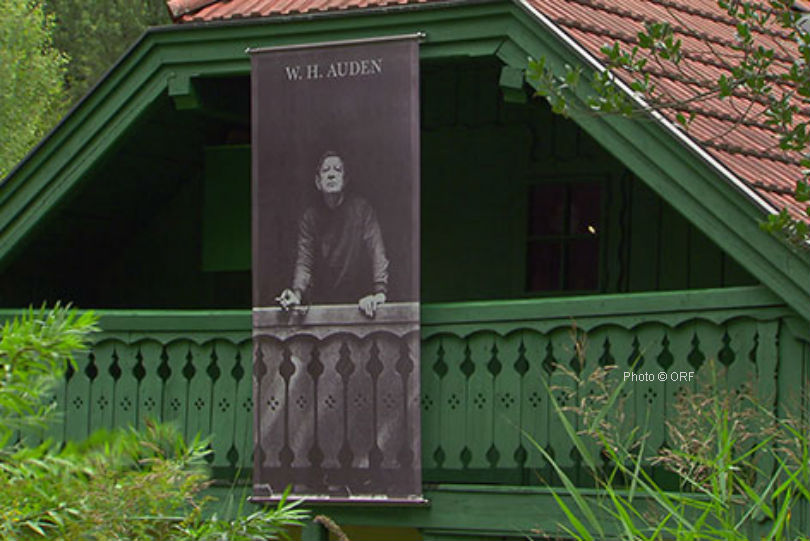
Auden at Home

In About the House, published in 1965, W. H. Auden gives readers a tour of his home in Kirchstetten, Austria. Each of the twelve poems in the section titled “Thanksgiving for a Habitat,” bears a dedication to an individual, one of Auden’s friends.

(“Down There,” about the cellar, is dedicated to Irving Weiss, and “Up There,” about the attic, is dedicated to Anne Weiss. Irving Weiss taught in the English Department of SUNY New Paltz and retired in 1985, before I was a student in that department, but he was still around when I was there. Anne was his wife. For me, “Auden dedicated a poem to him” may as well have been the caption under his face each time I saw Professor Weiss. He is still alive, 94 years old, and a profile of him in a recent Long Island newspaper does not mention any of the above.)

Back to Auden’s home (pictured in a recent photo at top with a poster bringing the master back to the porch outside his upstairs study):
Read More

Step by Step

Six years today …

* * * *
Every alcoholic in recovery has a collection of anecdotes that can be simultaneously heartbreaking, outrageous, and hilarious. Perhaps they are hilarious only to fellow alcoholics; perhaps they can not even be listened to by outsiders. For an outsider, most alcoholic anecdotes may as well conclude with the same dark punchline, an interchangeable rubber-stamped ending: “And then I got away with it again.” Or, “I didn’t die that time, either.” And then comes the next hair-raising—or eyebrow-raising—tale.

Every alcoholic in recovery is living a story with a weird ending, if they remain in recovery. It is that two-word pair there, “in recovery,” that provides the surprise, the weirdness, a period of life as surprising to behold as some of the antics, the many bizarre actions and activities and inactions and inactivities that were surprising for outsiders to watch unfold in the previous life.
Read More

Sentimental Journeys

Laurence Sterne was dying of consumption, the polite yet dramatic term that people used to employ for pulmonary diseases, especially tuberculosis. He had contracted it by 1740, when he was still in his 20s, and he fought for his every breath for his remaining three decades of life.

In 1765, he left England in search of better breathing, and he traveled abroad to France and Italy. He was a surprise best-selling author by this point, a clergyman who had decided on a whim to start telling the life story of a character but by not telling it in a straightforward manner, to comically digress his way through The Life and Opinions of Tristram Shandy, Gentleman. One of the earliest novels in English or any language, “Shandy” was an instant success when its first two volumes started appearing in 1759.

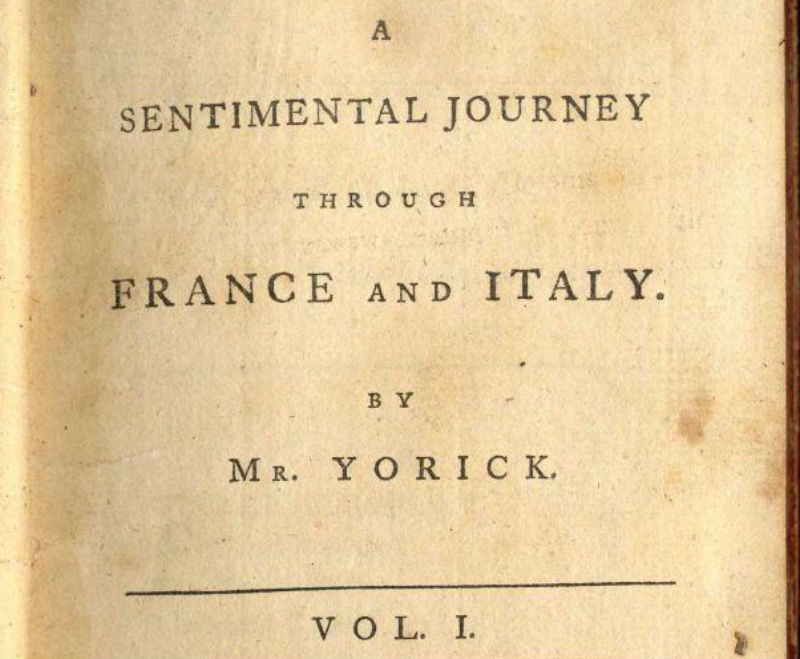
The genre we call “travel writing” was not as common in the 1760s as it is now, and most works in that genre at that time were quite unsentimental: verbal pictures of natural phenomena and wonders of the man-made world and warnings-slash-complaints about the foreignness of foreigners on their strange home turf. In his 1765 journey, Sterne encountered fellow novelist Tobias Smollett, and the stern, dry Smollett left such an impression on the always amused Sterne that in his book, A Sentimental Journey Through France and Italy, he based a character named “Smelfungus” on Smollett. Nice revenge.
Read More