Statistics and Other Things

Our newspaper’s weekly circulation was a closely guarded exaggeration. The circulation manager knew the number, the editorial department knew it, the advertising manager knew it. The newspaper’s circulation was about 2000 copies per week. And now you know it, too.

The pliability of the words “circulation,” “copies,” “newspaper,” and “week” was tested with every ad sales phone call. This is because if we told an advertiser the (correct) 2000-per-week number, that advertiser might have asked us to pay them for the honor of placing their ads; thus, our ad sales manager gave them a number 10 times larger. More often than not, they were told that over 20,000 pairs of eyes “saw” any given issue of the newspaper. Actually, in a laudable effort at a specificity that would grant our numbers legitimacy, they were given a figure of “21,000 readers.”
Read More

An Untold Story

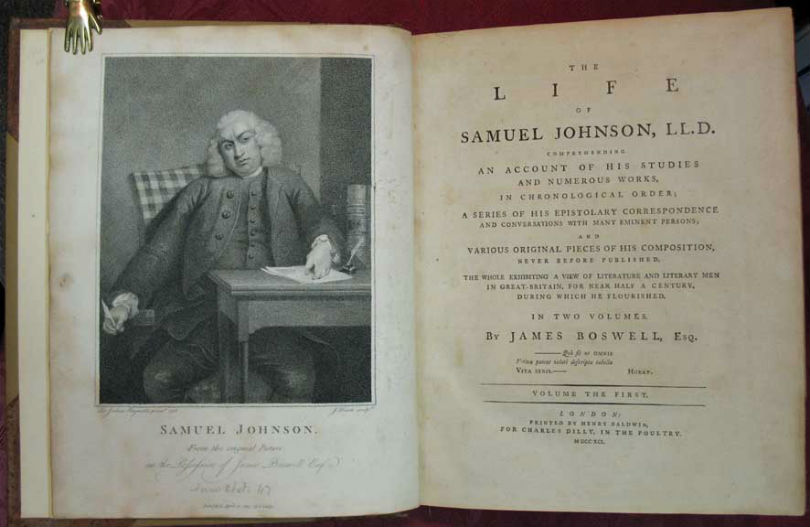
“We cannot tell the precise moment when friendship is formed. As in filling a vessel drop by drop, there is at last a drop which makes it run over; so in a series of kindnesses there is at last one which makes the heart run over.”—James Boswell, The Life of Samuel Johnson, LL.D.

Boswell’s “Life of Johnson” was published in 1791, a little more than six years after Johnson’s death. It is not a biography as readers may think of a biography: the recounting of incidents from a life of action. The poet W.H. Auden said that writers are “makers, not doers” and thus he, Auden, was not going to write his memoirs. We need biographies of the doers in order to learn what was happening behind the scenes, how close the men of action came to disaster and saved their (and sometimes, our) day, he suggested. Johnson’s life was the life of a man of letters, a life spent writing plays, compiling the first major English dictionary, compiling an edition of Shakespeare’s plays, writing weekly columns on every topic his extraordinary mind could entertain. He was a maker.
Read More

#FreeShawkan

So far in 2015, we have seen journalists beheaded with machetes, a blogger whipped with a cane as an official judicial punishment for his writing, editorial cartoonists gunned down in their office, bloggers hacked to death in Bangladesh, more than 20 journalists detained and even convicted and jailed in Egypt, and journalists detained in America for covering the racism prevalent in almost every official part of our system. Not a great year.

In August, a judge reaffirmed a guilty verdict against three al-Jazeera English journalists. Last month, President al-Sisi pardoned the journalists as a part of the annual Eid holiday tradition of leaders granting pardons. The current regime in Egypt does not much like journalists, and it is estimated that some two dozen writers and photographers are in prison in that country, having been arrested for doing their jobs. Usually, they are charged with “spying,” but more often than not they are detained for months or even years before they even hear why they were arrested or what charges they face.

Mahmoud Abu Zeid is a photojournalist whose work you may very well have seen, as his photographs have appeared in Time magazine and some of them were syndicated by Corbis. (One appears below the fold.) He covered the protests in Tahrir Square and the trial of former president Hosni Mubarak. His professional name is Shawkan. As of today, November 30, 2015, he has spent 838 days in pre-trial detention. His first court session is due to take place on December 12, but his lawyer reports to Amnesty International that he has yet to see Shawkan’s case file. Under Egyptian law, there is a two-year cap on pre-trial detention; 794 days is longer than two years.
Read More