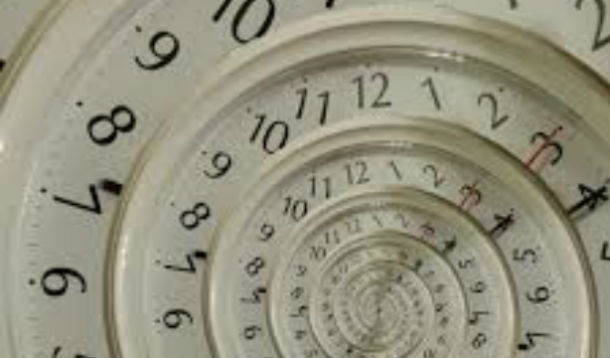
Some Time Travels
In his “Confessions,” St. Augustine writes, “What then is time? If no one asks me, I know; if I wish to explain it to one that asks, I know not.” He decides that time is an idea, unique to humans, and also unique in that we can simultaneously grasp the past in memory, the present by attention, and the future by expectation. In our minds, but only there, we are not locked to one perception of one reality.
Yesterday, I deleted everything that I had written up to that point by dragging my unbuttoned shirtsleeve across my laptop’s touchpad while reaching for my coffee. (No, I can not replicate the results in an experiment; yes, like an idiot, I have attempted to replicate these results in an experiment.) In a feat of memory, I retyped all that I had written to that point; simultaneously I remembered what I had written, was super-present and typed it attentively, and expected a future in which I regularly saved my work, a lesson I first learned, oh, 20 years ago. I was in three specific time-experiences at once, and all of them sucked.
* * * *
For decades, it has been known that subatomic particles can be in two places at the same time. In yet more recent (2014) experiments, physicists have “simulated” time travel. Science reporters tell us that time travel is in the “near future,” or, more prosaically, “just around the corner.” If this is so, no one from the future has yet visited us, because if it truly is something that we will invent or discover in the future (near or not-so) we would know all about it already. This is because, oh, you get it.
Many therapy techniques suggest remembering oneself in a childhood moment and reaching out to that younger self; the thought is that we carry every self we have yet been forward into our psychological present and can communicate something of a healing nature to those past selves. Whenever I have attempted anything of this sort, I have cried. I have received no reports from the younger self about what he made of the unexplained appearance of an older man leaning on a cane.
* * * *
How the false truths of the years of youth have passed!
Have passed at full speed like trains which never stopped
There where I stood and waited, hardly aware,
How little I knew, or which of them was the one
To mount and ride to hope or where true hope arrives.— “I Am A Book I Neither Wrote Nor Read,” Delmore Schwartz
* * * *
The thought experiment of time travel has a long history in popular culture. Fantasists invent tools (a jet-pack in every garage) in novels and movies, tools which actually only address the needs of the present moment and do not attempt to imagine the future needs that will be answered by the future tools. In almost every science fiction work that uses the device of time travel, the several paradoxes of “a visitor from the future would influence current history and thus change their present” or “if I go back in time and change a mistake, erase an error, will I not change who I am now?” are addressed.
Many of the heroes decide or discover that the path that brought them to where they are and to the person they are now was always worth taking, errors and all. As long as one is breathing, lessons can be applied. (Ebenezer Scrooge, for example.)
It is a seductive thought experiment, though. Offer a person a time machine to return to a specific moment in the past and take up residence there, from that moment onward, and relive one’s life so one can fix whichever errors and enhance whichever successes that followed, well, it is seductive. Offer a person life from a future moment from which they can see it all unfold, … well.
* * * *
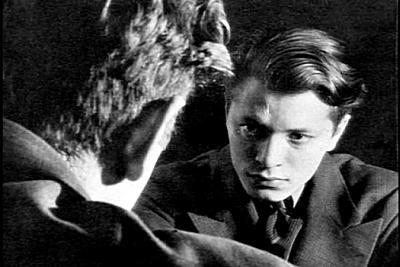
Delmore Schwartz
Delmore Schwartz’s heart-rending short story, “In Dreams Begin Responsibilities,” opens with the narrator in a movie theater as he realizes the feature is his parents on their first date; he becomes frantic and yells at the screen, “Don’t do it!” and gives a list of reasons. (Oh, to have been Delmore’s mother. He was 21 when the story was published.) The audience hisses him down, as he is ruining the movie for them, but he knows how it ends.
My father tells my mother how much money he has made in the week just past, exaggerating an amount which need not have been exaggerated. But my father has always felt that actualities somehow fall short, no matter how fine they are. Suddenly I begin to weep. The determined old lady who sits next to me in the theatre is annoyed and looks at me with an angry face, and being intimidated, I stop. I drag out my handkerchief and dry my face, licking the drop which has fallen near my lips. Meanwhile I have missed something, for here are my father and mother alighting from the street-car at the last stop, Coney Island.
At the end, the narrator is thrown out of the movie theater while on screen his father is refusing to have his fortune told by a Coney Island fortune teller. And then he awakens to “the bleak winter morning” of his 21st birthday. It was all a dream.
* * * *
As Augustine saw, way back in the 4th century, we always live in the three time zones of our experience and psyche simultaneously: past, present, and future. Always.
I no more wrote than read that book which is
The self I am, half-hidden as it is
From one and all who see within a kiss
The lounging formless blackness of an abyss.How could I think the brief years were enough
To prove the reality of endless love? — “I Am A Book I Neither Wrote Nor Read,” Delmore Schwartz
* * * *
Neat Thing of the Day: Lou Reed reading “In Dreams Begin Responsibilities” (Reed had been a student-mentee of Schwartz’s at Syracuse University): In Dreams Begin Responsibilities.
____________________________________________
The WordPress Daily Prompt for October 7 asks, “Congrats! You’re the owner of a new time machine. The catch? It comes in two models, each traveling one way only: the past OR the future. Which do you choose, and why?”

 The Gad About Town