Harassment & Free Speech

The essayist who wrote this in 2012:

We are all by now accustomed to the periodic whinging of public figures after another round of drive-by shootings on Twitter. But the problem isn’t restricted to those who put themselves on a public platform. Just take a look at how people are talking to each other as well. Frankly, it’s terrifying, and it occurs to me that one of the great challenges of the next decade will be how we, as a society, manage those people unable to manage themselves.

… was banned “permanently” from posting on Twitter this week. A spokesman for Twitter told an interviewer for Buzzfeed, “People should be able to express diverse opinions and beliefs on Twitter, but no one deserves to be subjected to targeted abuse online, and our rules prohibit inciting or engaging in the targeted abuse or harassment of others.”

The author of the essay quoted above, titled, “The Internet Is Turning Us All Into Sociopaths,” is one Milo Yiannopoulos, who seems to have decided that his article was more useful to him as a point-by-point, how-to-become-a-sociopath expository essay instead of a complaint against sociopathy. In the subsequent four years, he became famous as an Internet sociopath, celebrated as an “alt-Right wing” hero of some sort, a keyboard bully who never had the balls to say what he wrote to anyone’s face and yet wore a bulletproof vest for show as if he had even one time spoken truth to power.
Read More

Starved for Attention

What I Did for ‘Like’

* * * *
In this social media-saturated (and social-media-about-social-media-saturated) era, in which both of my parents, one of them an octogenarian, have active Facebook accounts, and in which people who have told me to my face that they do not understand Twitter themselves have a couple thousand followers apiece on that very service, drawing attention to one’s writing or art or craft or charitable work without purchasing advertising time on the radio to scream for 30 continuous seconds can seem daunting. For me, a naturally quiet sort, sharing the publication of a new piece feels unnatural, like actually recording that 30-second Janovian advertisement. Screaming is so unseemly.

(Perhaps I will go ahead and record that.)

In the Peter Cook-Dudley Moore film, “Bedazzled,” poor Stanley Moon (Moore) wants the affection of Margaret (Eleanor Bron). The Devil, George Spigott (Peter Cook), offers him seven wishes to win her. In one, Stanley is a gold-lamé-costumed rock star whose new hit song “Love Me!” drives all the young women, including Margaret, wild. The lyrics, and Moore’s performance, are little more than him screaming for 30 seconds, “LOVE ME!”

The very next act, Drimble Wedge and the Vegetations, wins the entire screaming audience over to the Devil, George, as he speak-sings his dripping contempt for their affections towards him. “I’m self-contained. Leave me alone,” goes the new hit, and his dry loathing for them makes the women in the audience desire him all the more. Stanley gets run over by the crowd that once briefly adored him as it rushes to the Devil at the end of his song. (The video clip that follows below the fold here both takes up too much space and is set too loud. Brace your ears.)
Read More

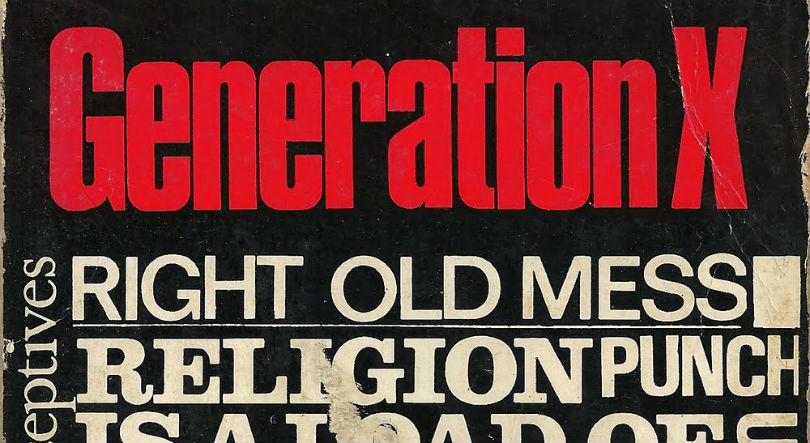
Generation X?

“You’d really hate an adult to understand you,” one girl named Susan is quoted as saying. “That’s the only thing you’ve got over them—the fact that you can mystify and worry them.”

Others are quoted as saying things like, “Marriage is the only thing that really scares me,” and, “Religion is for old people who have given up living,” or, “I’d prefer to do something for the good of humanity,” and, “You want to hit back at all the old geezers who tell us what to do.”

Man, those millennial kids today have so much anger! Except each one of these quotes comes from a book published in 1964 in the United Kingdom called “Generation X.”
Read More