
Vivian Stanshall: Not an Eccentric
The Bonzo Dog Doo-Dah Band played the role of jester in the court of the Beatles in the late 1960s, and Vivian Stanshall was the charismatic, curious leader of the leaderless and leader-resistant Bonzos. The missing link between the Beatles and Monty Python (if one was needed), in 1967 the Bonzos appeared in both “Magical Mystery Tour” (partially entertaining the Beatles with a performance of “Death Cab for Cutie”) and in the pre-Python but mostly Python-staffed afternoon television show, “Do Not Adjust Your Set.”
Here, Michael Palin of the Pythons introduces the Bonzos, and Stanshall does his best worst Elvis in “Death Cab for Cutie.”
Stanshall, a writer for whom no declarative statement could be too perplexing (“I’ve never met a man I didn’t mutilate”), was paired up with Neil Innes, a songwriter whose Beatles-esque melodies led not only to to the Bonzos being produced by Paul McCartney (the minor hit “I’m the Urban Spaceman”) but also to a Beatles lawsuit after music for his parody group, “The Rutles,” was thought to be too reminiscent for comfort. (Further cementing the Beatles-Python link, “The Rutles” was an Eric Idle project.)
Their collaboration “Mr. Apollo” combines an almost-too-catchy Innes tune with Stanshall’s absurdly deep baritone and lengthy fake sales pitch for an exercise gimmick: “Five years ago, I was a four-stone apology. Today, I am two separate gorillas. No tiresome exercises. No tricks. No unpleasant bending.” It also features a heavy metal guitar lick invented about six months before heavy metal.
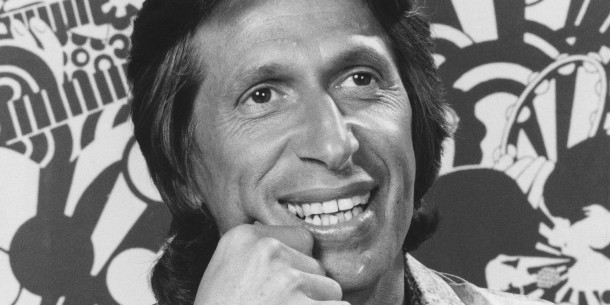
Vivian Stanshall was born 71 years ago tomorrow, March 21; few people have spent their lives (his ended in a house fire in 1995, a sadly Stanshall-esque end if anyone did not deserve one) confounding more people and delighting in the resulting stares than he. After the Bonzos disbanded, if they ever truly did—the group’s set lineup varied in name and number whimsically and reunited a number of times, so it could be said that its members simply wandered away—Stanshall became known as a presence. He was a person about whom wild anecdotes proliferated, usually starring Stanshall, his friend Keith Moon, and their friend, alcohol; whose voice was heard on overnight radio talk shows that had no set sign-off time except daybreak; and who semi-occasionally emerged with enormously creative, incredibly language-saturated audio theater pieces, usually concerning the fictional family of Sir Henry Rawlinson. (In one of the oddest of all possible odd coincidences, Stanshall and the real Sir Henry share a death date, precisely one century apart, March 5, 1895 and 1995.)
Joycean in its surreal ambitions, Stanshall’s “Sir Henry at Rawlinson End” always opts for the obscure joke and invented pun over the profound statement, which resembles Joyce in many of his Joycean ambitions, too. The recorded piece was made into a film starring Trevor Howard and Stanshall that may as well have been a rumor until its DVD release a few years ago. One can piece together the hour-long film from clips on YouTube. The Rawlinson family saga offers an English Addams Family whose adventures take place in a landscape of long-standing family games with long, obscure, histories behind them and traditions that must be celebrated by exploding them. It is aristocracy viewed through the eyes of an alien, not just to these traditions, but to the idea of tradition.
The opening sentence: “English as tuppence, changing yet changeless as canal-water, nestling in green nowhere, armored and effete, bold flag-bearer, lotus-fed Miss Havishambling, opsimath and eremite, feudal-still reactionary Rawlinson End. The story so far.”
According to radio legend John Peel, the friend on whose programs the Rawlinson stories were first dictated, Stanshall’s appetite for drink and tranquilizers hindered his career. “Unreliability and prevarication, on an epic scale,” is how Peel mournfully described his friend’s habits of work, in a comment about how working with Stanshall could yet be extraordinary and worth the effort.
In most articles, Stanshall is described as an eccentric, a member of the famous English eccentric class. No other country is said to celebrate its eccentrics more than England, or to reflect more on the idea of having a group of people called “eccentrics,” and Stanshall offered plenty of material to draw from: living on a houseboat, showing up in a Nazi officer’s uniform for photo sessions with Keith Moon, cultivating an epic beard. He dressed the part, alternating between hobo-chic and carnival barker classy.
But for those who insisted he was an eccentric in the classic, “English” sense, Stanshall had a reply:
A few years ago a woman from the Daily Mail phoned to inform me they were doing a piece on Sir John Betjeman and they would like me to companion him in the article, I being representative of the younger English eccentric. She wanted to know if was still doing it. Well, I don’t do it, I’m merely myself, … I’m whatever you like, just don’t expect me to join in. I do like games, though. You see, I’m not different for the sake of being different, only for the desperate sake of being myself. I can’t join your gang: you’d think I was a phony—and I’d know it.
“For the desperate sake of being myself.” That is as true and good a personal code as any statement one could come up with towards having a worthwhile life.
Around the time of the “Sir Henry at Rawlinson End” film, 1980, Stanshall provided his friend Steve Winwood, one of the least cynical or eccentric of performers, with a lyric that is confident in its obscurity (“my rock and roll is putting on weight”) and yet sweet and plain in its sentiment (“This time to the sky I’ll sing, if clouds don’t hear me/To the sun I’ll cry, and even if I’m blinded/I’ll try moon gazer…because with you I’m stronger”). “Arc of a Diver” does not seem like a Vivian Stanshall lyric because it is.
She bathes me in sweetness, I cannot reveal
For sharing dreams I need my woman
This humble expression…meagerly dressed
My eyes so mean it has no meaning
But jealous night and all her secret chords
I must be deaf…on the telephone…I need my love to translate
I play the piano, no more running honey
This time to the sky I’ll sing if clouds don’t hear me
To the sun I’ll cry and even if I’m blinded
I’ll try moon gazer, because with you I’m stronger…I’m stronger…I’m stronger
Arc of a diver…effortlessly…my mind in sky and when I wake up
In daytime or nighttime…I feel you near
Warm water breathing…she helps me hear
But jealous night and all her secret chords
I must be deaf…on the telephone…I need my love to translate
This time to the sky I’ll sing if clouds don’t hear me
To the sun I’ll cry and even if I’m blinded
I’ll try moon gazer…because with you I’m stronger
But jealous night and all her secret chords
I must be deaf…on the telephone…I’ll need my love to translate
This time to the sky I’ll sing if clouds don’t hear me
To the sun I’ll cry and even if I’m blinded
I’ll try moon gazer…because with you I’m stronger
Lean streaky music…spawned on the streets…I hear it but with you I have to go
Cause my rock ‘n’ roll…is putting on weight…and the beat. it goes on
Arc of a diver…effortlessly…my mind in sky and when I wake up, woah-oh-oh
Daytime and nighttime…I feel you near
Warm water breathing…she helps me hear
But jealous night and all her secret chords
I must be deaf…on the telephone…I’ll need my love to translate
With you my love we’re going to…raid the future
With you my love we’re going to stick up the past
We’ll hold today to ransom…’til our quartz clock stop…until yesterday
Woah, until yesterday
Until yesterday
Til our quartz clock stop
____________________________________________
Follow The Gad About Town on Facebook! Subscribe today for daily facts (well, trivia) about literature and history, plus links to other writers on Facebook.
Follow The Gad About Town on Instagram!

This work is licensed under a Creative Commons Attribution-NoDerivs 3.0 Unported License.

 The Gad About Town