Cave of Stories

The aurochs is an extinct form of cattle that overlapped with humans for tens of thousands of years. It lived in Europe, North Africa, and western Asia; the last one died in 1627. We domesticated it: Our modern-day beef cattle and dairy cows are descended from the aurochs and some of them bear a deep resemblance to the extinct animal. (Picture a bullfight but make the animals taller and more muscular and thus the fight more even.) The reasons for the extinction are the familiar ones and can be summed up as: Humans have enjoyed beef for a very long time.

Early modern humans, homo sapiens, showed up around 100,000 years ago and really started to leave a mark on the landscape around 40,000 years ago. This is deep in our prehistory, and no one knows what our Upper Paleolithic ancestors were thinking. It just appears that thinking is something they were doing.

Awareness is a nice thing to have, and every creature with a nervous system has awareness. Some animals even have a form of memory and the ability to use these memories to their advantage in actions taken in the here and now. Some of us have pets that seem to have better situational awareness than people we deal with every day. Awareness is not thought and the use of awareness is not thinking; they are so close, though.

Consciousness is humanity’s great gift and burden.

By 30,000 years ago—discoveries announced in 2014 are pushing this date further back, to almost 40,000 years ago—our ancestors were painting on the stone walls of their domiciles and meeting places. We do not even know if the spots in what were then and are now caves were homes, temples, some form of market. Stone Age man was not writing things down; writing was many thousands of years in the future. We do not know what early man was communicating or how.

Most of the items found and dated from this period are simple tools—scrapers and blades—but some items have been found that may be tools for making other tools, which is a subtle shift but a huge one. When one is making a tool to make another tool, one is aware of something called “the future.”

The earliest works of art also date back some 35,000 years. Carvings of animals and “Venus” figurines, even a flute made from an antler have been found in different locations. What these represented in early man’s mind is not knowable, but items like these they are not tools for immediate use, like knives or arrows. And then there are the many cave paintings found throughout Europe, Asia, and Africa.

The majority of cave paintings depict animals, animals that were being hunted, like the aurochs, and animals that hunted, like fearsome panthers and bears. The minority of paintings are a sort of declaration of “I am here” that any child would recognize: hand prints.

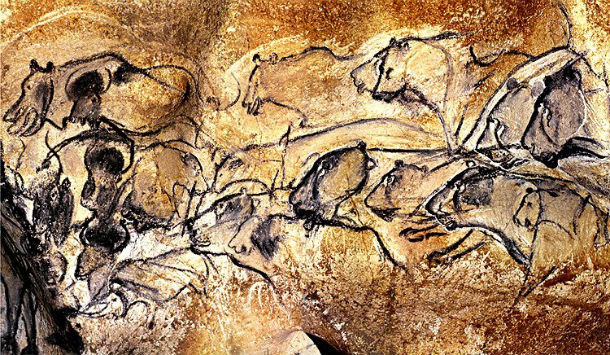
In southern France, the Chauvet Cave is one of the most famous. Rediscovered by modern man in 1994, the many investigations of the many drawings in the cave have narrowed the period in which the works were made to a remarkably specific 30,000–32,000 years ago. (In geologic terms, this is like saying a thing happened in “October” of a certain year.) The picture at top is is of lions hunting aurochs from that cave.

(The cave is the subject of a 2010 documentary, “Cave of Forgotten Dreams,” by Werner Herzog. I believe the film is still available on Netflix, for those with an account. Herzog was given unprecedented access to the inside of the cave, which has never been opened to the public and never will be in order to preserve it. If you are like me and could listen to Werner Herzog read the list of ingredients from a box of breakfast cereal, well, enjoy. It is a great documentary.)

Cave paintings are a snapshot of the birth of human consciousness, and we may be looking at different forms of story on those walls, from journalism to fiction.

The paintings depict animals on the move. Animals they use like horses, animals they hunt, like the aurochs, animals that maybe they avoid, like bears and rhinos.

chauvetfightA fight between two animals is shown. This may be an early form of journalism; the painter or painters saw this happen. The picture at top, of lions on the hunt, demonstrates that the artist or artists had already learned how to effectively use perspective. Some of the lions are in front of other lions, blocking the view of all but the legs of the lions behind them. Their heads are proportionate in size to the perspective used. The cats are not carbon copies of one generic “cat,” but are individual.

“I saw this” is a form of reporting, is awareness. The birth of consciousness came with the idea of a future. Some of the paintings may depict something like, “You can find this many animals over here, I promise you. Next Tuesday.” Some of the paintings are the first stories, fantasies about a successful hunt or accounts of past ones. Some of them are the first lies: Boasts about the number hunted.

That is where the true birth of consciousness resides, in stories.

____________________________________________
The WordPress Daily Prompt for November 23 asks, “What makes a good storyteller, in your opinion? Are your favorite storytellers people you know or writers you admire?”

* * * *
Please subscribe to The Gad About Town on Facebook: http://www.facebook.com/thegadabouttown

A Work of Art That Is Both and Neither

Objects do not often speak for themselves. It takes the right artist or poet to find the voice the object demands.

I wish I still possessed a copy of my one published academic paper. I remember its subject but not its point. The late Thomas M. Greene was rumored to have liked it; he may have told someone who told another who eventually (a year later) mentioned to me that he considered my work “unique.” (In academia, “unique” is not always not a back-handed compliment, and if he had been my professor he might have asked me to make it a bit less unique.) Professor Greene was an invited guest to a symposium my graduate studies department was holding; I was one of about ten speakers. My work, unique or not, was not invited to Yale, which Professor Greene called home. I was working on George Herbert and Arcimboldo, who had little to do with one another but were both looking for that moment when a work of art transcends work or art.

George Herbert was an early 17th century poet and Anglican priest, though he might have flipped that order to tell you about himself. In a handful of poems, he gives voices to objects by shaping the poems. Each word is not merely necessary for the sake of meaning, it is needed for the poem to make sense visually. In his poem, “The Altar,” each word is a stone making up the altar that the poem is conceived as being:

A broken ALTAR, Lord, thy servant rears,
Made of a heart and cemented with tears;
Whose parts are as thy hand did frame;
No workman’s tool hath touch’d the same.
A HEART alone
Is such a stone,
As nothing but
Thy pow’r doth cut.
Wherefore each part
Of my hard heart
Meets in this frame
To praise thy name.
That if I chance to hold my peace,
These stones to praise thee may not cease.
Oh, let thy blessed SACRIFICE be mine,
And sanctify this ALTAR to be thine.

One word, a single syllable, too many or one word mislaid or deleted, and there is no altar there. It is an altar made of words but no less central to the life of a church than an altar made of stone. The poem appears in the only book of poems that he compiled himself, a book titled “The Temple,” which walks the reader, a “dejected poor soul,” through a church. Thus, the altar, “The Altar,” is central.

In later eras, poems like this came to be called shape or pattern or emblem poems. They are sometimes used to get elementary school students interested in, captivated by, poetry, the potential playfulness and the playful potentials of poetry. “The Altar” is not one of those poems given to elementary school kids with that playful ambition.

It is an altar, however. A “broken altar,” because words are shards of meaning like pieces of stone fitted together to make the church structure. A heart is the only perfect, unbroken, stone for worship, is the only true altar. But all that his heart can make is something out of these pieces of meaning, words, and if he can get out of his own way (“if I chance to hold my peace”), these words as assembled here only exist to worship and love. They are what they are, words, and the words each on their own are not an altar, and a spoken version of this poem is not an altar, either. When is an altar an altar? At what point is a poem something other than, more than, words on a page?

Printed on the page (or screen), it is an altar for Herbert’s church in book form. “The Temple” is like a 17th Century pop-up book for Anglican communicants.

Just before Herbert was writing his worshipful shape poems, an Italian painter named Guiseppe Arcimboldo was working in Milan. Arcimboldo died the year Herbert was born, 1593, and it is extremely unlikely Herbert ever heard of or saw replicas of Arcimboldo’s paintings. He may have understood them better than many contemporaries—by 1633, the year of Herbert’s death, Arcimboldo was already a forgotten figure in art, out of style, passé.

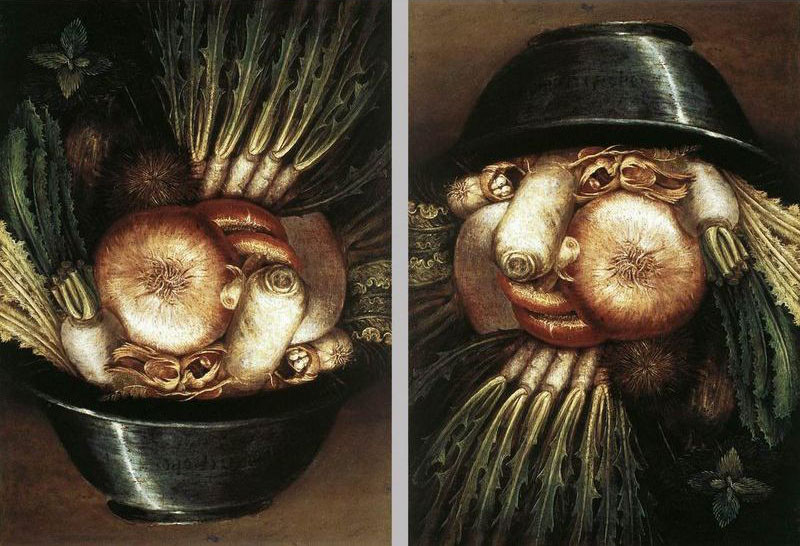
Arcimboldo openly toys with the conceit that what one is looking at is the thing it is depicting. His subject as an artist is the idea that a painting is only a painting and that you the viewer really do most of the work of “believing” that one is looking at something, some thing. This idea is similar to Herbert’s altar of words serving as an idea of an altar and as an altar at the same time.

When is a face a face and when is it a bowl of root vegetables? When is a painting a painting and something greater than a collection of chemicals on canvas?

Vegetables In A Bowl, Or, The Gardener

As with Herbert’s “Altar,” one word, one vegetable, too many or one item mislaid, and there is no face there. It is as carefully assembled as all works of art that appear to be casually thrown together are. If only he had included the actual vegetables in the paints he used …

The Surrealists rediscovered Arcimboldo for themselves in the 1920s and ’30s, and his paintings have been popular ever since. Herbert never went out of fashion, because he was never a fashion. They are each the most humble of flashy artists, taking themselves out (“hold my peace”) of the way in the name of depicting an idea about ideas. An idea that was revolutionary in the 20th Century, that art did and did not depict anything and was its own thing, had precursors centuries earlier. A gardener is his vegetables, an altar has a worshipful voice; art is self-conscious in its forgetting of self.

____________________________________________
The WordPress Daily Prompt for November 7 asks, Yesterday, your pet/baby/inanimate object could read your post. Today, they can write back (thanks for the suggestion, lifelessons!). Write a post from their point of view (or just pick any non-verbal creature/object).”

* * * *
Please subscribe to The Gad About Town on Facebook: http://www.facebook.com/thegadabouttown

Daily Prompt: ‘Beauty is truth, truth beauty …’

(Some thought-fragments about art with a small a and Beauty with a capital B.) (Or vice versa.)

The title is from the final lines of Keats’ “Ode on a Grecian Urn,” which the poet ends by telling us that the centuries-old vase he has been describing serves as a reminder that, “‘Beauty is truth, truth beauty,—that is all / Ye know on earth, and all ye need to know.'” Earlier the poet also says, “Heard melodies are sweet, but those unheard / Are sweeter … .”

The ones I can not hear, because I am a mere mortal and what I hear on Earth is all I need to know, those are the sweeter ones. O, vile mortality!

* * * *
Some experiences are almost universal: without sharing a common language, audiences will laugh at many of the same things. A person slipping on a banana peel. The fish-slapping dance. Analysis of comedy kills comedy (unless one is making fun of analyzing comedy) because laughter is more than a feeling, it is a reaction; when honestly expressed, it comes in an instant. Conversely, some experiences are unique to each one of us: all of us experience physical and/or emotional pain, but the best any of us can do is talk around it in an attempt to almost come close to describing it. Pain management specialists present their patients with a chart of a series of faces and ask the patients to circle the grimacing face that “matches” how they feel. It is simplistic, but it does something important in that it asks us to leave language, which can be misinterpreted, aside.

Language. The most vile and hateful sentiments can be expressed in sentences that might sound pretty when they are spoken. There is probably a language in which the sentence “I am going to kill you” would make me swoon just before I got shot.

* * * *
What makes me laugh might make you cry (if you were the person who slipped and fell) and what makes me cry might make you laugh. There is much ugliness in this world and someone somewhere finds harsh and violent things funny.

I find the sentence on that poster at the top, “We all have within us our own …,” which is a piece of typical Facebook inspiration-stuff, a poster that is designed to elicit a hopeful gaze or something, to be clunky and, worse, empty. Sunsets are nice and all, but why put words all over one? (I would rather the Kadampa Center had just put a picture of their temple on there.)

* * * *
To the best we can tell, birds are singing shopping lists to each other. “Seeds over here, seeds over here; nice sturdy branch I’m standing on.” The most boring and necessary stuff, but pretty to our ears, a sweet unheard melody to Keats.

* * * *
alainWe teach each other what we find beautiful. The cartoon at right captures, without words, something of this. Artists in a class learn to depict reality, but what about the world made Egyptians in the era of the pyramids and pharaohs depict things and humans as they did? We look the same now as we did then, but the art seen in the ancient (and beautiful) monuments does not look like our twenty-first century reality. Did life in the ancient world look all that different to eyes that are biologically identical to ours?

Certainly not. The same cartoon could be drawn about art classes from other eras: the flat crowds with identical faces in Giotto’s scenes, the extraordinary gowns and suits that probably rendered most people who wore them immobile for longer than the time it took to to sit for just the start of a portrait.

* * * *
Someone might bring up the Cubists, Picasso specifically. At different points in the cultural history of art, the visual and the performing arts diverge from mass notions of “pretty.” They always seem to reconvene, usually when the mass notions of pretty start to include the works of art the masses once rejected. Rocks were thrown at the orchestra during the debut performance of Stravinsky’s “The Rite of Spring,” because it sounded so odd. You might hear snippets of it in television ads during NFL games now.

I can tell you that for me, Picasso’s drawing line is voluptuous and his color scheme, well, beautiful. And the intellectual challenge the Cubists presented themselves and attempted to conquer: to include time and time’s passage in a static form, painting (which is why two eyes will appear on the same side of a human head—think of any photo you have taken in which someone turned away just as the camera snapped); I find the intellectual challenge and game and the attempt to meet and match it exciting and, well, here is that word again: beautiful.

Here is one of David Hockney’s “joiners,” a type of photo-collage that he explored in the 1970s and ’80s. It is made of 77 Polaroid photos of a swimming pool taken as the sunlight shifted through the day, photos taken over the period of time that it would take to make 77 Polaroid photos with one camera and one artist. Pretty as a sunset but with time added as a design element as important as color in the image. It is a Cubist sunset. It is a beautiful attempt at one. hockney-sun-on-the-pool

* * * *
The WordPress Daily Prompt for September 16 asks, “We’ve all heard that beauty is in the eye of the beholder. Do you agree? is all beauty contingent on a subjective point of view?” The answer is a definite and thus easily questioned simultaneous yes and no.

There is a famous “Twilight Zone” episode that I am sure someone else has referenced in their response, titled “The Eye of the Beholder,” in which a world that culturally dictates notions of physical beauty sends away people that we Americans of a certain era might find beautiful. We live in neither a world of only sunsets and platitudes and easy listening music nor in one in which we force one precise, single idea of beauty on one another, and that, that in itself, is beautiful. (Sadly, this is not true in every country, not right now; in some countries, Rod Serling’s script might seem to present a pretty good idea.)