To be is to despair and to despair is to remember the thousand tightly missed connections and not-yet completed conversations that will reveal themselves eventually as never really begun. The Surrealists got despair, perhaps better than most. They adopted Existentialism’s finer frustrations and rendered them with comedy, joy, and horror in sometimes strange proportions.
The comedy of coincidence and the tragedy of imminent abandonment dominate their work. Everyone is always alone, and this fact is simultaneously hilarious and horrifying in Surrealist Art.
André Breton, the founder of the movement, defined Surrealism as larger than a philosophy, deeper than mere art, an example of pure reason. His definition was both narrow and enormous, and it left his fellow writers, thinkers, and artists with the notion that they either were or were not Surrealists, whether they thought they were or not. If you said you were, you probably were not. The Surrealists did not reside in a safe and amusing world interrupted by slightly sad moments and then dinner; they lived fully in a horrifying and hilarious existence that demanded full attention, especially to one’s unconscious. Read More
41.402038-74.324319
Thank you for sharing this via one of these wonderful services:
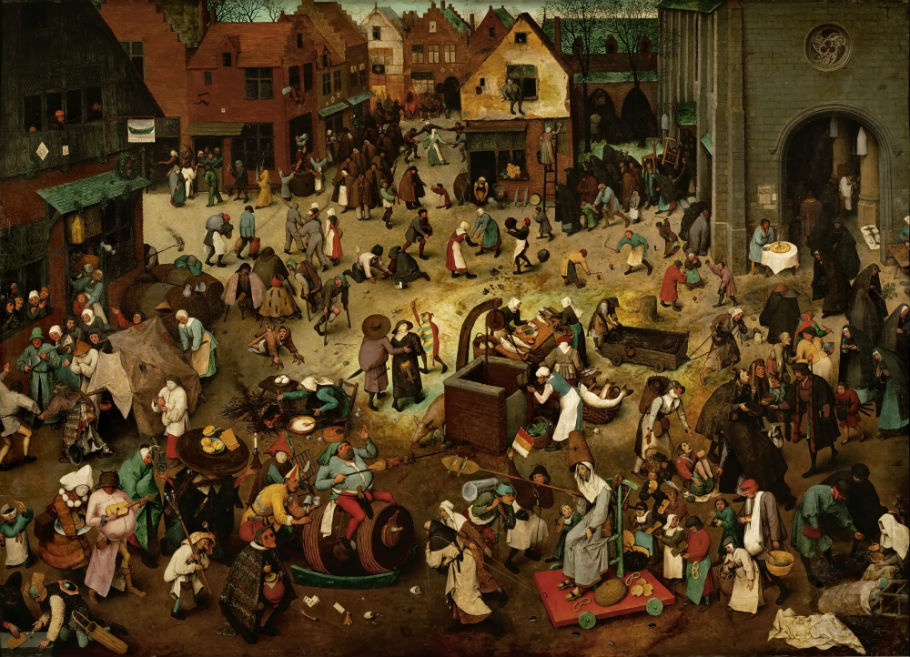
Pieter Bruegel the Elder’s Kampf zwischen Fasching und Fasten (“The Fight Between Carnival and Lent”) depicts today, the day before Lent. Today is an important enough day in the Christian calendar to go by a few nicknames: Shrove Tuesday, Mardi Gras, “Fat Tuesday,” “Pancake Day.”
Any day that is associated with food, whether because restrictions are about to be imposed or restrictions are to be erased for one special day, by rights ought to have as many nicknames as it can bear. Read More
41.402038-74.324319
Thank you for sharing this via one of these wonderful services:
The only message worth devoting much time and effort to communicating is love. Today, a sad news day, is a good day to remember that.
A few months ago I wrote about two artists who played with the question of whether what they are depicting is anything more or less than words on a page or paint on a surface. Both George Herbert and Arcimboldo (and Andy Warhol, in his own way) make art of the question, What is art? Is it what it depicts, an idea about what it depicts, both at the same time (which makes it a third option), or something less than? Is art, by definition, always a misfire, in that a depiction of a thing is not the thing and never can be?
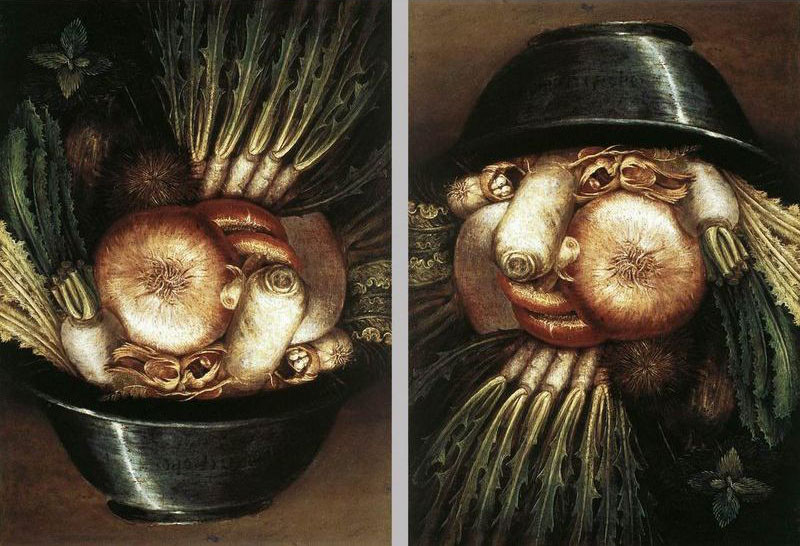
Arcimboldo painted portraits of character types rather than individuals; for instance, a librarian composed entirely of books or a gardener made of vegetables in a bowl. That latter painting depends on the viewer to decide to see the bowl filled with veggies or a human “face.”
When is a face a face and when is it a bowl of root vegetables? When is a painting a painting and something greater than a collection of chemicals on canvas?
Vegetables In A Bowl, Or, The Gardener
George Herbert wrote poems about the only idea that he deemed to be worth considering: The eternal love of his Christian God and man’s time-and-space-and-language-constrained attempt to return that love. Two of his poems are written in the shape of what they are about. Like Arcimboldo painting a root vegetable for a nose, Herbert uses words to build an item; in one, “The Altar,” each word is a “stone” making up the altar that the poem is conceived as being:
A broken ALTAR, Lord, thy servant rears,
Made of a heart and cemented with tears;
Whose parts are as thy hand did frame;
No workman’s tool hath touch’d the same.
A HEART alone
Is such a stone,
As nothing but
Thy pow’r doth cut.
Wherefore each part
Of my hard heart
Meets in this frame
To praise thy name.
That if I chance to hold my peace,
These stones to praise thee may not cease.
Oh, let thy blessed SACRIFICE be mine,
And sanctify this ALTAR to be thine.
One word, a single syllable, too many or one word mislaid or deleted, and there is no altar there. It is an altar made of words but no less central to the life of a church than an altar made of stone. The poem appears in the only book of poems that he compiled himself, a book titled “The Temple,” which walks the reader, a “dejected poor soul,” through a church. Thus, his altar, “The Altar,” is central in the book. (At Herbert’s request, the book was published posthumously, with his stated desire that it might bring “consolation of [to] any dejected poor soul.”)
It is probably an untranslatable poem, in fact if not sentiment. (Indeed, an admittedly brief survey has not yielded one.) The shape of the poem is dictated by the number of syllables in his choice of words; it is a translation of an object, a real thing, into words anyway, and as such is forever a failure. It is a “broken altar.” The human heart is the only perfect, unbroken, stone for worship, is the only true altar. All that his mind can make is something out of these pieces of meaning, words, and if he can get out of his own way (“if I chance to hold my peace”), these words as assembled here only exist to worship and love. They are what they are, words, and the words each on their own are not an altar, and a spoken version of this poem is not an altar, either. When is an altar an altar? At what point is a poem something other than, more than, words on a page?
However well-constructed it may be—it looks like an altar, for crying out loud—it does not matter. It is no altar. Not even a photorealistic painting of an altar would be an altar. Further, no altar is truly an ALTAR, as no earthly object is made of the only stone of faith that exists: the human heart “cut” by God.
Herbert’s faith was that of a man for whom questions about faith were a part of it. His worship and his poetry exist in a space of failure, where a poem of an altar is not an altar but is a sort of altar, an attempt at one. His poetry depicts a figure who is struggling in every way to comprehend and return eternal love and who is met every time by a figure who replies that it is all a bit easier than he is making it. But all I have is language, Herbert’s speakers proclaim: “We say amiss / This or that is: / Thy word is all, if we could spell.”—”The Flower.”
Herbert often describes the moment when the perceiving of love comes easily, and it is always sensuous, often reads as if it is written to a new love:
Who would have thought my shriveled heart
Could have recovered greenness? It was gone
Quite underground; as flowers depart
To see their mother-root, when they have blown—”The Flower”
But Herbert’s worshipper is always doubting himself, his faith, whether his faith is correct or not. In “Love (iii),” Herbert’s speaker is an unworthy guest in God’s (Love’s) home, but his host is gently persistent:
Love bade me welcome: yet my soul drew back.
Guiltie of dust and sinne.
But quick-ey’d Love, observing me grow slack
From my first entrance in,
Drew nearer to me, sweetly questioning
If I lack’d anything.
A guest, I answer’d, worthy to be here:
Love said, You shall be he.
I the unkinde, ungrateful? Ah, my deare,
I cannot look on thee.
Love took my hand, and smiling did reply,
Who made the eyes but I?
Truth Lord, but I have marr’d them: let my shame
Go where it doth deserve.
And know you not, sayes Love, who bore the blame?
My deare, then I will serve.
You must sit down, sayes Love, and taste my meat:
So I did sit and eat.
So if poetry is always at best an approximation of True Love, why not try to sing this struggle, as well? The “cheerfully agnostic” (which pretty much describes me, as well) English composer Ralph Vaughan Williams created five songs out of four Herbert poems a little over a century ago. The suite is called “Five Mystical Songs,” and one, “Love Bade Me Welcome,” is a setting of “Love (iii).” Some churches use the last song, “Antiphon,” as a hymn sung by the congregation.
Here is Sir Thomas Allen performing the set (in two sections) with the BBC Symphony Orchestra:
____________________________________________ The WordPress Daily Prompt for December 16 asks, “You have to write a message to someone dear to you, telling that person how much he/she means to you. However—instead of words, you can only use 5-10 objects to convey your emotions. Which objects do you choose, and what do they mean?”


 The Gad About Town