Down with Renoir!

Yesterday at noon, protesters began to chant: “Rosy cheeks are for clowns / Do your job, take them down.” Another: “God hates Renoir! God hates Renoir!” The number of people attending the protest in front of Boston’s Museum of Fine Arts numbered in the middle-to-high single digits, according to reports.

Max Geller, a political organizer, hates Pierre-Auguste Renoir, the Impressionist painter who died in 1919 and never used anything but pastels in any of his several many famous and gigantic works. If one could type a sentence that used air quotes and then took them away and then replaced them again, one might perhaps begin to convey a sense of how completely almost serious and almost mocking and yet earnestly this hatred is felt.

Protest is important. In a free country, one ought to be able to protest anything and everything. This happens to be a free country, and the display of Renoir’s frenetically-dabbed pastel pastorals is as good an object of protest as many. (Not “any,” but many.) Two of his works have fetched more than $70 million at auction in the last quarter-century, so the received perceived wisdom in both the art world and the world world is that Renoir’s many giant works are good and valuable.
Read More

My Favorite Cave

The aurochs is an extinct form of cattle that overlapped with humans for tens of thousands of years. It lived in Europe, North Africa, and western Asia; the last one died in 1627. We domesticated it: Our modern-day beef cattle and dairy cows are descended from the aurochs and some of them bear a deep resemblance to the extinct animal. (Picture a bull in a bullfight, but make the animal taller and even more muscular; this would have made a bullfight a bit more even.) The reason for the extinction of the aurochs is the all-too familiar one, and it can be summed up as: Humans have enjoyed beef for a very long time.

Early modern humans, homo sapiens, showed up around 100,000 years ago, and we really started to leave a mark on the landscape around 40,000 years ago. This is deep in our prehistory, and no one knows what our Upper Paleolithic ancestors were thinking. It just appears that thinking is something they were doing.
Read More

Do I Dare?

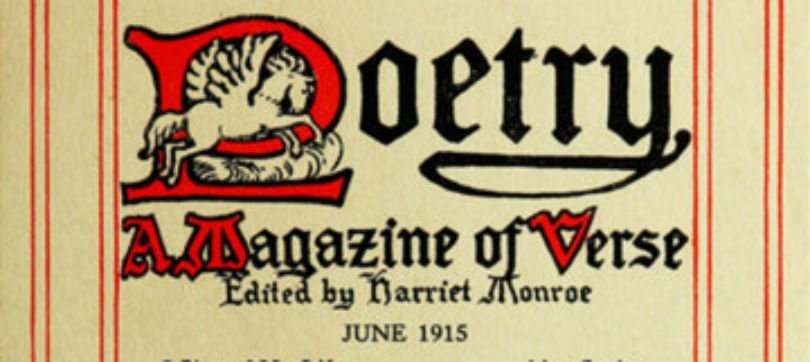
If you were a subscriber to Harriet Monroe’s monthly magazine Poetry in 1915, you received your June edition this week 100 years ago. It was an issue with 16 poems, one of which was “The Love Song of J. Alfred Prufrock” by T.S. Eliot. Eliot was 26, about to marry, wrote the poem in 1910, and put it in a desk drawer. He devoted himself to his graduate studies and then moved to England, where he met his fellow American, Ezra Pound.

Eliot showed Pound some of his poems, including “Prufrock.” Pound, whose skills at publicity sometimes outmatched his poetry (if he were alive today, he would be on Twitter ’round the clock, which is not necessarily something I write out of admiration), talked about a new young poet he had found at every opportunity.

Prufrock and “Prufrock” are 100 this week. The response to the poem in the 1910s was visceral; in the ongoing critical conversations “Where is literature now?” and “Where is literature headed?,” “Prufrock” revealed that 1915 was a moment in which both questions were the same for once. A critic in the Times Literary Supplement wrote a year later, “The fact that these things occurred to the mind of Mr Eliot is surely of the smallest importance to any one—even to himself. They certainly have no relation to ‘poetry.'” That is not a vote in favor. Pound’s positive reaction was no less effusive: “Prufrock” is “the best poem I have yet had or seen from an American.”
Read More